
The volume accompanying the permanent exhibition sheds light on almost a century of German and international contemporary history. The title alone expresses the outstanding importance Helmut Schmidt attached to democracy as a form of government and society – including its principles of debate and compromise based on freedom of opinion and freedom of the press. In this spirit, socially controversial topics are presented from multiple perspectives, giving the reader an understanding of the respective pro and contra positions so that they can form their own opinions.
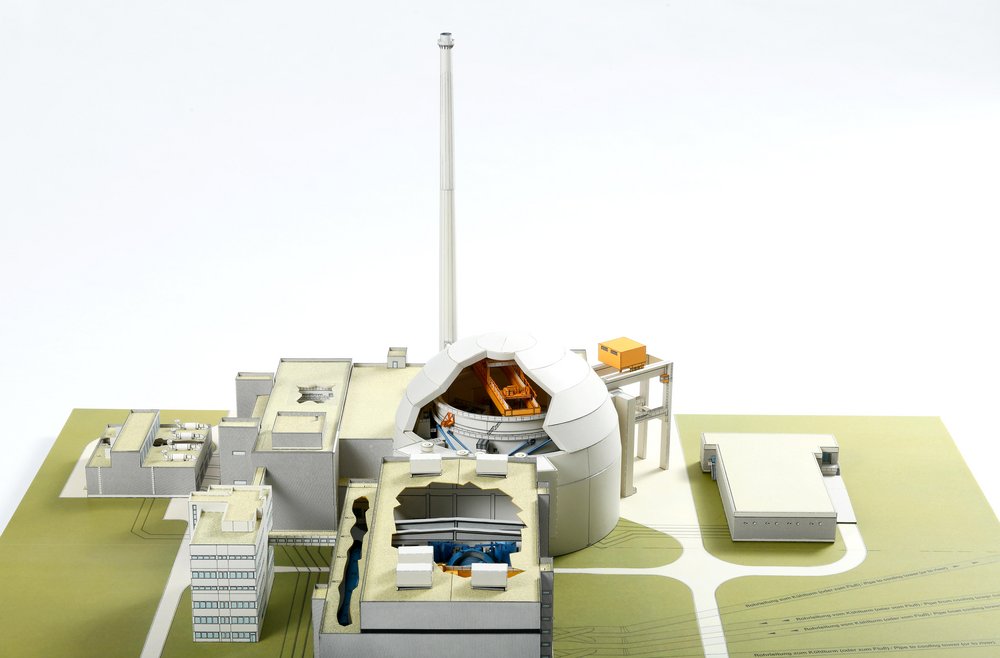
The richly illustrated book begins with a timeline summarising important stages in Schmidt’s private and political life. Historical case studies are devoted to topics that are still controversial today, from nuclear power to the global economy, as well as biographical aspects such as his time in the Wehrmacht or his many activities as former chancellor. In addition, object histories present material testimonies that go beyond the paper tradition and bring history to life: for example, a hairnet, a brandy bottle or a model of a nuclear power plant.
Daring more hair
When he was appointed Minister of Defence in the autumn of 1969, Schmidt set himself the task of further reforming the armed forces in line with the model of the “citizen in uniform”, which had emerged as a distinction from the Nazi era. One of his most controversial decisions was the “hairnet decree” of 5 February 1971, which allowed soldiers to bypass the previously prescribed short haircut.
Its history and implementation left traces at very different levels: For example, the Parliamentary Commissioner for the Armed Forces received several submissions arguing in favour of the constitutional right to “free development of the personality”. During parliamentary debates, allusions to bald heads and sideburns, for example, repeatedly led to moments of cross-party hilarity, and the topic was also included in two “white papers” from the Ministry of Defence due to an officially identified need for regulation. A specially convened procurement commission bureaucratically scrutinised more than a dozen models on offer before a total of 739,177 were purchased for just under DM 352,000.
Schmidt was awarded the “Against Animal Seriousness” medal by the Aachen Carnival Association for his efforts to keep his hair free, but only State Secretary Karl Wilhelm Berkhan attended the presentation ceremony. After some harsh criticism of the troupe’s appearance, the old rules applied again from 13 May 1972 – officially for hygienic-sanitary reasons.
Distillate of friendship
Even as Federal Chancellor, the Social Democrat Schmidt had a close relationship with the liberal French President Valéry Giscard d’Estaing. During his term of office from 1974 to 1981, they worked as a bilateral tandem to promote the institutional development and global political strengthening of the European Community.
A personal gift from Giscard is the exquisite brandy from the Gascony region in south-west France, distilled in 1918, the year of Schmidt’s birth, and bottled in 1980 after decades of ageing in barrels. The initials of the family-run distillery Francis Darroze are embossed on the wax stopper, while the label shows the name of the Gachot vineyard and the alcohol content of 40% by volume alongside the protected designation of origin “Bas-Armagnac”. The 0.7-litre bottle found its final resting place together with specialities such as Chinese fragrant blossom wine, Lippe juniper schnapps and Romanian plum brandy on a shelf of spirits in the legendary Langenhorn house bar, “Ottis Bar”, which was named after Schmidt’s bodyguard Ernst-Otto Heuer.
When its extensive inventory was recorded in a database in 2018, the high-proof gift of friendship with the inventory number BO 324 quickly aroused the interest of the exhibition team. Apparently, the same cannot be said for the recipient’s thirst, as the meticulous processor noted “unopened, filling height 21 cm” as the object status.
Splitting processes
As part of its public relations work, the Siemens-managed Kraftwerk Union AG commissioned the detailed model “DWR 1300 MW” from the specialised publisher J. F. Schreiber. It shows a pressurised water reactor of the 1,300 megawatt class as it was under construction in 1983 at the Isar 2 (Bavaria), Emsland (Lower Saxony) and Neckarwestheim 2 (Baden-Württemberg) sites.
For the exhibition, the assembly of the 1,154 parts from 18 sheets was carried out by the developer Thomas Pleiner himself with a great deal of sensitivity and patience, which was then rewarded with a view of the reactor dome, which can be seen through removable roof sections. Together with a brochure, floor plan and poster, the 1:1350 scale kit was on display in the visitor and information centres of nuclear power plants; the target group also included educational institutions such as schools. With a German-language print run of more than 100,000 copies, the advertising package was intended to fascinate people with the controversial technology and at the same time convey its supposed controllability.
However, the goal of affordable and safe nuclear energy, which was also pursued by the Schmidt government, continued to lose support among the population and politicians with every nuclear incident and without a functioning final storage facility. After four decades of often fierce social debate, the Isar 2, Emsland and Neckarwestheim 2 nuclear power plants ended their operations on 15 April 2023 as the last operating nuclear power plants in Germany.