
Helmut Schmidt in the struggle for the idea of a "global ethic"
23. Apr 2022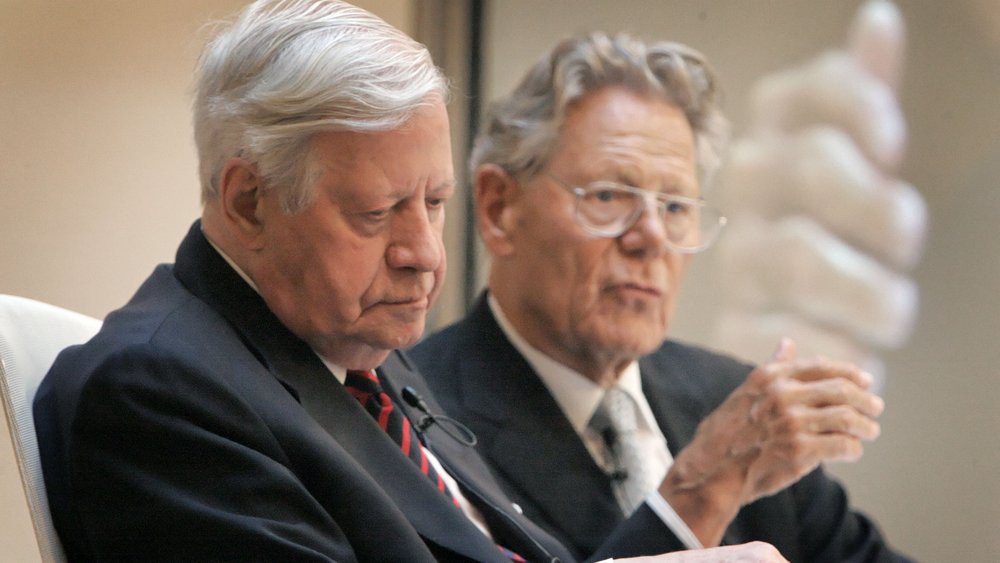
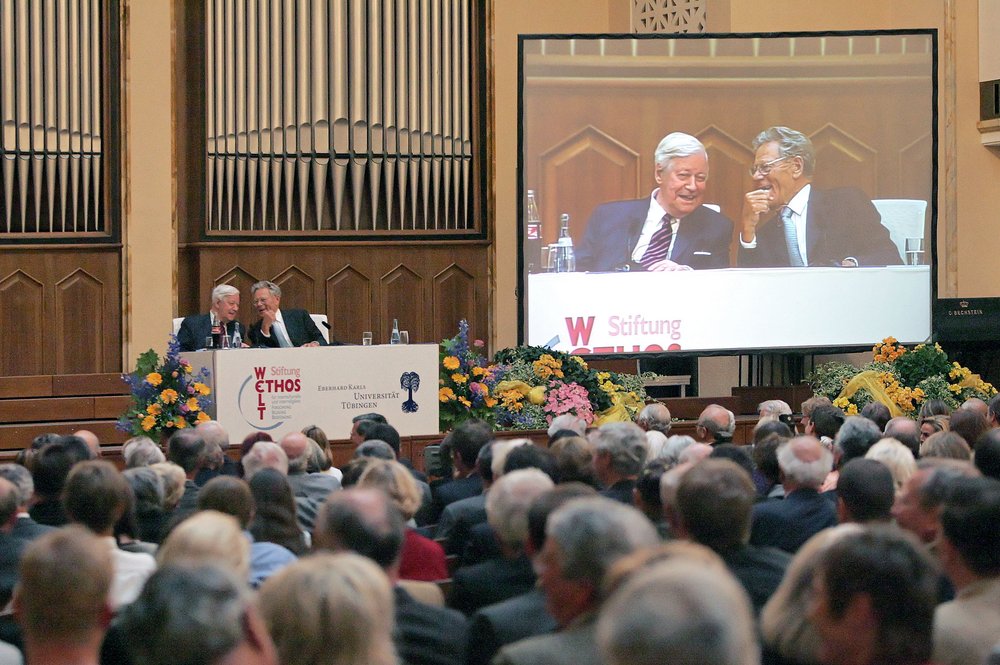
Since the 1990s, Helmut Schmidt has increasingly and intensively explored the idea of so-called "human duties", which he closely associated with the concept of a "global ethic". He engaged in a lively exchange of ideas with the Swiss theologian Hans Küng, the creator of this concept. With his Global Ethic project, Küng created an awareness of fundamental shared values in all parts of society as well as peaceful and respectful coexistence across the boundaries of religions, cultures and nations. Fundamental precepts such as non-violence and truthfulness are part of the foundation established by Küng, which also explains this on its homepage in light of current events.
in 1998, Helmut Schmidt gave a speech in Prague on the 50th anniversary of the "Declaration of Human Rights". In it, he emphasised that the concept of human rights had its historical origins in the West. He then sharply criticised the leaders of the states in what is now known as the "Global South", which postulate the enjoyment of human rights for themselves, but make no effort to underpin this by creating democratic structures. With the words: "Sadly, this relationship between freedom and responsibility has not always been clearly understood", he leads on to the "human duties" that he co-authored.
In the same year, he writes that it is time to talk about human duties. It continues: "The [...] outline of human duties attempts to balance freedom and responsibility and to bring about a change in thinking, from the freedom of indifference to the freedom of commitment."
"Universal Declaration of Human Duties"
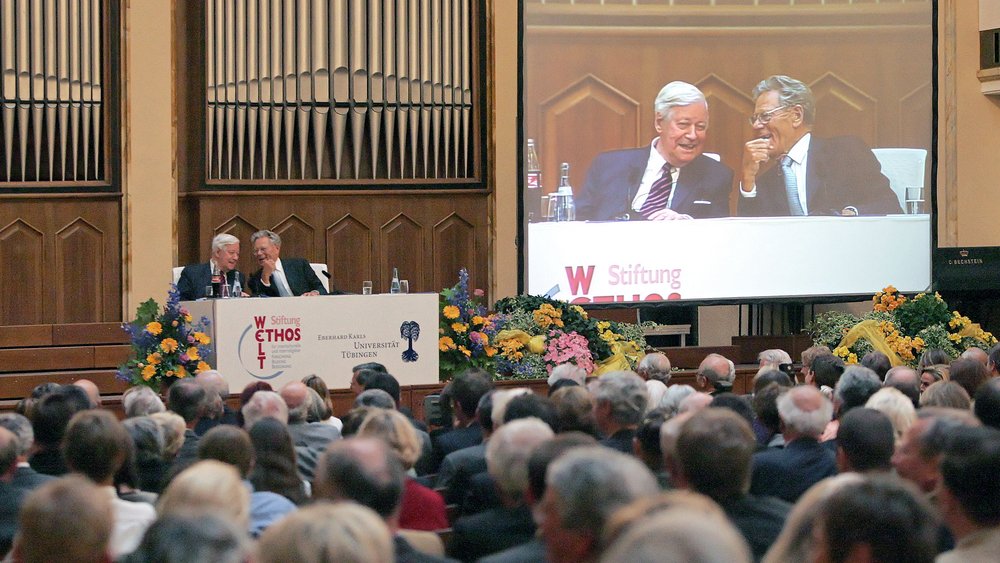
in 1996, Schmidt intensified his efforts with regard to the catalogue of duties. At the time, he was Chairman of the InterAction Council, an association of former heads of state and government that he had founded together with Japanese Prime Minister Takeo Fukuda in 1983. The topic was discussed in detail with Hans Küng in this high-calibre group. On 3 June 1997, the InterAction Council adopted a "Universal Declaration of Human Responsibilities". The "Human Responsibilities" were not only received favourably by the public. Constanze Stelzenmüller, for example, published a response to "The Dangerous Eighteen Commandments" in Die Zeit shortly after its publication. The authors repeatedly pointed out that they did not compete with the United Nations' "Declaration of Human Rights", but were merely intended to complement it in a sensible way. In his global ethic speech "Conflict between reason and religion", held on 8 May 2007 in Tübingen, Helmut Schmidt once again summarised both the global ethic and the catalogue of duties.
Fulfilling one's duty to society was a matter of course for Helmut Schmidt. To this end, the state had to create organising conditions, but not provide any spiritual leadership. Schmidt formulated this clearly in his farewell speech to the German Bundestag on 10 September 1986. He expected intellectual guidance from teachers, artists and writers, but also from churches and religious communities. However, it was up to the individual to find their own personal guidelines. Personal decisions are diverse and of great plurality - Schmidt refers to different intellectual attitudes, philosophies, ethics and morals - which is why the pluralistic state and its society can be affirmed, which provides people with sufficient room for manoeuvre for their diverse activities.
A guarantor of human rights?
For Schmidt, who grew up under the Nazi dictatorship and who as Federal Chancellor was confronted with the leaders of the "dictatorship of the proletariat" in the Eastern Bloc and up-and-coming autocrats in decolonised Africa, only the democratic state based on the Western model could be a guarantor of human rights. Schmidt emphasised that, first and foremost, respect for the freedom and dignity of others was decisive for the quality of our democracy, and that there could be no political culture without lived freedom. This freedom, he argued, could only exist in conjunction with the rights and duties of each individual towards society.
In principle, the idea of a "global ethic" could be endorsed, as it promised global world peace. In his global ethic speech from 2007, Schmidt remembers the former Egyptian president Anwar el-Sadat and his efforts to achieve peace: "He knew about the common offer of peace, for example in the Psalms of the Jewish Old Testament, for example in the Sermon on the Mount or in the fourth sura of the Muslim Koran. If only the nations were aware of this agreement, if only the political leaders of the nations were aware of this ethical agreement between their religions, then lasting peace would be possible. This was a deep conviction." However, the three Abrahamic religions as the basis of the "global ethic" are by no means sufficient to realise world peace. The history of the 20th century alone provides striking evidence of this.
"By their deeds you shall know them"
Basing human behaviour on ethical and moral principles is a good approach. However, ethics and morals are not universal constants, but depend on the culture and society in which people live. Ultimately, the "global ethic" and "catalogue of duties" remain Western European views that derive from the specific European history of the 20th century, as Schmidt himself recognised. Even if the idea can be credited with striving for world peace for all, it remains a model of European thinking. In view of the continuing political and economic hegemony of the West over the Global South, from today's perspective, the question of human obligations seems to be less important than the call for respect for human rights worldwide.
The export of the Western model of democracy is also proving to be a failure in the 21st century, accompanied by regional military conflicts worldwide.
So what remains of Schmidt's "global ethic" and the "catalogue of duties"? There is no concrete answer to this question. After all, it remains to be seen whether and how today's globally networked humanity will achieve worldwide social justice and thus peace.
For Helmut Schmidt, who liked to quote from the Bible, 1 John 2.6 may apply: "By their deeds you shall know them". The "human duties" he called for can certainly be scrutinised in relation to himself. If the decisions he made during his term of office as Federal Chancellor and member of the German Bundestag are measured against his ethical and moral principles, it becomes clear that he understood his political work as the fulfilment of his duty to society. Schmidt's conviction, gained after the Second World War, to place his political actions at the service of the liberal and democratic state may well be exemplary even today.
Here you can see the original Global Ethic speech: