
Disclaimer: Check against delivery.
Ladies and Gentlemen, dear guests,
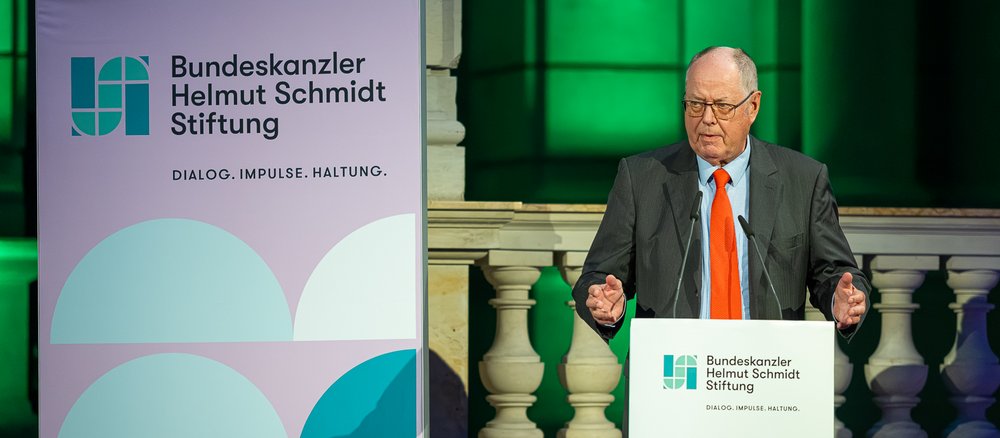
A warm welcome to the sixth Helmut Schmidt Lecture of the Bundeskanzler-Helmut-Schmidt-Stiftung.
Dear Ivan, welcome to Berlin. We are delighted and honoured to have you with us this evening.
With the Helmut Schmidt Lecture, our foundation commemorates its namesake. Each year, the Lecture addresses topics that concerned Helmut Schmidt, that shaped his political thinking and actions, and that challenge us once again today, albeit under different circumstances.
This year’s theme is:
“Navigating Power and Principles!”
It captures one of the most difficult political tasks of our time: remaining capable of action in a world of growing power competition without abandoning our principles.
Where is pragmatic cooperation still possible? And where must boundaries be drawn because compromise would otherwise become self-abandonment?
These are not theoretical questions. They arise in the face of war and violence, authoritarian power politics, hybrid threats, and the erosion of international law. They confront us in security and defense policy no less than in trade, technology, energy and migration policy. And they emerge whenever political responsibility requires us to distinguish between what is desirable and what is actually achievable.
Helmut Schmidt was a politician who understood this tension very well. He described himself as a pragmatist, but with one crucial qualification: he was not, he insisted, a pragmatist without theory, and certainly not one without values.
This thought leads directly to the subject of this evening.
There is not necessarily a contradiction between adherence to principles and pragmatism. On the one hand, principles without the ability to implement them politically risk remaining little more than ineffective declarations. On the other hand, power without normative constraints loses its legitimacy and ultimately its sense of direction.
Politics therefore requires both: a moral compass and the ability to steer the ship through the storm.
Ladies and Gentlemen,
The world in which we must orient ourselves politically is becoming increasingly complex. Familiar certainties are losing their validity.
Open societies face a particular challenge. Their openness is one of their greatest strengths: It enables exchange, innovation, criticism and social renewal. Yet it is precisely this openness that makes them vulnerable: to disinformation, political interference, economic coercion, cyberattacks and several other forms of hybrid threats.
So how do we protect our democracies without turning them into something they are not supposed to be?
Europe must find answers to this. It must learn to think more strategically and act more decisively.
Yet strategic autonomy does not mean avoiding every dependency or abandoning all cooperation. Europe will continue to rely on partners in the future. The crucial question is therefore not whether we cooperate, but with whom, under what conditions, and up to what point.
Pragmatism does not mean acting without principles. Nor must one’s fidelity to principles become an excuse for inaction.
It is not enough to stand on the right side of an argument. We must also be able to make a difference from where we stand.
This is precisely why this year’s BKHS Magazine raises uncomfortable but necessary questions. It explores the grey zones of a world order in which strategic interests and moral obligations are becoming increasingly intertwined.
The contributions examine, among other topics, Europe’s role as a principled middle power, the erosion of international law, democratic resilience and hybrid threats, geopolitics and economic power, corporate responsibility, humanitarian action, and Europe’s position in the global competition for technology and artificial intelligence.
The magazine does not seek to provide a finished navigation chart. Such a chart probably does not exist. Rather, it aims to offer a compass for the search for a politics that neither glorifies power nor ignores its significance. Even more, it provides a compass for a politics that does not only invoke principles but translates them into political action.
I can tell you, dear guests, that for this discussion, we could hardly have found a more suitable speaker than Ivan Krastev.
He is one of Europe’s most distinguished political thinkers. As Chairman of the Centre for Liberal Strategies in Sofia and Permanent Fellow at the Institute for Human Sciences in Vienna, he has spent many years examining the transformation of liberal democracies, political trust, authoritarian and illiberal developments, and Europe’s role in a changing world order.
What distinguishes his analyses is not only their intellectual sharpness. It is also his ability to identify developments at an early stage, challenge familiar assumptions, and reveal political contradictions without rushing to resolve them.
This is particularly important for our discussion tonight. For the tension between power and principles cannot be eliminated by any elegant formula. It must be endured politically, reassessed time and again, and ultimately translated into concrete decisions.
In this context, it is not only the values we uphold that matter. Equally important is whether our societies trust those values.
Democracies do not survive on institutions and procedures alone. They depend on people believing that these institutions work, that rules apply, and that political decisions serve the common good rather than particular interests.
Where this trust erodes, the foundations of democratic governance also come under pressure.
That is why the question of Europe’s role in the world is always also a question about the state of our democracies at home. A society that is no longer confident in its own principles will hardly be able to defend them credibly abroad. And a democracy that no longer appears capable of action risks losing the trust of its citizens.
Helmut Schmidt understood that political leadership consists neither solely of moral conviction nor solely of technocratic problem-solving – as our new Schmidt exhibition shows, which is presented this evening at this museum.
His politics were shaped by the conviction that democracy and peace require a willingness to compromise. But, for him, compromise required having a position of one’s own. Those who have no clear stance do not make compromises. They give way.
Perhaps therein lies an important guideline for today’s debate: remaining open to dialogue and cooperation without losing sight of the limits of what is acceptable. Acknowledging power-political realities soberly, without automatically accepting them. And taking our values seriously enough to provide them with political, economic, and security substance.
Since 2021, the Helmut Schmidt Lecture and the BKHS Magazine have successfully brought together leading figures from politics, academia and civil society to examine the urgent questions of today from a range of perspectives. These dialogues have not only provided meaningful insights over the years but have also taken a stand for our democratic principles.
My sincere thanks therefore go to the entire team of the Bundeskanzler-Helmut-Schmidt-Stiftung. Once again, the preparation of this Lecture and the production of the sixth edition of the BKHS Magazine have required great creativity, perseverance, and, as the saying goes, efforts above and beyond the call of duty.
My thanks also go to all the authors, artists, and contributors who have enriched the magazine with their perspectives.
Before you get the impression that I intend to deliver this year’s Helmut Schmidt Lecture myself, let me come to a close.
Dear Ivan,
We look forward to your analysis of a world in which rules and certainties are fading, power is being redistributed, and Europe has yet to fully define its place.
Or, to remain with this evening’s metaphor: we look forward to your guidance on how to stay on course when the geopolitical storm intensifies and the familiar maps can no longer be trusted.
Dear Ivan Krastev, the floor is yours!