
"I loved him..."
16. Oct 2021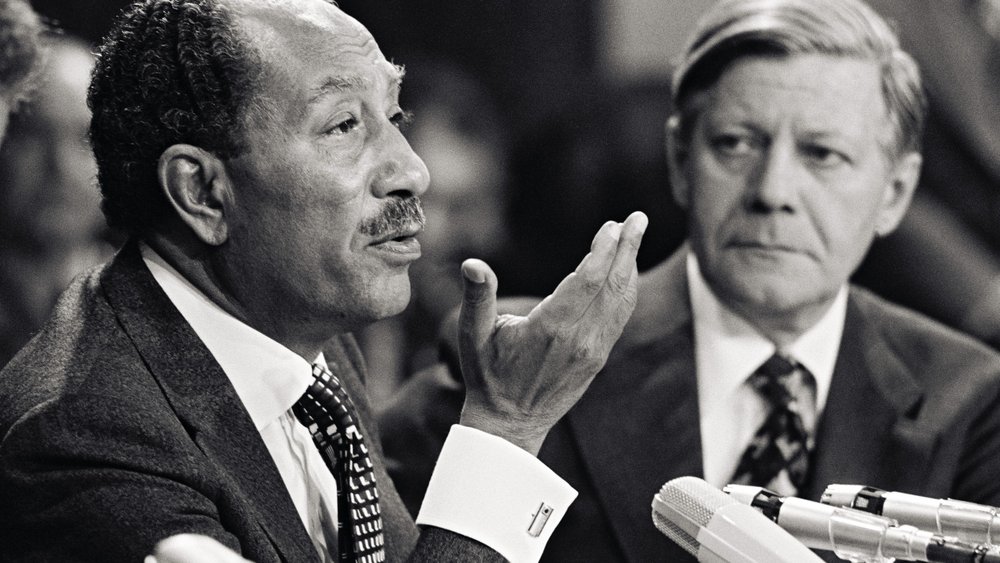
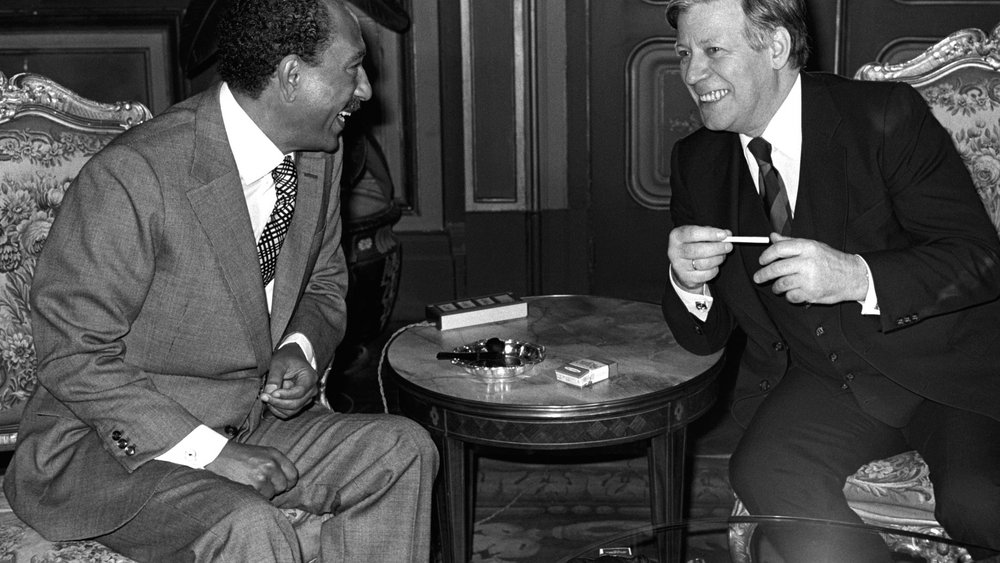
It is Helmut Schmidt's 90th birthday. He is sitting in a darkened room on a velvet-red armchair, talking to Reinhold Beckmann about his eventful life. The former chancellor is taking a concentrated drag on his cigarette when he interrupts his counterpart: "But I want to answer another question that you didn't ask: Which of my political dialogue partners has impressed me the most?" The answer comes promptly - it is the former Egyptian President Anwar as-Sadat.
1977 - a year of decision?
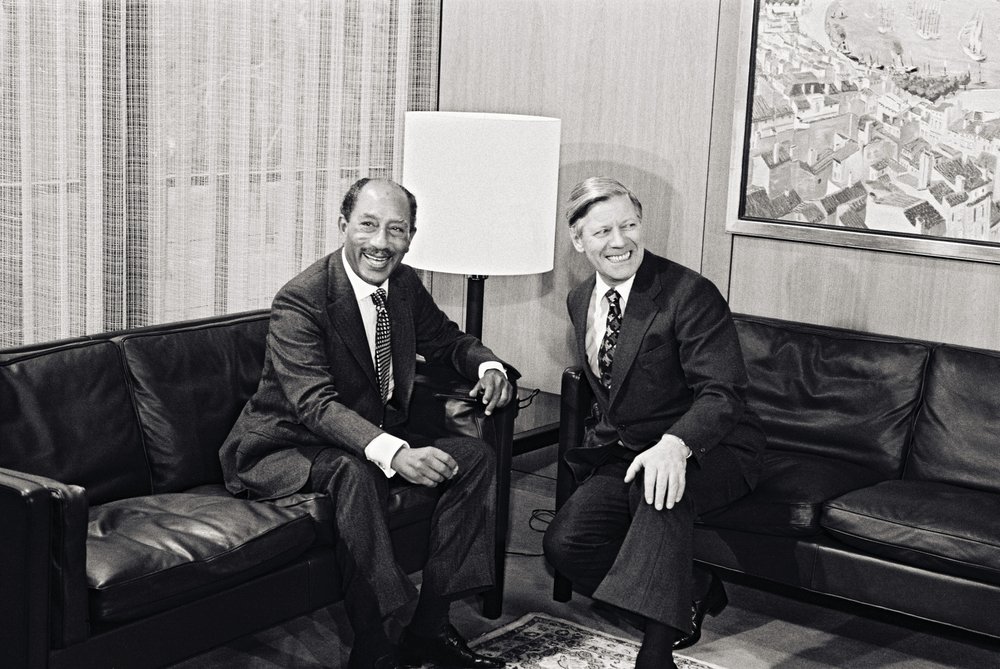
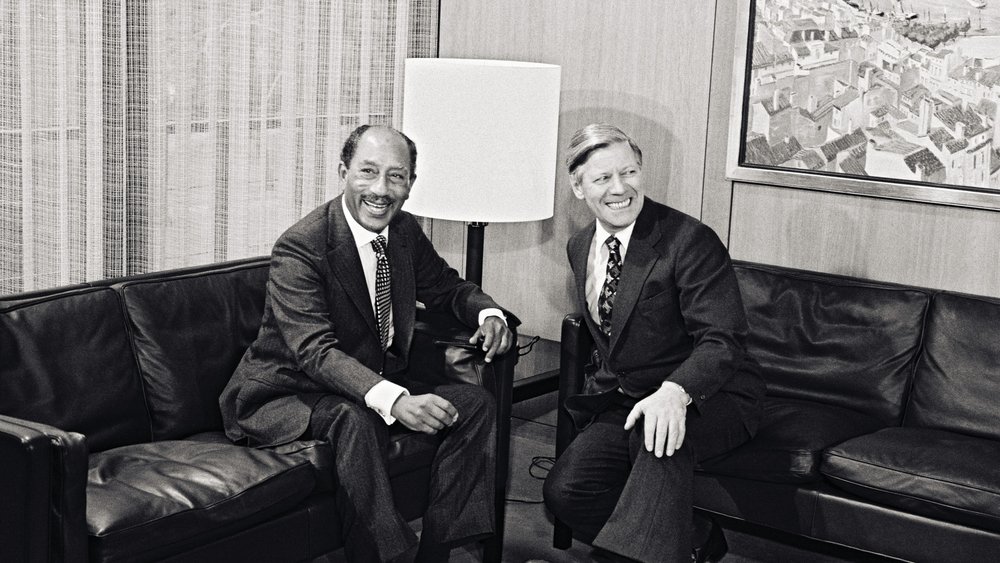
Schmidt and Sadat met during a diplomatic exchange in the spring of 1976. The two statesmen quickly developed a deep trust and lifelong admiration for each other. Their unconditional desire for peace, which had grown out of similar experiences of war, formed the basis of their bond. Sadat, who had led the last offensive against Israel as president in 1973, had recognised that peace in the Middle East was more important than ever. He was convinced that the religious commonalities of Islam and Judaism could have been the basis for a lasting peace with Israel. After all, Jews, Christians and Muslims see the figure of Abraham as the common father of their faith.
And indeed: in November 1977, the Egyptian was the first Muslim president to visit Jerusalem and was allowed to explain his peace initiative to the Knesset, the Israeli parliament, on 20 November. His most important demand was Israel's withdrawal from the areas of Jerusalem occupied since 1967, Mount Sinai and the Golan Heights - places of great religious significance: "We all love this land, this land of God. All of us, Muslims, Christians and Jews, who worship God." he called out to the audience and pleaded for peaceful coexistence. But Sadat also demanded real political concessions from the Israelis, such as the creation of a Palestinian state on the territory of the West Bank and the Gaza Strip as well as the right of all states in the region to secure and guaranteed borders.
What few people realise: Sadat discussed this extraordinary peace project in detail with the then German Chancellor and his friend Helmut Schmidt (more on this in an interview with the NZZ).
The world watched the Middle East spellbound as Israeli Prime Minister Menachem Begin greeted the Egyptian head of state at Tel Aviv airport. For the first time, peace seemed to be in sight.
A religious dialogue on the Nile
Sadat's visit to Jerusalem was only a few weeks ago when Loki and Helmut Schmidt travelled to Egypt on a state visit - and for the first time ever - at the end of December 1977. The meeting was characterised by practical interest politics. Schmidt always had to maintain a diplomatic balance between agreeing to Sadat's peace mission on the one hand and taking into account the rights and interests of the Israelis and Palestinians on the other.
But it was not the diplomatic exchange or the visits to ancient sites that made this trip a very special one. It was a conversation during a cruise on the Nile that made a deep impression on Schmidt. On the deck under a clear starry sky, Sadat spoke to him about the common historical and religious roots of the three monotheistic religions and explained to his friend his vision of a peaceful coexistence of Islam, Judaism and Christianity and his idea of a reconciliation of the three Abrahamic religions. "Sadat hoped for a great peaceful encounter between Judaism, Christianity and Islam," writes Schmidt in his book "Weggefährten" (Companions), looking back in 1996. "It was to take place symbolically on Mount Sinai, the Mount of Moses, as it is called in Arabic. A synagogue, a church and a mosque were to be built next to each other there to bear witness to unity."
This unforgettable conversation for Schmidt decisively changed his view of the importance of the major religions for the peaceful coexistence of people. Helmut Schmidt drew on this narrative well into old age to tell his audiences about the importance and interrelationships of peace, world religions and political actors. Just one year after his trip to the Nile, during a speech in a synagogue in Cologne, he returned to this narrative. It was a time of great expectations, as the first peace talks between Egypt and Israel had taken place in the meantime and raised hopes among the people.
(Not) a historic peace
After all, it took over a year for Sadat and Israel's Prime Minister Begin to sign a separate peace agreement, mediated by US President Jimmy Carter at Camp David. It was the first ever agreement between an Arab state and Israel, but the reaction from Egypt's allies was devastating. Syria, Iraq, Libya and Algeria broke off diplomatic relations and Egypt fell into foreign policy isolation. The reason for this was the associated recognition of Israel's right to exist. However, a front also formed against Sadat within Egypt, who increasingly had the militant opposition - especially radical supporters of the Muslim Brotherhood - imprisoned.
The assassination attempt of 6 October 1981
Critics blamed Sadat for this fatal domestic political development, which also strengthened Islamist conspirators as a result. It was four of them who carried out the assassination attempt on Anwar as-Sadat during a military parade on 6 October 1981. While he was sitting on the tribune of honour, the assassins fired dozens of bullets at him, three of which fatally wounded Sadat. The news of the violent death of the Egyptian president shook the Western world. Helmut Schmidt was also deeply shocked.
Schmidt publicly admitted: "I loved him. We were the same age for all but two days. Our nightly conversation on the Nile is one of the happiest memories of my political life. Sadat's desire for peace literally crossed borders, Schmidt continued. Sadat knew that he was risking his life with this peace initiative. But because he nevertheless followed his conscience, he was the person who impressed him the most among all state leaders.

Franziska heads the correspondence project at the Helmut Schmidt-Archiv, where she combines archival description and cataloguing of the impressive collection of letters with issues relating to long-term archiving and historical and political education.
She studied German Studies, European History and History at Otto von Guericke University Magdeburg and the University of Hamburg. She has been with the Bundeskanzler-Helmut-Schmidt-Stiftung since 2017, where she previously oversaw the “60 Years of the Storm Surge” project.
More