
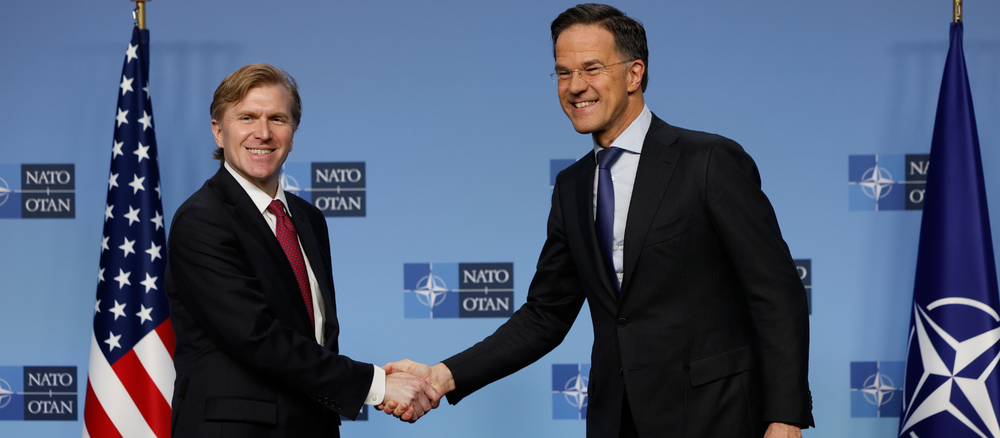
How can Europe safeguard its security, freedom and territorial integrity in terms of defence policy? For those European states that identify as Western, the answer to this question seemed clear for decades: through NATO and in partnership with the United States. Under the banner of ‘NATO 3.0’, Washington is now calling on Europeans to assume primary responsibility for their conventional defence. Does this represent a step towards European sovereignty, or merely a new burden-sharing arrangement whilst American hegemony persists?
From NATO 1.0 to NATO 3.0
NATO (1.0) was founded in 1949 as an alliance for collective defence. During the Cold War, the allies’ conventional armed forces, together with the US’s nuclear security guarantee, served as a deterrent against the Soviet Union and the Warsaw Pact. With the disappearance of the immediate territorial threat after 1990, this evolved into NATO 2.0, with new members and missions outside the alliance’s territory. Operations in the Balkans and Afghanistan characterised this phase, as did the European ‘peace dividend’ resulting from disarmament, reduced armed forces and falling defence spending. The US continued to provide essential military capabilities, although these were increasingly used to further its own global interests.
This model appears increasingly untenable to the US and less and less reliable to Europeans. That said, territorial alliance defence has once again moved more firmly to the centre of the Alliance’s focus since Russia’s annexation of Crimea in 2014 and its attack on Ukraine in 2022. Under Trump’s second presidency, strategic shifts are accelerating, accompanied by a neo-imperial stance and a fundamental questioning of existing security partnerships. Elbridge Colby, Under-Secretary of State for Defence Policy, outlined the concept of ‘NATO 3.0’ as follows: Europe is to take on the bulk of conventional defence itself, whilst the US retains its military access rights and bases for global power projection. NATO is to focus on operational readiness and collective defence, whilst Washington prioritises the Western Hemisphere and the Western Pacific.
Burden-sharing does not yet equate to sovereignty
The United States is therefore demanding significantly greater European commitment without, in return, relinquishing military leadership responsibilities or political decision-making power. At the same time, whilst NATO does have established command structures, joint defence planning and well-rehearsed procedures, building these up independently in Europe would require a considerable investment of time and resources. Consequently, these structures remain oriented towards the US, which continues to provide key capabilities in intelligence, command, logistics and transport. Such a ‘NATO 3.0’ would significantly increase Europe’s burden, but would merely perpetuate its dependence on Washington in a new form.
A European pillar or a Europeanised NATO?
Leonard Schütte, a defence expert at the Carnegie Endowment for International Peace, therefore distinguishes between a stronger European pillar within NATO and an actual Europeanisation of the alliance. The former continues to require substantial American involvement, whilst the latter would have to enable Europe to ensure its own defence even without the US. In view of political developments in Washington, the question is increasingly being raised as to whether Europe should not be planning for ‘no America’ rather than merely for ‘less America’. European defence sovereignty would not mean complete self-sufficiency, but rather the ability to decide independently on security policy objectives and to pursue them militarily even without mandatory American support.
But how could an independent European security and defence capability be established? Three institutional options are available, which need not be mutually exclusive.
The EU could deploy its economic, technological and financial resources towards joint armaments development, procurement, infrastructure and military mobility. Furthermore, in the areas of comprehensive security, societal resilience and hybrid threats, it possesses instruments that go far beyond NATO’s military capabilities.
Coalitions of the willing could enable political action if not all European states are prepared to act jointly. They would need to be open and inclusive in nature and involve key European partners outside the EU.
A reformed and Europeanised NATO could provide the shared military infrastructure. In the event of an alliance crisis, North America and Europe would act jointly. In other situations, the Europeans could utilise existing structures even without substantial American involvement. This would, however, require a reorganisation of command structures, decision-making procedures and responsibilities.
The unresolved nuclear issue
Nuclear deterrence remains particularly challenging. France’s and the UK’s nuclear capabilities are linked to their partners via the EU and NATO. However, they cannot serve as an equivalent replacement for the US’s nuclear security guarantee. A significant withdrawal of US conventional forces from Europe could also undermine Europe’s credibility. It must therefore discuss not only its own military capabilities but also future nuclear deterrence and closer cooperation with France and the UK. This touches upon what is arguably the most critical issue concerning European defence sovereignty. Whilst conventional capabilities could be gradually Europeanised, decisions on the use of French and British nuclear weapons will, for the foreseeable future, remain a matter of national responsibility.
Power for what purpose?
An independent European defence capability requires more than just ‘burden sharing’: it presupposes autonomous political decision-making and operational capability. This is not merely a matter of resources and military capabilities, but of developing a genuinely European defence strategy. Only from this can we deduce what military capabilities Europe requires. A Europeanised NATO therefore also requires a break from US-influenced strategic and military thinking.
Military autonomy is not, however, an end in itself. It opens up scope for political action, but does not yet answer the question of what Europe intends to use its power for. Is Europe striving to assert its interests through power politics as yet another major geopolitical power? Or should its increased capacity for action serve to strengthen an international order based on multilateralism, international law, the United Nations Charter, the equality of sovereign states and equitable development – as stipulated in Article 21 of the TEU? The crucial question is therefore not only how Europe can become capable of defending itself and more independent of the US, but also what political role it intends to assume with this new autonomy.