
Disclaimer: The original text was published in German
Peer Steinbrück, Chairman of the Board of Trustees of the Bundeskanzler-Helmut-Schmidt-Stiftung and former Federal Minister, said in his introductory remarks that Helmut Schmidt had been one of the most significant statesmen of the 20th century. Taking a clear stand and maintaining a firm stance – that was what Schmidt stood for. Defence Minister Boris Pistorius, the evening’s speaker, was “cut from the same cloth”, according to Steinbrück.
A political role model
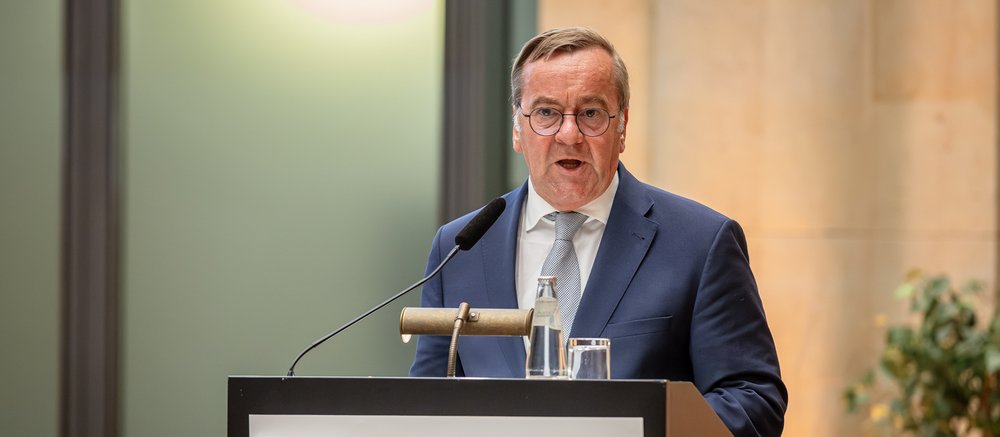
“Helmut Schmidt knew how to handle a crisis,” Pistorius summed up before an audience of around 250, which included former Defence Minister Rudolf Scharping. Pistorius described Helmut Schmidt as a political role model. Schmidt had not shied away from difficult decisions, for example during the Cold War. One thing, however, had been different back then, Pistorius noted. The circumstances had been clear at the time. As Chancellor, Schmidt had also pushed through the NATO Double-Track Decision in the face of strong opposition.
Even before that, as Defence Minister, he had set the course. He had reformed the Bundeswehr and championed the ‘Inner Leadership’ model. This remains unforgotten and is still effective today.
Political virtues then and now
Schmidt stood by his decisions, even when they were difficult, controversial and unpopular. Pistorius described this approach as a political virtue that must be upheld both then and now. Reflecting on the present, Pistorius emphasised: “We are living in a world that is becoming ever more unpredictable.”
The threats to Germany’s freedom and democracy are greater than they have been for a long time. “We must protect this democracy – more strongly and more resolutely than ever before,” the minister stressed. A prerequisite for this, he said, is that Germany expands its own defence capabilities. “Without our own military strength, we will not be able to deter threats successfully,” said Pistorius. In doing so, he also recalled Helmut Schmidt’s consistent adherence to the principles of deterrence and dialogue. He noted that the Bundeswehr has now been placed on a strong, sustainable financial footing that will remain stable in the long term. “The threat situation takes precedence over the financial situation,” the minister emphasised once again.
Thinking about tomorrow today
Speaking at the fifth Helmut Schmidt Lecture, Pistorius emphasised that he was concerned with the question of how we can ensure today that our children and grandchildren will be able to live in peace and security in the future. “Only if we take care of this today will we be able to live in safety tomorrow,” the Minister affirmed. He emphatically stressed that security was a task for society as a whole. Germany, he said, was a free country, a liberal democracy that had nothing in common with authoritarian states such as Russia.
Against this backdrop, Pistorius drew attention to Germany’s strength, which has grown over decades through the Alliance. As a “child of the Cold War”, he looked back on the time when the solidarity of NATO partners provided protection for the then Federal Republic of Germany, and when this was made tangible even in his home town of Osnabrück through the presence of British soldiers. He said he was deeply grateful for this. It fills him with pride today that Germany is now able to give something back to its allies in return for the support they provided back then: for example, by securing NATO’s eastern flank.
Trust is a prerequisite for security policy
This marks the first time in the history of the Federal Republic of Germany that a Bundeswehr brigade has been permanently stationed in another country, namely Lithuania.
On that very day, Pistorius was in Lithuania taking part in the Freedom Shield 2026 military exercise. Freedom Shield is the first major exercise for the German 45th Armoured Brigade, the core of the Bundeswehr’s Lithuania Brigade. There, he spoke with the German soldiers. They told him that the Lithuanian people had shown them a great deal of trust and gratitude for their service.
Close partnership with France
In memory of Helmut Schmidt, Pistorius emphasised that the statesman had understood that security policy depends above all on mutual trust. As an example of a particularly trusting political relationship, the Minister highlighted Schmidt’s close cooperation with the French President Valéry Giscard d’Estaing.
Many years have passed since then. Even though there have occasionally been setbacks in this long-standing partnership – such as recently with the “Future Combat Air System” (FCAS) project – this does not spell the end of Franco-German defence cooperation. Nor is it by any means a vote of no confidence in Franco-German friendship. Both partners continue to work closely together in numerous areas and are currently identifying projects where even closer cooperation is feasible. New agreements could emerge at the upcoming Franco-German Ministerial Council in July.
In the spirit of Helmut Schmidt, the Minister expressed his conviction that the challenges could be overcome together. “Ultimately, we are united by one conviction: our freedom and our democratic values are what are worth standing up for,” said Pistorius.
The minister’s speech was followed by a panel discussion featuring Pistorius and the Acting Co-Director of the Jacques Delors Centre, Thu Nguyen. The debate was moderated by Melanie Amann, Digital Editor-in-Chief at Funke’s Central Editorial Office.
Click here for the original text from the Federal Ministry of Defence (German)