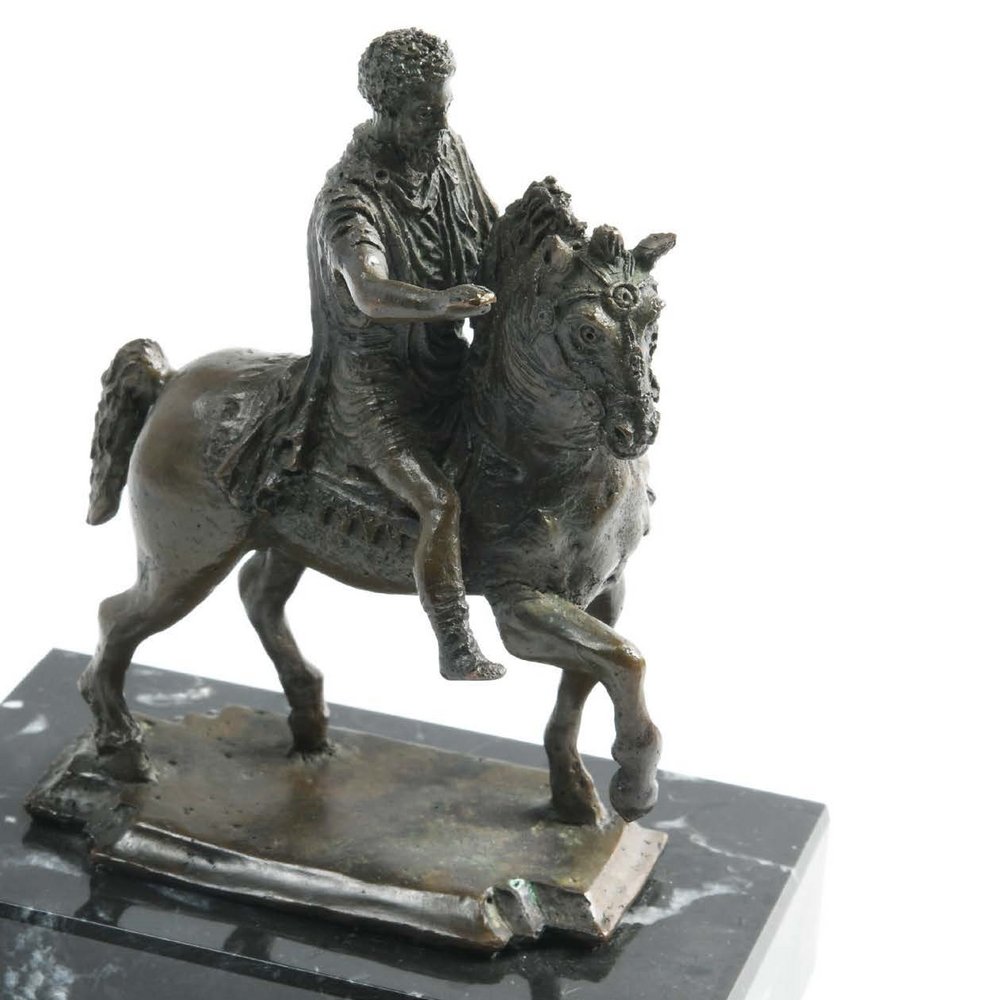
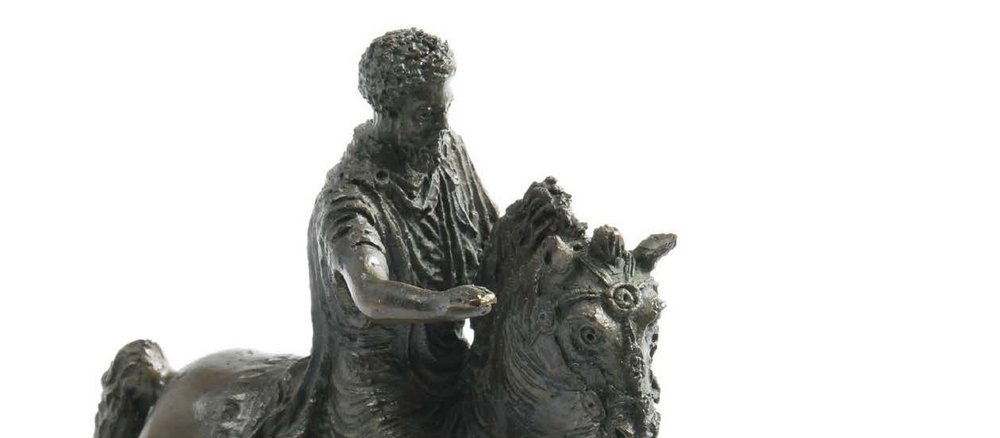
In Helmut Schmidt’s private study in Hamburg-Langenhorn there is a small equestrian statue. It depicts the Roman emperor Marcus Aurelius, whose maxims on how to live his life he internalised as a young man: The will to fulfil one’s duty and inner composure helped Schmidt later as a politician when massive crises had to be overcome and difficult decisions had to be made. In the fight against the Hamburg storm surge disaster in 1962, in the face of terrorism by the Red Army faction in the “German Autumn” and in the implementation of the NATO Double-Track Decision in 1979 – Marcus Aurelius, the “philosopher on the imperial throne”, always served as a role model for him.
A momentous confirmation gift
Schmidt received Marcus Aurelius’ “Self-Reflections” as a confirmation gift from his uncle Heinz Koch in 1934. After the church ritual and the subsequent family celebration, he began reading the book that very evening. Whilst Schmidt, by his own admission, had little interest in confirmation classes, he was enthusiastic about the work of the emperor, who was known as a stoic. Throughout his life, the book remained an important source of guidance for him, even if he repeatedly interrupted it because he was annoyed by the numerous repetitions and lacked experience with abstract philosophical texts.
Shortly before the end of his life, Helmut Schmidt described the “Selbstbetrachtungen” in an article in Die Zeit as “a kind of ideal catalogue for just and intelligent government”. In his view, this required a pronounced sense of responsibility for the state and the common good, combined with emotional self-control, fulfilment of duty, discipline, rational sobriety and sovereignty. He also adopted Marcus Aurelius’ call for humanity and justice. Schmidt was not a shirt-sleeved, unprincipled “doer”, neither as a senator in Hamburg nor as a minister and Federal Chancellor in Bonn. Despite his pragmatism, politics for him was linked to clear values and ethical standards. He attached great importance to acting in a rational and philosophically sound manner.
In his admiration, it played a subordinate role for Schmidt that Marcus Aurelius as emperor (161 to 180 AD) had by no means acted as exemplary and calmly as was demanded in the “Selbstbetrachtungen”. On the contrary, as Schmidt later learnt, he enforced the interests of the Roman Empire with great rigour. He waged several wars, cancelled the abolition of slave torture and accelerated the persecution of Christians. Schmidt in no way denied this in his assessment of the historical figure, but at the same time emphasised that Marcus Aurelius had written his book only for himself, as a kind of self-dialogue, in order to compare political reality with his personal aspirations. Incidentally, the ancients were not aware of this written struggle for their own adherence to principles; a manuscript of Marcus Aurelius’ book only appeared in the 10th century. For Schmidt, it was clear that nobody had to be a saint to be able to use at least part of their biography as a role model.
Intellectual fixed stars
As a social democrat, Helmut Schmidt also counted Immanuel Kant, Max Weber and Karl Popper among his intellectual fixed stars. When he quoted these important thinkers, he usually wanted to signalise that he did not make his political decisions lightly, but based on values. In his long-standing engagement with philosophical and sociological concepts, he focussed on the adoption of central set pieces, which he made the benchmark for his actions. He was fascinated by Kant’s categorical imperative and, with the help of Max Weber, Schmidt reflected on the right balance between judgement, responsibility and passion in politics. Following the eminent sociologist, he characterised himself as an ethicist of responsibility who always assessed the consequences of his actions and – in contrast to a mere ethicist of conviction – was prepared to stand up for them without reservation. Schmidt and Popper, with whom he had personal contact as Federal Chancellor, shared a commitment to critical rationalism and a rejection of totalitarian world views and systems.
At the beginning of this inspiring series are the “Selbstbetrachtungen”. During the Second World War, Schmidt – like many other soldiers – even took this book with him to the front in his knapsack for inner strength, which was urgently needed in view of the brutality of the war. Marcus Aurelius, whose 1900th birthday is just a few days away, inspired him to take a critical look at the tense relationship between fulfilment of duty and serenity. After the end of the war, Schmidt orientated himself on these two maxims when building and consolidating West German democracy, for which he soon assumed responsibility, increasingly in prominent positions. Just like the equestrian figure, the aforementioned confirmation gift, the book edition of “Selbstbetrachtungen” published by Kröner-Verlag, still stands in his study today and keeps the memory of this influential reading alive.
Listening tip: In our podcast “Der Krisenlotse”, we discuss with you what today’s crisis managers use as a guide.