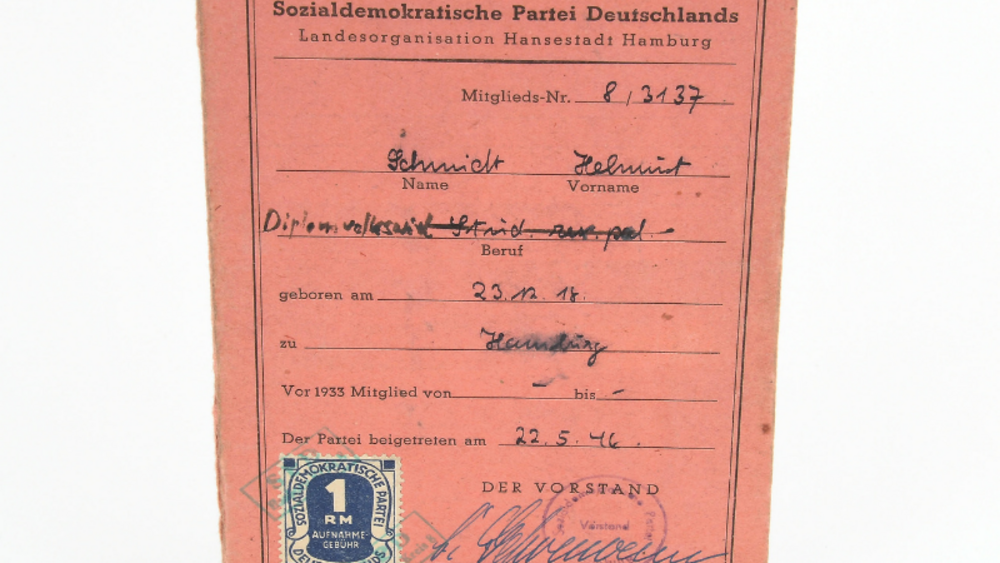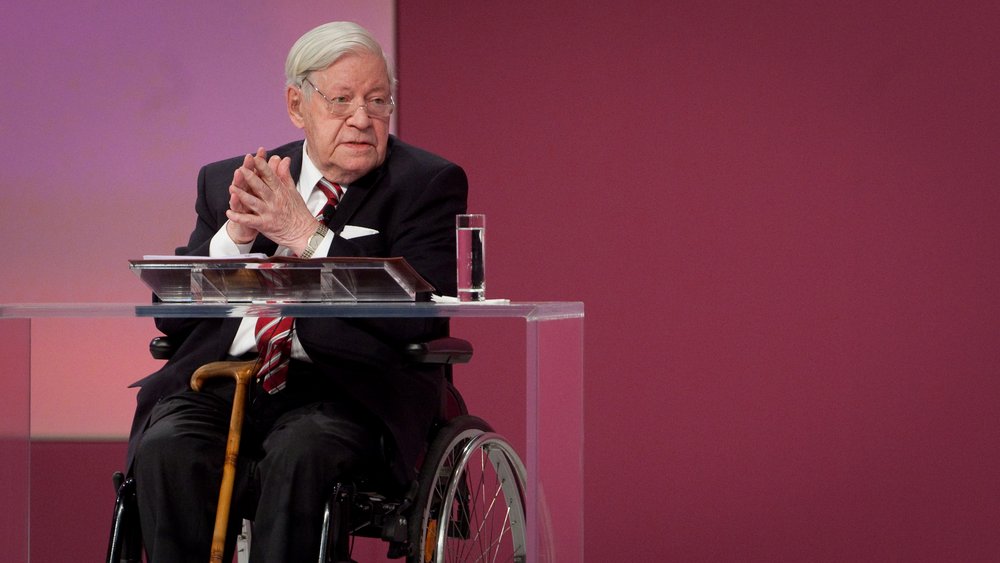
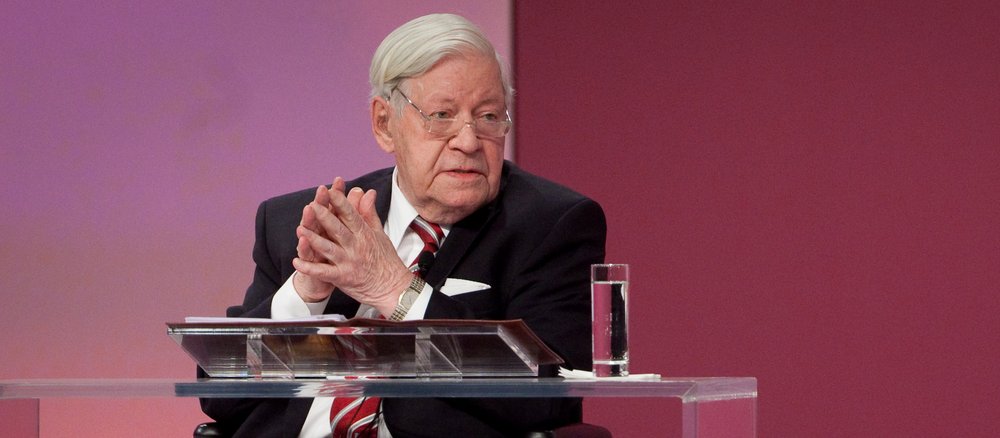
It was only four years after Helmut Schmidt’s death that it was found in his private archive in Hamburg-Langenhorn: his membership card, with which he had decided to join the SPD after the Second World War. There it lay, under a landing in an old cardboard box together with other personal documents. Four pages of red, now aged paper, given to the new member for an admission fee of one Reichsmark, signed on 22 May 1946 by Carl Gehrmann, the SPD district chairman of Harburg. Schmidt pasted the membership fee stamps into his membership card without any gaps over the years, but it is much more than just a carefully maintained party membership card: behind Schmidt’s entry into the SPD is a fundamental political decision after a long and painful maturing process.
After the end of the war, Schmidt felt cheated of his youth by the National Socialists and abused by their criminal leadership clique as a soldier in the German Wehrmacht. As a British prisoner of war since April 1945, he had a lot of time to think. He thought he recognised some parallels between the soldierly comradeship he had experienced at the front, which he held in high esteem, and the socialist principle of solidarity among comrades. The tyranny established over the entire European continent with the help of the Wehrmacht, to which he had contributed, did not cause him to fundamentally reject the military after 1945, but convinced him of the necessity that every army required democratic integration and control.
First points of contact with social democracy
In the prisoner of war camp near Bruges, Schmidt met his fellow prisoner Hans Bohnenkamp, born in 1893, around whom a small discussion group had formed. Lectures were also held, for example on the Germans as a people “seduced by the Nazi regime” or on the resistance of 20 July 1944. Bohnenkamp, a religious socialist and highly decorated officer in both world wars, had worked as a professor of education and philosophy at various universities from 1930 to 1939 after years as a teacher, meaning he had managed to hold this position even after the Nazis came to power. He had also joined the SA in 1933 and the NSDAP in 1937. Nevertheless, or perhaps precisely because of this, he managed to impress Schmidt with his values and views after the bankruptcy of National Socialism and the total defeat of Germany. He introduced his campmate, who was 25 years younger than him, to the ideas of the labour movement. On his initiative, Schmidt, for whom a new intellectual horizon opened up and who eagerly absorbed the knowledge imparted, began to analyse more intensively the conditions and social value of democracy, the rule of law and socialism.
Schmidt referred to these learning processes initiated by Bohnenkamp in his farewell speech to the Bundestag in September 1986, mentioning his mentor by name. With unusual candour, Schmidt spoke about his emotions and psychological hardships during his time as a soldier, which he described as a generational experience. It was a schizophrenic state of mind to fight for a dictatorship at the front during the day and to wish for its collapse at night despite all the sense of duty.
A thought leader with rough edges
When Schmidt retired from parliament, he had 40 years of intensive commitment as a Social Democrat behind him, from 1968 to 1984 as deputy party chairman, always supported by the “canal workers”, the influential conservative and trade union-affiliated SPD grouping. The comrade with the membership number 8/3137 was a forward thinker with rough edges who spoke his mind and tried to assert it politically. But the SPD did not make it easy for him either. Especially as a minister and Federal Chancellor during the social-liberal coalition, Schmidt suffered from the infighting in his party and the neo-Marxist-inspired Jusos. He warned that social democracy had binding basic values and lived from shared convictions. Under no circumstances should the SPD be allowed to degenerate into an umbrella organisation without a clear profile.