On 25 November 2020, the Federal Government paved the way for the “Defensive Democracy Promotion Act”. Following the right-wing extremist, racist and anti-Semitic attacks in Halle and Hanau, the commitment to democracy and against hatred, agitation and violence is to be supported with more than one billion euros. Just four days earlier, the Council of the EU had decided to do more to promote the commitment and “democratic awareness” of young people in Europe in order to achieve a “vibrant democracy in Europe”, according to the wording. In addition, a nationwide citizens’ assembly on the topic of democracy was held for the first time in September 2019 and is set to enter its second round this year. In this model, citizens selected by lot will discuss the state of democracy, primarily its crisis (and its causes) – and what is needed to counteract it.
Many different adjustments are being made in an attempt to give democracy in Germany and Europe a new lease of life and to counteract the threats. Democracy researcher Wolfgang Merkel speaks of a veritable “start-up boom” in view of the large number of projects and initiatives aimed at saving democracy. Meanwhile, Joe Biden has already announced a global “Summit for Democracy” in the USA to revitalise the “democratic spirit”. At its core, it is always about the same thing: the vitality and resilience of our democracy. Helmut Schmidt was already convinced that democracy must not only be consensus-orientated, but also robust and resilient in order to survive. The question of defence is inherent to the question of the stability of a democracy, but to what extent have our understanding of democracy and its challenges changed since the post-war period?
In essence, it is always about the same thing: the vitality and resilience of our democracy.
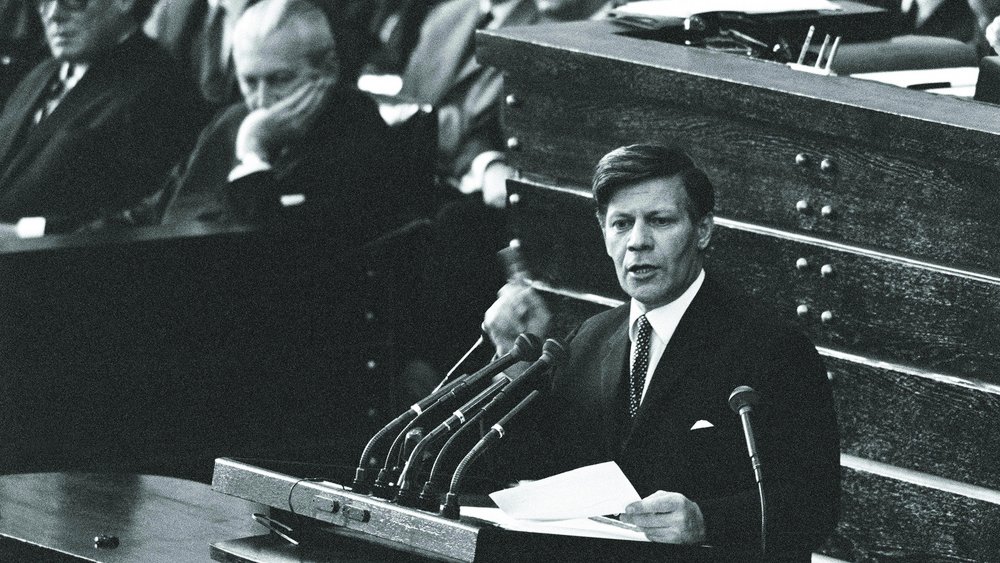
According to Edgar Wolfrum, a contemporary historian who teaches at the University of Heidelberg, democracy in (West) Germany was in its infancy and learnt its first steps in the “Bonn years of apprenticeship”. The exclamation “Bonn is not Weimar” reflected the first achievements of a stable party system. Having grown up during the Weimar Republic, Helmut Schmidt experienced the global economic crisis of 1929 as a teenager, the erosion of democracy by the presidential regimes and, as a 14-year-old, the transfer of power to the National Socialists. He therefore always emphasised the importance of the stability of institutions: “The constitutional state does not have to win, nor does it have to lose, but it has to exist!” The goal was primarily a “functioning democracy” in that constitutional institutions are established, people go to the polls regularly and parties unite to form majorities capable of governing. We still recognise these premises today in the promotion of democracy abroad, where the establishment of statehood based on the European model is often equated with democracy.
Their vitality, with questions about access, participation and the accountability of those in power to citizens, only came to the fore later with the emergence of the new social movements in the 1960s and 1970s. Young people in particular developed a new understanding of democracy that challenged the stability paradigm of many politicians, including Helmut Schmidt. Although he called for “courage for the future”, he underestimated the importance of protesters and their impact. In the course of this, the American Trilateral Commission’s report spoke for the first time of a “crisis of democracy” in Western Europe. Unlike today, however, the crisis diagnosis for democracy in Europe and the USA referred to the overloading of the system with citizens’ interests and their negotiations with a simultaneous decline in state authority. The increase in protests was interpreted as a sign of crisis. This shows not least what the history professor Hedwig Richter has been tracing for Germany since the 18th century – the history of democracy was initially an elite project and revolved around the question of how decision-making and electoral processes could be organised in a stable and efficient manner.
The increase in protests was interpreted as a sign of crisis.
It was not until the Peaceful Revolution of 1989/90 that attention was increasingly focussed on the importance of citizens and their attitudes and values. From then on, democracy was seen as the victor and its premises as anchored in the (West German) population. The fact that right-wing groups were already attacking and setting fire to refugee centres at the time was not reason enough to proclaim a crisis of democracy. It was only at the beginning of the 2000s, when the mainstream parties lost votes, and with the entry of the AfD into the Bundestag in 2017, that concerns about democracy developed into a declaration of its crisis and its resilience has since been discussed with renewed urgency. Unlike before, it was no longer about the overburdening of the democratic state, but about the question of how politics is communicated to citizens and the threat to democracy posed by right-wing populist and extremist groups.
Right-wing and right-wing populist attitudes have not only recently threatened our democracy, but have always done so.
Another interpretation suggests that the incidents we are currently observing expose predetermined breaking points that have existed for a long time. Right-wing and right-wing populist attitudes are not a recent threat to our democracy, but have always been. The exclusion of certain groups is also not a new phenomenon, but a historical constant, although it is now gaining a greater voice in public debate. In this context, Wolfgang Merkel spoke of an “increased sensitivity to issues of gender equality, ethnicity and sexual preference since the 1960s and 1970s”. The current book by Naika Fouroutan and Jana Hensel entitled “Die Gesellschaft der Anderen” (The Society of Others) shows how people with migration biographies are similarly excluded from certain (elite) positions as people from East Germany – and makes the success story of overcoming the division of Germany crumble. These injustices and threats persist and challenge the democratic promise of equality, freedom and justice.
This brief outline of the history of German democracy raises questions about the criteria we use to measure the crisis of democracy. It is always important to distinguish between the ideal of democracy and its real-life variants, especially as many paradigms, such as the high level of protest, do not necessarily indicate a crisis, but rather the vitality of a democracy. Similar to the increasing loss of importance of the popular parties, these are initially signs of change. As Helmut Schmidt pointed out at the end of the 1960s, democracy is not a state on which we can rest: “Democracy is not a state, democracy is a process”.
Times of crisis offer the opportunity to change course.
The current pandemic situation is putting our democracy to a particular test. Times of crisis initially promote trust in the existing government, but have the potential to cause an increase in polarisation and division in the subsequent assessment of crisis management. People then look for support and often find it in authoritarian or populist promises of salvation. However, a second perspective is also required here: although (right-wing) populist mobilisations have already increased again, solidarity initiatives such as neighbourhood support or a digital democracy platform for collecting events on the topic have also emerged. Times of crisis offer the opportunity to change course. Helmut Schmidt once described the development in the Federal Republic of Germany since 1949 with the adoption of the Basic Law as a second attempt at democracy. In keeping with this, the Bundeskanzler-Helmut-Schmidt-Stiftung has named its new exhibition “Schmidt! Living Democracy” to emphasise both his work as a democrat and the need to actively shape and ultimately “live” democracy. Today may be just the right time to revitalise this second decade and strengthen the resilience of democracy. The Basic Law forms the framework of our democracy, and living its values – and thus actively promoting them – is a first step in the right direction with the Democracy Promotion Act.