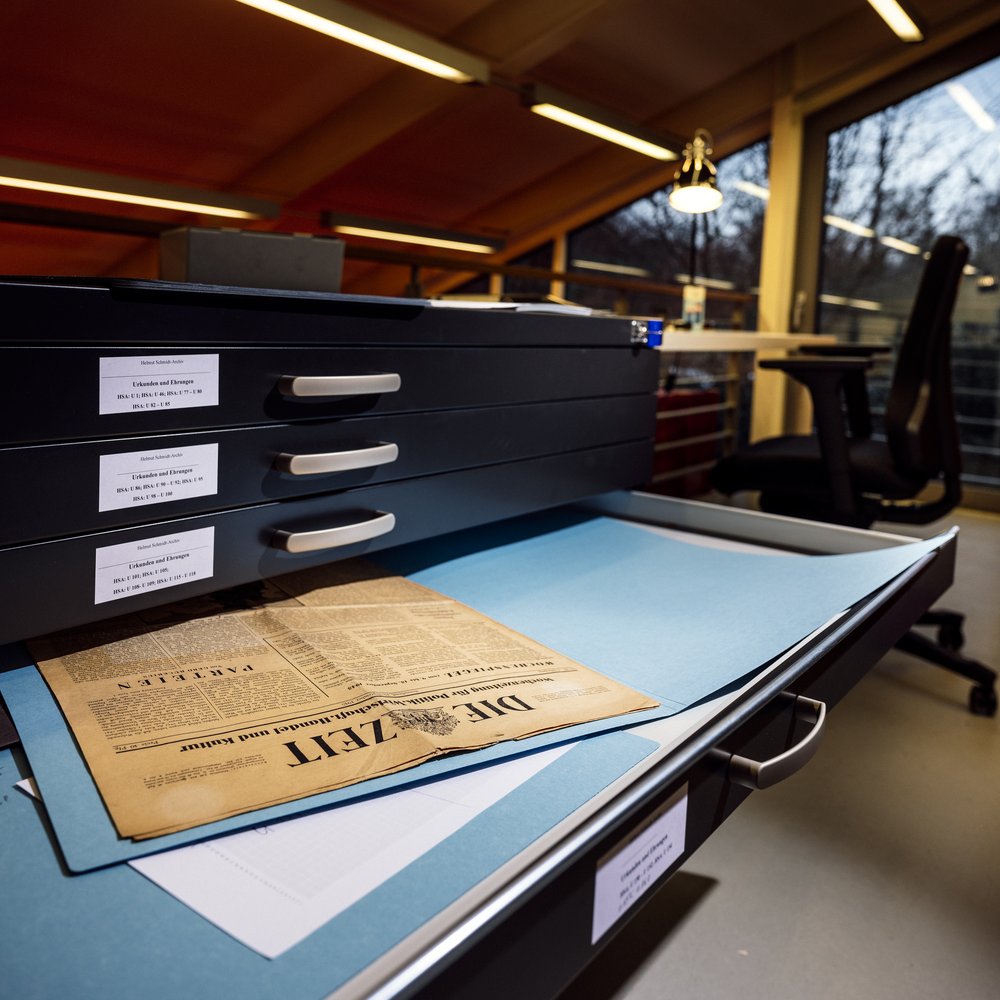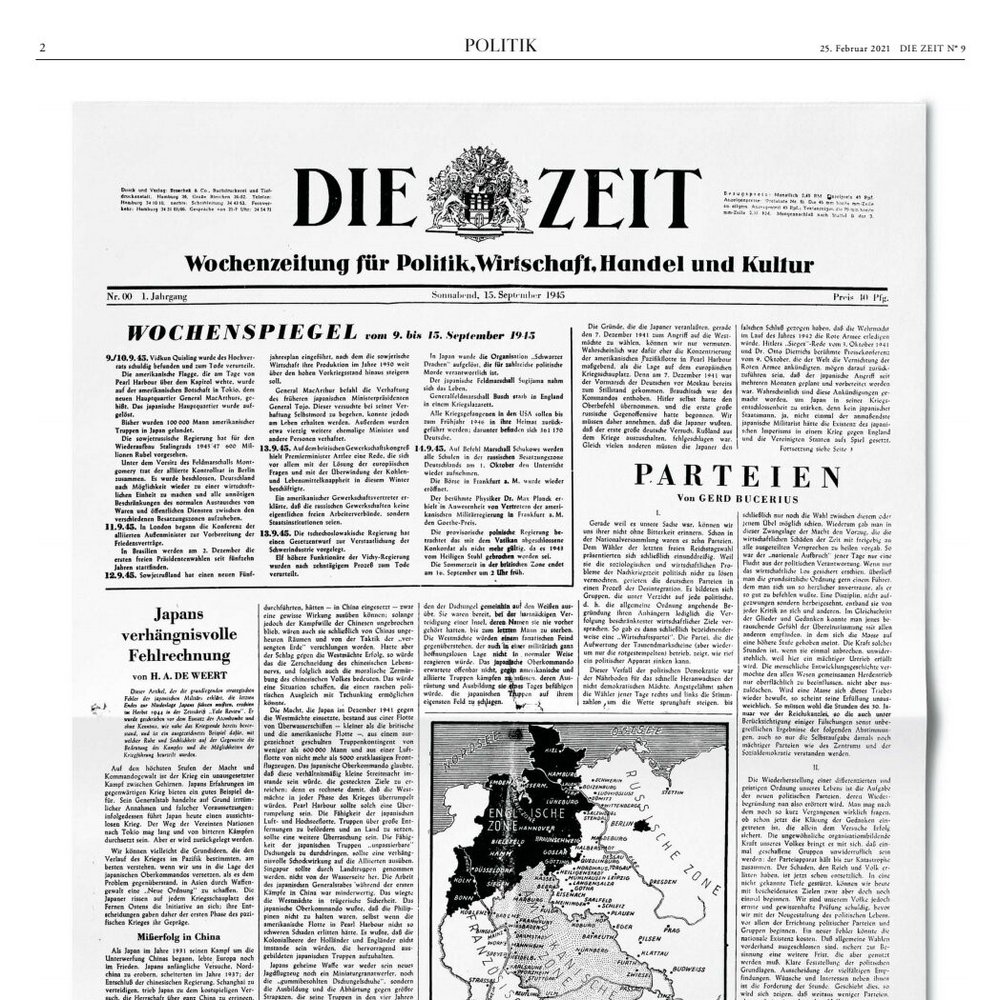
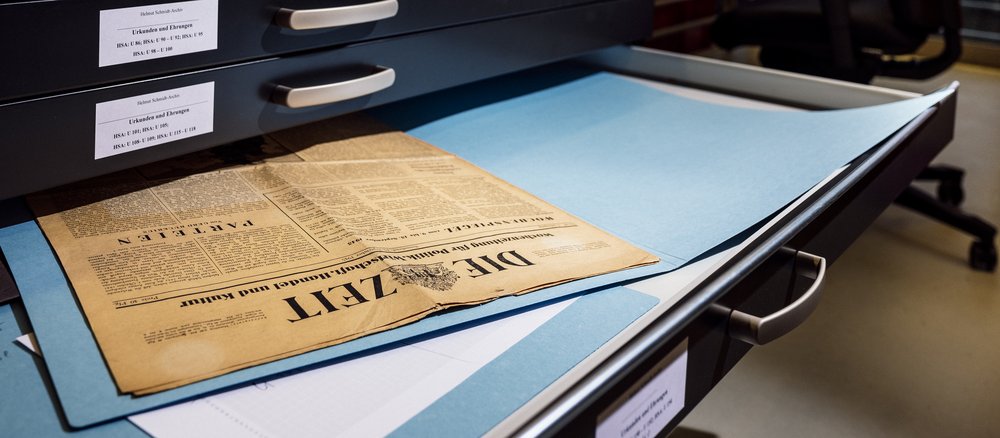
On 25 February, we congratulated Die Zeit on its 75th birthday with a spectacular find: issue number zero from 15 September 1945. Why was this eight-page sample issue found in the estate of the former Federal Chancellor? How did it get there? After his career as a politician in Bonn, the traces lead back to Hamburg and the press centre on Speersort. There, on 26 March 1983, the Zeit publisher Gerd Bucerius caused a surprise with a press release: he announced that Helmut Schmidt would be working as an editor and publicist for Die Zeit in future.
Schmidt learns to appreciate the times
According to Bucerius’ memories, the two members of the Bundestag Gerd Bucerius (1949-1962 for the CDU) and Helmut Schmidt (from 1953 for the SPD) got to know each other in the 1950s on train journeys to Bonn in the dining car. It is not known what ideas Schmidt picked up on these journeys – Bucerius had been the sole publisher of Die Zeit since 1957 – or what further thoughts he had. Nevertheless, the then Chancellor congratulated the publisher on the 30th anniversary of Die Zeit on 27 February 1976 and described himself as one of the many Zeit readers from the very first issue. “As a publisher and as a homo politicus, you have steered the paper through many perils... Since its first issue, Die Zeit has maintained continuity, to use an important word in the appropriate context. This applies as much to the liberalism of the paper as to the calibre of its authors. We pay tribute to this great journalistic and publishing achievement and wish it success for the next decade. Yours, Helmut Schmidt.” At the time, Schmidt had no idea that a decade later he himself would become editor and author of Die Zeit: in a collegial birthday letter in 1986, Schmidt described himself as “a reader of our newspaper for almost all forty years”. The decades-long relationship with Marion Gräfin Dönhoff, editor-in-chief and later publisher, also brought many points of contact. Schmidt was also able to lure two of the paper’s journalists to Bonn for political work: Theo Sommer headed the planning staff under Federal Defence Minister Schmidt and Kurt Becker worked as government spokesman and head of the Federal Press Office from 1980 to 1982.
Publisher Bucerius hires
Due to the political challenges, Chancellor Schmidt was increasingly sidelined from 1981 onwards. This did not go unnoticed by the publisher of Die Zeit and so Bucerius became active in 1982 when it came to offering Helmut Schmidt a new job. Some readers of Die Zeit will have been left speechless when they looked at page 1 on 1 April 1983, where Bucerius wrote: “There has never been any doubt in my mind that this man of extraordinary gifts and great achievements for the Federal Republic of Germany should be given a platform from which he can speak his mind and give his advice without hesitation. The voice of this statesman is heard in the world. Through my friend (and member of the Zeit Foundation’s Board of Trustees) Karl Klasen, I therefore asked Helmut Schmidt whether he would be prepared to become co-editor of Die Zeit alongside Marion Gräfin Dönhoff. Schmidt agreed. Helmut Schmidt will be co-editor of Die Zeit from 1 May. This will also be welcomed by readers of Die Zeit who disagree with Schmidt on important issues and – like me – wanted Kohl and not Vogel as chancellor on 6 March. Die Zeit has critical readers. They demand that the paper presents the controversy to them in the best possible way and without bias.”
Reader reactions from “April Fool’s joke” to “fabulous”
In the first quarter of 1983, circulation exceeded 400,000 copies sold for the first time, a good start for the prominent reinforcement. Bucerius was not really impressed by the 61 favourable and 138 negative reader reactions, which ranged from “this must be an April Fool’s joke” to “fabulous”. The publisher hoped that his coup would lead to a long-term increase in circulation when the former Federal Chancellor wrote in his newspaper. The employment letter of 25 April 1983 commented: “The editorial team would be grateful for one longer and one shorter article (gloss) per month“. The expectation was in black and white: Schmidt was to deliver texts.
After the first six months, Schmidt celebrated his 65th birthday. What do you give a new colleague and former Federal Chancellor? An early Barlach drawing was presented by Marion Gräfin Dönhoff, Hilde von Lang, Theo Sommer and Gerd Bucerius with the following lines: “So this is Zeit’s contribution to the 65th birthday of a man who deserves our personal affection over and above our appreciation. We – the editorial team – may not always agree with you, but everyone knows what you have done for all of us. What we will not forget.” Schmidt thanked him with a letter from Langenhorn: “At the same time, I can tell you that I am enjoying my work for the time being; in the coming years, I want to become increasingly involved in the joint task.” They stayed together for the following time – and Schmidt kept his promise.
Editor and author Helmut Schmidt
He wrote numerous articles for the paper over the next 30 years. His witty and far-sighted analyses of current affairs included security and alliance issues, world economics and the rising power of China. Circulation rose to around 500,000 in the 1980s and fell in the 1990s. Bucerius and Schmidt worked together at Die Zeit for another twelve years and wrote a number of letters to each other, including controversial ones such as this one from 1987: “Dear Mr Schmidt, your view that Die Zeit must not become an adult education centre – that really stung me. Because I saw and see it very differently.”
Schmidt’s role as publisher was to advise the publishing house and editorial team on all matters relating to the paper, especially commercial and business issues. As a member of the board of trustees of the Zeit Foundation, he played a key role in the discussions about securing the future of Zeit and the publishing house. After Bucerius’ death in 1995, the company was sold to the Holtzbrinck publishing group a year later. Helmut Schmidt remained loyal to Die Zeit as an editor and author for 32 years until his death in 2015.
More successful than ever with 550,000 copies
This brings us back to the initial question. Why was the zero issue of Die Zeit in an inconspicuous pile, folded in a transparent envelope and without any reference? We can only assume: because Schmidt felt a long and close connection to Die Zeit. He joined the paper as one of its last protagonists after Bucerius, Dönhoff, Sommer and von Lang and stayed until the end of his life.
It is not known whether Helmut Schmidt was aware of how Die Zeit learned to run on 21 February 1946 with 25,000 copies. It had to overcome many crises, often caused grief, cost publisher Bucerius a lot of money and yet still became a great success. Today, in its 75th year of existence, the weekly newspaper is more successful than ever with more than 550,000 copies – and that’s without Bucerius, Countess Dönhoff (until 2002) and Helmut Schmidt. Die Zeit has grown up.