
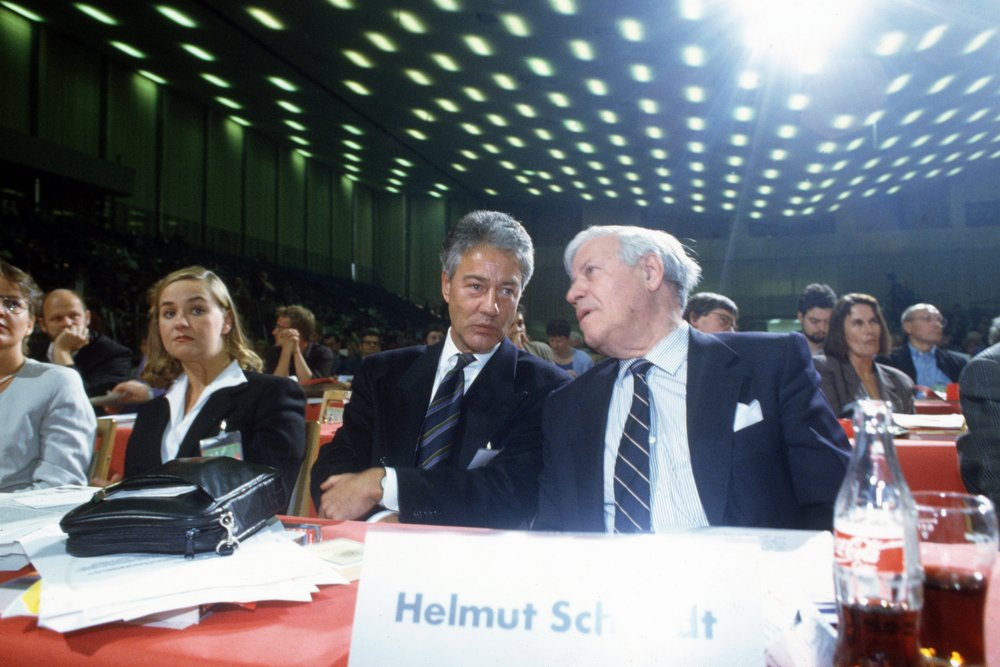
Bertold Brecht's poem "Questions of a Reading Worker" contains the lines: "Caesar beat the Gauls. Didn't he at least have a cook with him?" This expresses a simple truth that usually remains unspoken when looking at historically outstanding figures and which, although he was anything but a Caesar, also applies to Helmut Schmidt: in order to be successful, he needed people at his side who served him well, supported him and accompanied his political and journalistic work (sometimes critically). In our contemporary witness project, which began last year and will continue at least until the end of 2025, we are focussing on the men and women who are still alive and who were among his employees and companions.
Who are these people and what is their biographical background? What was their work like in the Chancellery or later in one of his offices in Hamburg, Bonn and Berlin, or at Die Zeit and other organisations in which Schmidt was active? What do these people know about him, his working methods, his personality and his network? We would like to find out through oral history interviews, which we will record and archive audiovisually. At the end of the project, we will present these interviews on the online indexing and research platform "Oral-History.Digital" (oh.d) and make them accessible for the purposes of historical research, media reporting and political education.
Research interests and aims of our project
We ask the interviewees to tell us above all what tasks and difficulties they had to overcome when working with Helmut Schmidt, what characterised his behaviour as a leader and what experiences were particularly formative or moving for them. We are also interested in what the people around him have to say about his understanding of politics, history, journalism or art. Last but not least, we would also like to find out from the interviewees what they did before working with Helmut Schmidt and to what extent the years spent with him were formative for the rest of their lives.
The stories and assessments of contemporary witnesses are valuable sources. They open up new insights into areas of Helmut Schmidt's thoughts and actions about which little is known. At the same time, we are documenting and opening up the biographies and perspectives of the people who worked for him. Honouring their work and achievements is also an important aim of this contemporary witness project. Through the oral history interviews, we want to create a polyphonic and exciting space of memory and preserve it for posterity. In this way, we also promote the reconstruction of historical contexts and processes.
Insights into the first interviews
We have already conducted eight oral history interviews in Hamburg, Berlin, Bonn and Lübeck. The collection is set to grow to around 25 interviews by the end of 2025. We spoke to Thilo von Trotha, Petra Rosenbaum and Uwe Plachetka, among others, who were part of the speechwriting team at the Federal Chancellery and later on the staff of the former Chancellor's Office. Our most prominent interviewee so far has been an important political companion of Helmut Schmidt: a few days after his 85th birthday, we were able to interview former Minister President Björn Engholm, who was a member of the social-liberal federal government as Federal Minister of Education and Science in 1981/82 and SPD Chairman from 1991 to 1993.
The interviewees told us fascinating stories and experiences. Our interviewees unanimously admired the incredible knowledge that Helmut Schmidt possessed in so many areas and his tireless curiosity, which drove him to the end of his life. They were equally fascinated by his rhetorical brilliance, which was unrivalled. Without taking anything away from Schmidt's great abilities and merits, the interviews also address some critical aspects: his lack of understanding and empathy for the younger generation, his controversial statements about his time as a soldier in the Wehrmacht during the Nazi dictatorship or his occasionally overly coarse manners.
Samples to watch and listen to
There's no doubt about it: Helmut Schmidt was a boss who demanded an extraordinary amount. His employees not only had to work with extreme precision, but were often called to late-night meetings or even required to play chess at 1 or 2 o'clock in the morning. However, there are also reports of a family atmosphere that prevailed, especially at gatherings in the Schmidts' home in Neubergerweg, which was created by Loki Schmidt in particular, for example when she served soup for everyone at midnight.
Björn Engholm can tell you a thing or two about how Schmidt always wanted to know everything in detail. As a minister, he once had the thankless task of having to present a comprehensive higher education bill to the federal cabinet in just seven minutes. You can see what he experienced in this interview extract. You can watch and listen to further samples from the interviews already available here. One thing becomes very clear: although he demanded an enormous amount from them, our contemporary witnesses still feel closely connected to Helmut Schmidt to this day, and they feel joy and gratitude for having served him.