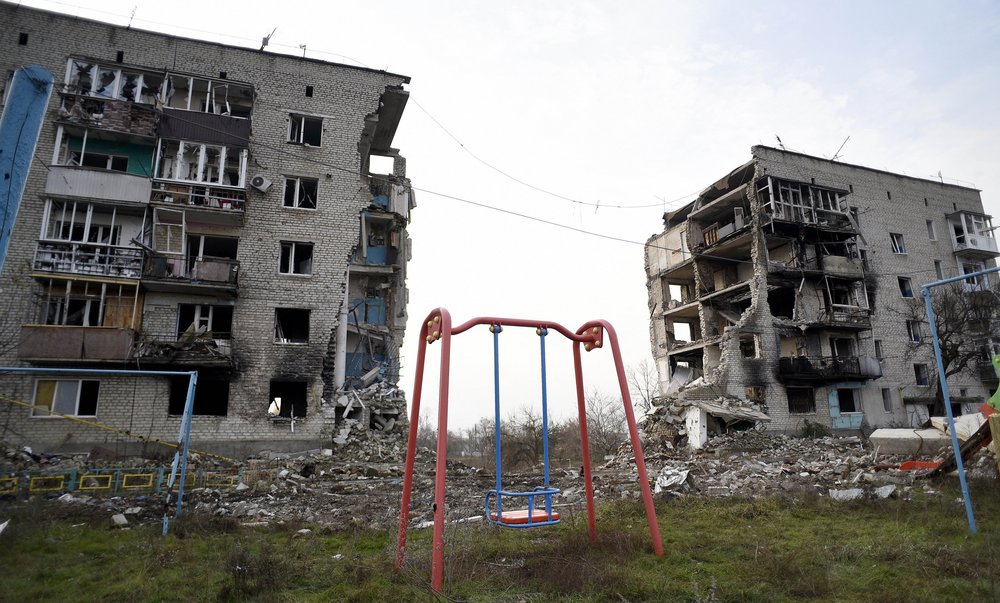
Today marks the second anniversary of Russia's widespread attack on Ukraine. The attack has brought unimaginable suffering to the Ukrainian people. The United Nations (UN) recently counted almost six million refugees in Europe, four million internally displaced persons and 15 million Ukrainians in need of humanitarian assistance. The UN has also documented numerous war crimes committed by Russian troops, including torture, sexualised violence and the forced abduction of children. Even if the number of war dead is never easy to determine, all internationallyrenownedconflict databases assume that the war in Ukraine is currently one of the world's deadliest conflicts.
But not only the war in Ukraine, but also the terrorist attack by Hamas on Israel and the war in the Gaza Strip, as well as the escalating violence in countries such as Sudan, Yemen and Myanmar, mean that the number of war deaths has risen worldwide: The number of wars worldwide is at an all-time high - and the number of people dying in these wars is higher than it has been for 30 years. According to one estimate, one in six people in the world currently lives in an active war zone.
Why it is so difficult to end wars
If wars are becoming more frequent, it is also becoming increasingly difficult to end them. The last major UN peacekeeping mission was deployed in 2014. Many internationally mediated peace processes, such as in Syria, have collapsed in the last decade.
There are many reasons for this development. These include Russia's and China's ambitions to become great powers and growing geopolitical conflicts that make multilateral compromises more difficult. In addition, countries such as Germany - which have been particularly active in promoting peace in the past - are increasingly confronted with domestic crises. This includes the rise of right-wing extremism. In Europe, the security interests of many states have also changed since the so-called "refugee crisis" in 2015, with border protection, migration control and counter-terrorism recently being prioritised over peacebuilding in countries of less strategic importance. And finally, the return of the Taliban to power in Afghanistan was a clear sign that the time when people thought they could promote peace according to the Western model was over.
What's more, wars are changing. They are becoming more complex. In more and more countries, warring parties are fighting in different, sometimes overlapping conflicts with local and national interests. Or they receive support from outside, for example from powers such as Iran or Saudi Arabia. Wars are also increasingly being fought using hybrid means such as disinformation campaigns. This is not new in itself - but what is new is the speed and extent of dissemination, which is favoured by the use of social media and artificial intelligence.
Smaller targets for the moment
Do international actors simply have to watch the escalating war violence from the sidelines in the face of these massive challenges? No, even if experts say that they need to pursue smaller goals at the moment. These include protecting and supplying the civilian population, documenting war crimes and long-term planning for the reconstruction of post-war societies - such as the Ukraine Recovery Conference, which will take place in Berlin in June 2024.
This is all important, but cannot be equated with truly sustainable conflict resolution. A new report, which we published this week together with the Friedrich Ebert Foundation, outlines what is needed for this in the future. The report is based on contributions from the Global Expert Group on Conflict Resolution and Peacebuilding - a network of leading representatives from academia, civil society and politics who themselves come from conflict countries - as well as numerous interviews and an evaluation of the current state of research.
A fundamental rethink is necessary
We show in the report: The crisis in peacebuilding is not only due to current challenges, but also to past mistakes. Afghanistan was not the first country to show that the international interventions of the last 30 years have had few unqualified successes. One reason is that peace has too often come "from above" and "from outside". Peace treaties were negotiated by heads of government and rebel leaders, but civil society organisations, opposition parties or victims' representatives were usually left out. After the treaties were signed, peace processes were often implemented by international organisations whose employees lacked knowledge of a country's history and languages. As a result, peace was often poorly adapted to the needs of the people on the ground - and international actors have to contend with dwindling legitimacy.
One example: there is an anecdote about the US administration of George W. Bush, which developed a strategy of "de-Baathification" - the removal of high-ranking representatives of the Baath Party from their posts - after the fall of Saddam Hussein in Iraq in 2003. The USA is said to have modelled itself so closely on denazification in Germany after 1945 that the word "Germany" mistakenly appeared in the draft of the US strategy. This is one of the most tangible examples of how peace in the world has been promoted "from the outside" and according to Western templates over the past three decades.
So the phenomenon is not new. But the global frustration over the perceived double standards of Western countries in their handling of the war in Ukraine compared to their handling of other wars will be a new reference point for old doubts about the legitimacy of international interventions. In order to address the mistakes of the past, a fundamental rethink must first take place in European capitals before strategies, guidelines or project objectives are revised. The key questions in the near future must be: What can realistically be achieved, by whom, when and where? What can a shift towards more pragmatic peacebuilding look like that does not end in a complete withdrawal? And how can the urgently needed contextual knowledge of conflict countries and the analysis of sub-national drivers of conflict in these countries be strengthened in government work in order to develop better and, above all, country-specific strategies?
No blueprints, but reliable funding
So there are no blueprints on how to end wars that always work everywhere. That is one lesson from the past. Another is that peace is not a project for a few years, but one for generations - and requires reliable funding.
However, the high level of attention in Europe on Ukraine has further exacerbated existing funding gaps in countries such as Afghanistan and Syria. This has consequences for the people on the ground - but also for politicians, as it is an accelerant for debates about Europe's lack of reliability. Because wars are also increasingly taking place in countries that are affected by other crises (such as climate change), politicians must continue to break down silo thinking in individual policy areas and mobilise resources across departmental logics in order to find lasting solutions. This is also a demand in the interim report of the Enquete Commission on Afghanistan, which speaks of "departmental egotisms".
In addition to selectively tackling acute drivers of conflict, structural causes of conflict must also be targeted more comprehensively, for example by focussing expenditure more than in the past not only on short-term but also on long-term goals. From this perspective, cutting funding for development cooperation and humanitarian aid in the 2024 federal budget is not a good idea as it runs counter to the growing global need.
The report "New perspectives: Peacebuilding and Conflict Transformation in a Changing World Order" in English and a German summary can be found here.