
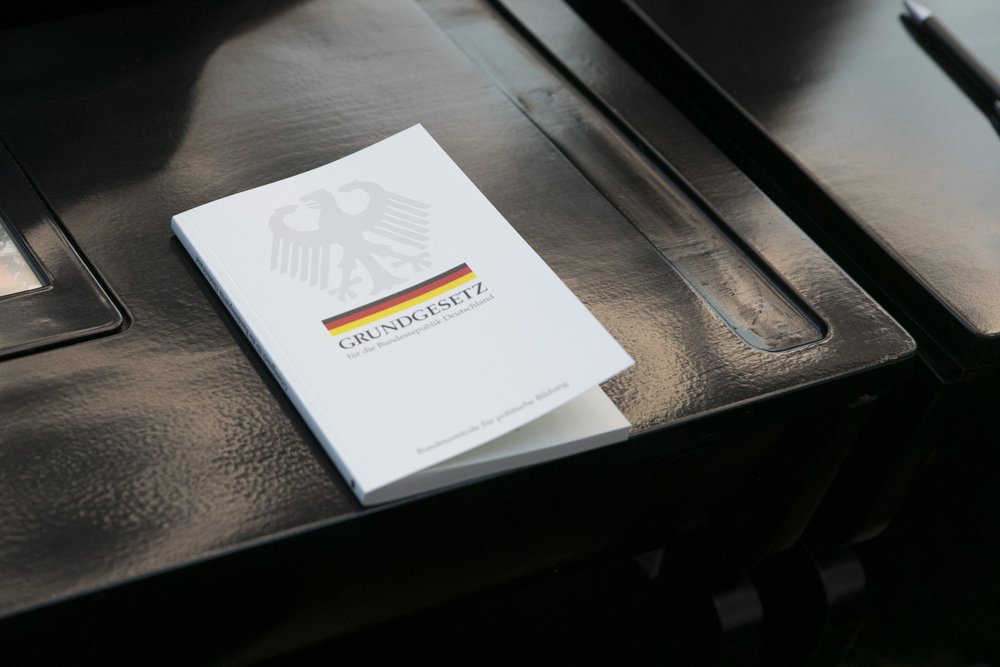
75 years ago, the founding fathers and mothers of the Basic Law wrote a constitution whose first 19 articles were intended to form a bulwark against the enemies of a free and democratic basic order. The background to this experience was the "breach of civilisation" of the National Socialist dictatorship. The "Führer state" systematically abolished political freedoms and, in the course of its rule, continually expanded the circle of those persecuted on "racial", political and other grounds. The regulations passed on 23 May 1949 therefore also formulated far-reaching protective rights for individuals against arbitrary state action. The Federal Constitutional Court (BVerfGE), established in 1951, later stipulated that these fundamental rights must be applied in the interpretation of the entire legal system. Today, fundamental rights therefore extend far into private (legal) relationships between citizens.
An age has passed since the Basic Law was adopted. However, most commentators from the media, law and history agree that the text still reads surprisingly fresh and modern today - at least in those parts that have remained virtually unchanged. However, it has almost doubled in size. Much has been added, and some of it reads as detailed and complicated. Significant changes included the defence constitution (1956), the emergency legislation (1968) and the extension of the area of validity of the Basic Law to the then "new federal states" following German reunification (1990).
"A framework that everyone continues to work on perfecting"
There are constantly new demands and initiatives to extend the provisions of the Basic Law. These include the inclusion of children's rights in the constitution, the concretisation of the principle of the welfare state and the deletion of Article 15, which allows the socialisation of land, natural resources and means of production under certain circumstances. Amendments to the Basic Law require a two-thirds majority of the Bundestag and Bundesrat, which is a relatively high hurdle. Upon request, any German can have the constitutionality of laws reviewed by the Federal Constitutional Court.
Helmut Schmidt also frequently emphasised the great importance of a living constitution. On the occasion of the 30th anniversary of the Basic Law in 1979, he warned that it was a "framework on whose perfection everyone must continue to work". The introduction of the right to "informational self-determination" (1983) is considered a successful example of this. This adapted the rights of citizens to the new circumstances in the face of "new media" (still unknown in 1949) or electronic data processing.
Political work in parliament is generally characterised by controversial debate in which the parliamentary group that achieves a majority prevails. Compromises often have to be reached. Despite all the disputes about positions and issues, the values of the Basic Law as a common working basis no longer appear to be uncontroversial. This is evidenced, for example, by the polemics of far-right forces against an allegedly synchronised "lying" or "system press" or against a policy that no longer represents the interests of a supposed "silent majority" of Germans. Events and decisions (not only) in Poland and Hungary, where the principles and practices of the rule of law have been or are being systematically overridden in some cases, show that statements and threats, including those made by well-known politicians from the Alternative for Germany (AfD), should be taken seriously in this context.
This is another reason why experts from the fields of law, media and politics are currently discussing whether the Federal Constitutional Court, in particular, should not be better protected as the guardian of the constitution. For example, a simple majority in the Bundestag would be enough to overturn the practice of appointing judges or otherwise attack the practice of "checks and balances" of the free and democratic basic order. A number of proposals are on the table to prevent this. However, due to the hardened fronts between the coalition and opposition in the Bundestag, new regulations requiring a two-thirds majority of votes currently appear difficult to implement.
The Basic Law: a defensive constitution
At the same time, there are encouraging developments: These include the replacement of the old government in Poland by a broad political alliance. This clearly shows that a democratic state cannot be abolished overnight and against the will of a majority of the population. And examples from history show that the Basic Law is also a defensive constitution: for example, the Socialist Reich Party (1952) and the Communist Party (1956) were banned as political organisations that were identified as anti-democratic by the responsible BVerfGE Senate. Such a ban is also being discussed with regard to the AfD, which is partly far-right. However, the developments surrounding the legal proceedings against US presidential candidate Donald Trump suggest that such a move would strengthen rather than weaken the party and its camp.
To mark the 75th anniversary of the Basic Law, Helmut Schmidt University/University of the Federal Armed Forces in Hamburg and the Institute of Contemporary History Munich-Berlin are organising a workshop in cooperation with the Federal Chancellor Helmut Schmidt Foundation. On 14 and 15 March, academics will present their findings at the event "The Open Constitution. The Basic Law in the History of the Federal Republic of Germany after 75 Years", academics will discuss the spirit and practice of individual provisions throughout the history of the Federal Republic. More recent research work will be discussed that deals with the stability, change and acceptance of the German constitutional order.
Interested guests are very welcome. Please register via .