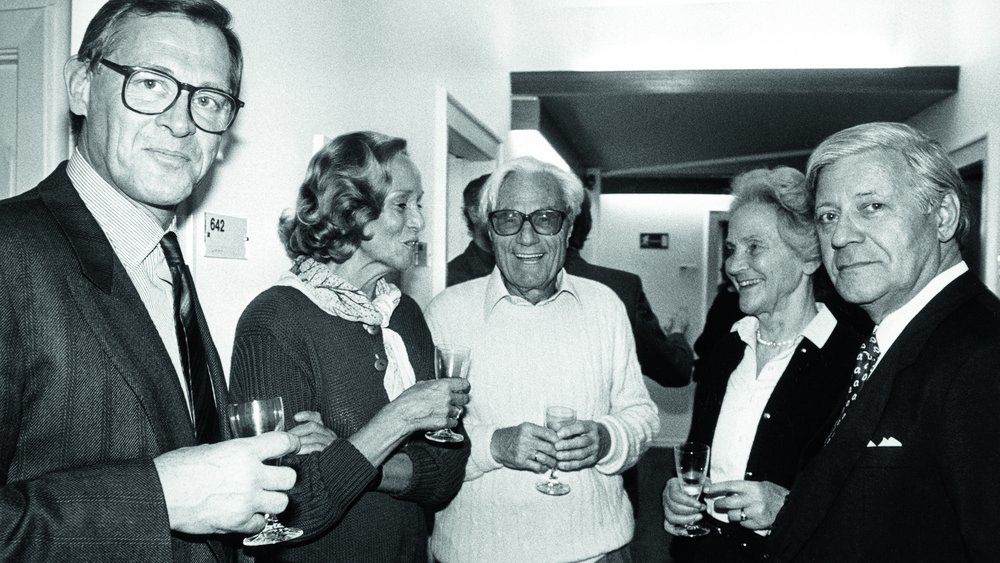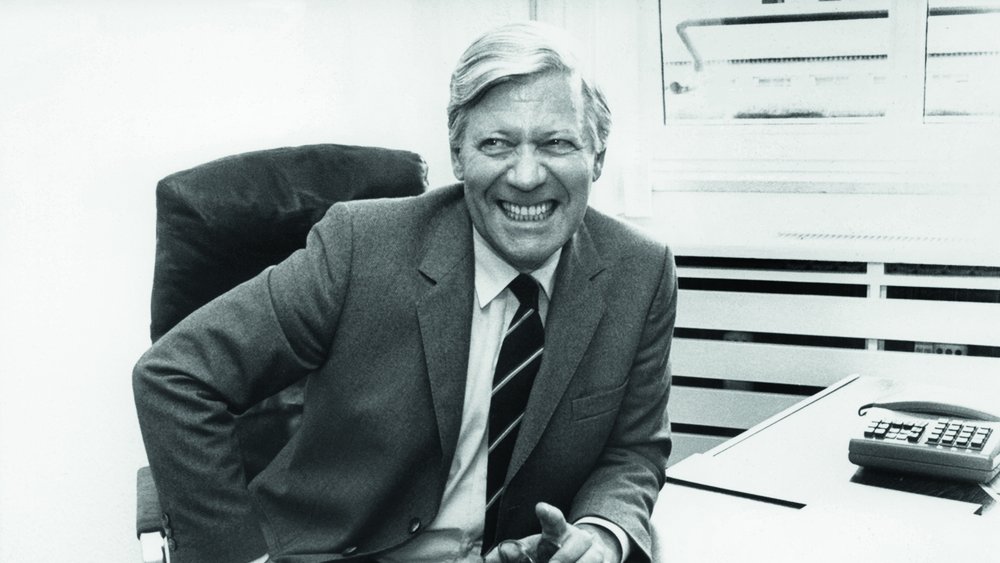
His name is still visible today, but his role as an important publisher is only known to a few people. He was born 120 years ago on 19 May 1906 in the Prussian town of Hamm in Westphalia in the German Empire, studied law in the Weimar Republic, lived through National Socialism under repression and adaptation, and his Jewish wife emigrated to England. He survived the period as a lawyer specialising in commercial criminal cases and as in-house counsel for a Hamburg company specialising in makeshift buildings.
After 1945, he became a sought-after man for the British military administration, worked for six months as a building senator in a destroyed Hamburg, was one of four licence holders of the first democratic weekly newspaper, found his political home in the CDU because he felt Kurt Schumacher's SPD was too nationalistic, became a Hamburg deputy in the Frankfurt Economic Council and in 1949 entered the first German Bundestag as a deputy, where he served for three full terms.
The man who ultimately owned Die Zeit and remained associated with it for half a century was Gerd Bucerius. For the last twelve years of his life (he died in 1995), he appointed Helmut Schmidt as co-editor of the weekly newspaper Die Zeit, from whom he also expected many good articles.
The years in the young Federal Republic
Gerd Bucerius was also a Christian Democrat politician for 16 years, from 1946 to 1962. Best known from this period is his rather unusual resignation from the CDU parliamentary group in 1962, combined with his resignation from the CDU because of a controversial Stern article - although the annoyances felt by Chancellor Adenauer dated back to earlier years. One story stands out in particular: the "Bucerius campaign" of 1956.
In the 1950s, the western part of divided Berlin played an important role for Bucerius in two respects. Business-wise, because he took a financial stake in the Ullstein publishing house, which was visibly in decline, as he wanted to open up "the zone" from Berlin in terms of publishing if the "Soviet-zone" government in East Berlin lost its power. Politically, because Bucerius held the office of Federal Commissioner for the Promotion of the Berlin Economy from 1952 to 1957 - and was, so to speak, Adenauer's envoy without a ministerial portfolio. In addition to a number of high-profile initiatives to promote ties with West Berlin, such as the kilometre markers erected on West German motorways bearing the likeness of the Berlin Bear or the Berlin Weeks in major West German cities under the motto "If you buy something, think of Berlin", the "Bucerius Campaign" overshadowed all of this.
The conflict over Berlin
With his "Aktion Berlin", Bucerius wanted to elevate the old imperial capital, which no longer existed, to the status of the federal capital. To this end, on 16 October 1956, he submitted a motion by the CDU/CSU parliamentary group to move the seat of the Bundestag and the leading federal bodies to Berlin, which were to take up their work on 1 May 1957. That was a bombshell. Preparing the ground more subtly, Bucerius wrote to the Chancellor on 29 September: "If you would suggest to the Bonn City Council that in future all letterheads be provided with a footer (in the smallest font) with the text: Bonn is the provisional capital of the Federal Republic. Berlin will be the capital of reunified Germany." The letter culminated in the suggestion that the Federal Chancellor should also travel by car from Bonn to Berlin via the "zone border" in Helmstedt. Apparently Bucerius could not imagine that the Soviet zone began behind the Elbe for Adenauer and appeared to be impassable.
In his letter of 29 October to Adenauer, Heinrich Vockel, the plenipotentiary of the Federal Republic of Germany in Berlin, assessed "Aktion Bucerius", which had been launched as "Aktion Berlin": "All of Berlin's newspapers welcome Aktion Bucerius. He is described as 'the hero of the week'. It is impossible to criticise the Bucerius campaign from here." The international situation seemed threatening, as the Hungarian uprising had broken out on 23 October 1956, which was followed with great sympathy, not least by the population in West Berlin. Even in the eastern part of the city, three years after the uprising of 17 June, there were quite a few sympathies among non-SED friends, but these could only be shown subtly and covertly.
Vockel wrote another letter to the Federal Chancellor stating that, according to a legal opinion, declaring Berlin the capital of the Federal Republic would be contrary to international treaties. In addition, Vockel recommended between the lines that Bucerius be removed from the trusted office of Federal Commissioner. They did not want to go that far, but US Ambassador James Bryant Conant and CDU/CSU parliamentary group leader Heinrich Krone also rejected the upgrading of Berlin to the status of federal capital. The Governing Mayor of West Berlin, Otto Suhr, introduced a resolution in the Berlin House of Representatives on 30 October "that it is welcomed that the German Bundestag wants to realise Berlin's demand to expand the German capital Berlin in order to be able to relocate federal bodies here in the near future" To Bucerius' ears, that would mean referring to the day after tomorrow. But that was fine with the Chancellor, who responded negatively to the "Berlin Action" and did not want any further activities: "It is clear that it is doubly necessary, especially in the current critical situation, to maintain the coherence of government business undiminished." So everything remained in its place. On 4 November 1956, the Hungarian uprising was crushed and the new pro-Soviet government under János Kádár was installed. The following year, Bucerius' position as Federal Commissioner ended.
His life's work: publisher
More than 30 years later, in 1988, the 82-year-old Gerd Bucerius said in retrospect: "[...] I only realised one thing: politics is always an adventure. If you want to become something in politics, strive for a certain position, you'll never get it. You have to work diligently, intensively, make yourself useful everywhere and suddenly you're told, oh, that's him, he's suitable for this and that position. [...] If you want to be at the top [...] then you have to sacrifice your life." Bucerius was not prepared to make this sacrifice. His goal in life was to make a living as a publisher, developing newspapers and magazines: "Becoming something in politics never crossed my mind."
After his retirement in 1962, he took the lead in founding the publishing house Gruner & Jahr in 1965, the second-largest German press publisher at the time after Axel Springer, later acquired a stake in the up-and-coming company Bertelsmann, kept his "favourite child", Die Zeit, and established the ZEIT Foundation in 1971, which, as his universal legacy, is now one of the most important German foundations. He had done everything right. And the fact that Bucerius brought Helmut Schmidt to Die Zeit in 1983 may have been due in part to the letter he wrote to Stern editor-in-chief Henri Nannen in 1969: "My office is sending you two books: H. Schmidt's 'Strategie des Gleichgewichts' and Kahn's 'Die Russen kommen nicht'. You should definitely read Schmidt. It is the best, most instructive book on the political world situation and Germany's position in it. Written simply and therefore brilliantly. It shows an extraordinary ability to differentiate and a critical distance. Noblesse against political opponents. Not at all the Schmidt you think you know."
Gerd Bucerius was characterised by great personal commitment to a cause, fairness towards his political opponents and respect for the lifetime achievements of others.