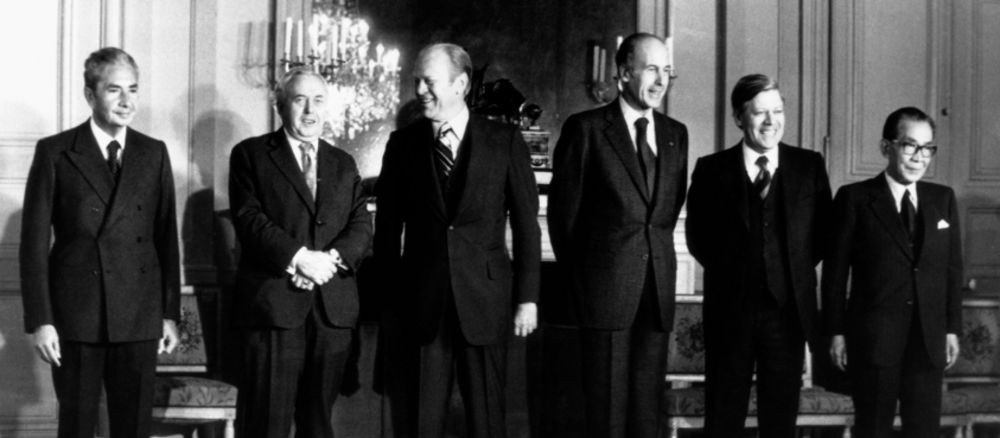
Fifty years ago, two convictions were at the origin of the world economic summits that are known today as the G7 format. Firstly, politics needs trust and reliable commitments, based on personal acquaintance and possibly even sympathy between the personalities involved. Genuine friendships, on the other hand, rarely develop in the political arena; in most cases, they are merely functionally invoked in political circles and also inflated by media coverage. The second conviction arose in 1975 from the realisation that the questions of the future in the the late 20th century could not be answered within the narrow confines of the nation state. Instead, European answers and global initiatives were increasingly needed, particularly in the fields of economic, financial and security policy.
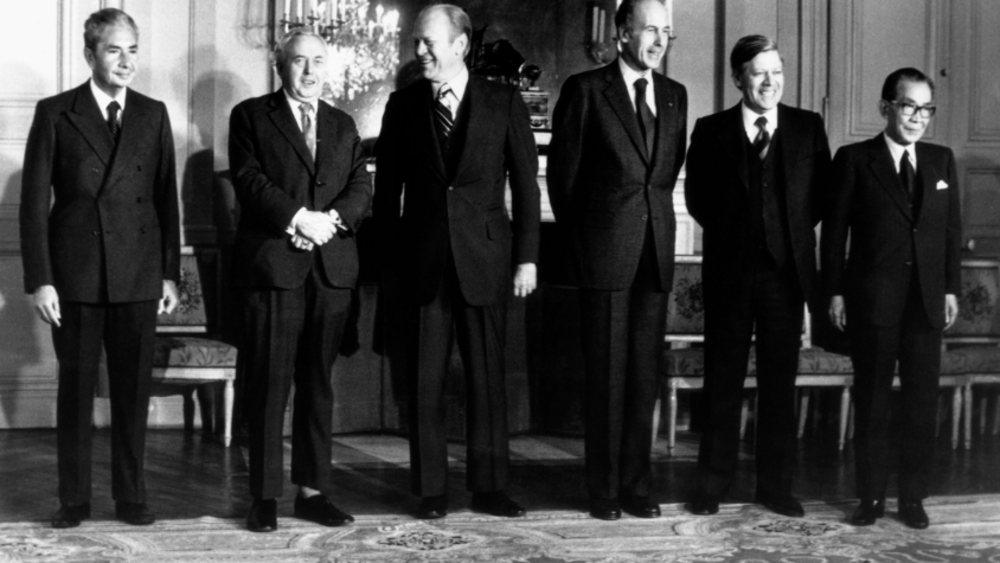
The idea of inviting the leading industrialised nations to annual world economic summits originated with Valéry Giscard d’Estaing and Helmut Schmidt. France’s President and Germany’s Chancellor did indeed have a friendly relationship and they appreciated each other’s political reliability. The first World Economic Summit took place from 15 to 17 November 1975 – in the first year without Canada – as the G6 at Rambouillet Castle near Paris, conceived as a forum for international crisis management. In addition to the two initiating states, the USA, Great Britain, Japan and Italy were also represented.
Conquering the Himalayas: Summit preparation by Sherpas
The G6 summit was prepared by a small group of Sherpas. Just like climbing Mount Everest, all participating heads of state and government were literally guided to the summit. As with high mountain expeditions, absolute reliability and mutual trust were also central to the summit preparations. Long-standing companions, whose expertise was beyond doubt, were particularly recommended for this task. The moderating, pioneering and gate-keeper function of the Sherpas in the run-up to the world economic summits, whose problems were comparable to Himalayan ascents in view of their complexity and interdependence, was of great importance from the very beginning. Currency turbulence, rampant inflation, the oil price crisis, rising unemployment and the world food situation were the predominant issues in the 1970s. Development policy, now a fixed element of G7 meetings, mostly led a shadowy existence during Schmidt’s time as Chancellor, apart from the 1982 World Economic Summit in Versailles, which responded to the recommendations of the North-South Commission.
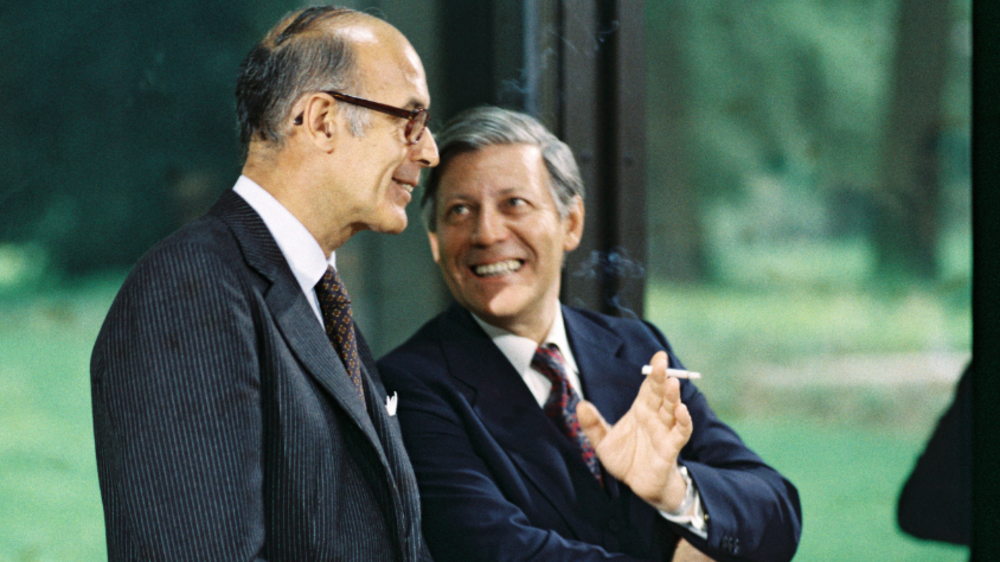
Helmut Schmidt and Valéry Giscard d’Estaing had already got to know and appreciate each other as finance ministers of their respective countries. As Federal Chancellor and President respectively (both since 1974), they expanded the axis between Bonn and Paris, strengthened the European Community and also cultivated a common understanding of foreign and economic policy, for which they developed international action strategies. Although the concept for the world economic summits was the result of a division of labour, Schmidt allowed his French partner to take the lead in public, as the choice of venue showed. As Chancellor of the West German state founded after the Second World War, Schmidt had no doubt that France, as a nuclear power and with a permanent seat on the UN Security Council, had a far stronger international standing than the Federal Republic of Germany.
Summit routines and negotiation results “without jacket and tie”
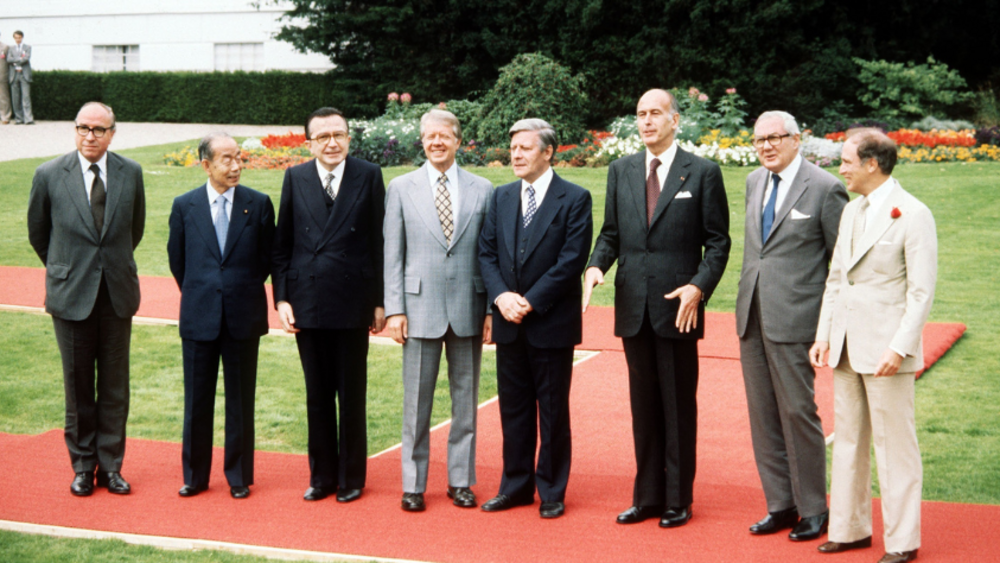
Particularly in the early years of their existence, the world economic summits offered a protected atmosphere for confidential talks, during which – as historical photographs show – the heads of state and government sometimes took off their jackets, loosened their ties or even wore a jumper. These may be outward appearances, but the deviation from the usual dress code in politics at the time also illustrates the spirit of the consultations.
As German Chancellor, Helmut Schmidt was able to assert his approach to economic stability policy at the G7 summit in London in May 1977. The countries with a strong balance of payments were to ensure a sustainable growth process and a reduction in unemployment, while the countries with a negative balance of payments were called upon in the final communiqué to concentrate on curbing inflation. The summit participants also endeavoured to help the “Conference on International Economic Cooperation”, which has been meeting in Paris since 1975, to achieve a positive outcome.
The venue and chairmanship of the World Economic Summits changed from year to year. On 16/17 July 1978, the G7 countries met in Bonn. At the beginning of the month, Germany also took over the rotating presidency of the Council of the European Community. Helmut Schmidt knew how to utilise this official influence on behalf of the Federal Republic, was at the height of summit diplomacy and moved about the international stage with his usual routine. “The global economy is our destiny” – Schmidt coined this motto for the 1970s, based on a phrase coined in 1921 by Walther Rathenau, who had been Minister of Reconstruction and then Foreign Minister of the Reich after the First World War. For Schmidt, the crises he was confronted with as Finance Minister and immediately afterwards as Federal Chancellor resulted in a duty to act responsibly and with foresight. He was not only concerned with restoring economic security and promoting growth. Rather, he also had the social dimension of international economic policy in mind, even if it was not his primary concern.
From a problem-solving machine to politically ineffective summit shows?
It would be too simplistic to idealise the first G7 summits as highly efficient problem-solving machines and to only note deficits for the meetings in our political present, to disqualify them in toto as “summit shows”. Even during Schmidt’s time – followed by the summits in Tokyo (1979), Venice (1980) and Ottawa (1981) – not everything went smoothly, with the sherpas initially wrangling over formulaic compromises, sometimes even over a comma in the final communiqués prepared before the start of the summit, in order to minimise the potential for conflict among the heads of state and government. The fact that Jimmy Carter took office as US President in January 1977 did not make things any easier for Schmidt. Together with his close partner Valéry Giscard d’Estaing, he considered Carter unsuitable to fulfil the office of President, especially as the successor to Gerald Ford, whom Schmidt held in high esteem, lacked any foreign policy experience. However, the 1982 World Economic Summit in Versailles, by then the US President was Ronald Reagan, was also characterised by European-American differences regarding monetary and interest rate policy, and was also only able to cover up other differences with difficulty.
Idealisations are therefore misplaced, if only because the G7 states are now faced with a changed world situation and the complexity of the numerous crises that need to be dealt with simultaneously has increased. With the rapid implementation of sanctions against Russia and the delivery of weapons to Ukraine following the attack on 24 February 2022, which violated international law, the G7 members sent a strong signal for international cohesion among democracies. However, the concerns of the Global South are still being treated rather peripherally by Western industrialised nations. The growing economic and therefore also political power of China poses a further challenge, and dealing with the sometimes divergent interests of the other BRICS states leads to new, additional questions. This makes the G7 summits all the more relevant: as a multilateral dialogue and negotiation forum with the power to set the agenda and a governance structure that is now far-reaching, is active throughout the year and, in the best-case scenario, ensures that politically virulent issues and problems are dealt with on an ongoing basis.