“Five tips for healthy coping”, “My coping mechanism? Memes and denial” or “Not me buying a little treat for coping – again!”: There are thousands of posts on social media in which young people – sometimes serious, sometimes joking, sometimes resigned or cynical – talk about which strategies help them to cope with the seemingly never-ending crises of the present. The English term “coping” has long become part of everyday German. This means that another word from psychology has entered our everyday lives. This trend towards “therapy-speak” can be criticised for many reasons. At the same time, it should give us pause for thought when an entire generation attempts to dissect their everyday lives – whether seriously or with a wink – using psychological terminology. Something seems to be amiss.
Instead of asking whether the young generation, who have already suffered massively from the social consequences of the coronavirus pandemic as children or teenagers, are perhaps simply being asked to do too much, they are often spoken of disrespectfully and the mothballs of generational clichés are dug deep.
Devaluation instead of recognition
Too self-centred, too demanding, too sensitive and not resilient enough – these are the more benign descriptions of young people. The old narrative of the “effeminate” and “lazy” youth is also regularly used and linked to the insinuation of a declining willingness to perform. Yet these patterns are by no means new. Almost every generation devalues the next at some point. However, the myth of “lazy youth” is often simply wrong. For example, the labour market participation of 20-24 year olds is currently higher than it has been for a long time. Nevertheless, this image is ritualised in populist rhetoric in the debate on working hours. This form of downward age discrimination is particularly fatal, as it distracts from the fact that it is actually worth seriously questioning the resilience of young people.
Generation Crisis
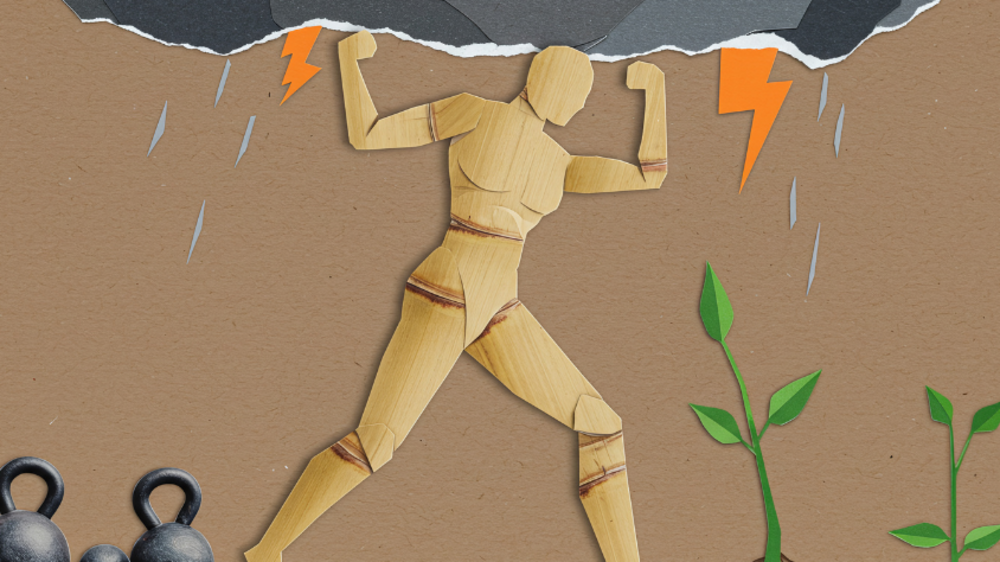
An increasingly challenging entry into the world of work, climate crisis, exploding housing costs: the fact is that a lot is demanded of the young generation today. As a vulnerable group with little to no political representation, they are particularly affected by the overlapping crises of the present and often feel powerless. The term “Generation Crisis” has long since become a buzzword. Youth studies show that the psychological stress of young people is constantly increasing. This is not surprising: the conditions for developing stable resilience are actually much more difficult for a generation growing up in a globalised and digital world. Recognising this finding instead of making fun of young people’s coping strategies or dismissing their demands, for example with regard to the changing world of work, as presumptuous would be a first step. But anyone who takes the situation seriously must also ask who is actually responsible for the resilience of young people and what role young people themselves play in this.
Resilience can be learnt – but it’s not a magic word
Let’s start on a positive note: resilience can be learnt. It is not an innate characteristic. Resilience models such as the American Psychological Association’s “Road to Resilience” show many small steps that can be trained in the right environment, from self-care to social connections.
But “more resilience” cannot simply be demanded. Responsibility must not be outsourced exclusively to individuals to act and “function” in the interests of the larger, resilient group. This is particularly true for the younger generation as a part of society that is often marginalised in multiple ways. On the one hand, this would fail to recognise the political responsibility that has led to many young people finding themselves in this situation in the first place through various decisions. Secondly, the steps on the path to personal resilience cannot be learnt at the snap of a finger. There is also a common misconception: resilience is often equated with toughness or even invulnerability – a state that neither individuals nor societies can ever achieve. Resilience is not a magic word.
More than just “coping”
Even though the term resilience is in vogue, it is often misunderstood. A simple image to describe the simplest form of resilience is a spring that returns to its original state after great tension – in contrast to a sheet of paper that tears. But if you transfer this image to reality, it quickly becomes clear that resilience is more complex and goes far beyond mere coping capacities. Young people cannot necessarily deal with global crises such as climate change, the rise of authoritarian regimes or the threat of war intuitively on their own. Expecting them to develop healthy coping strategies on their own and at the same time train their ability to adapt and transform – steps that are essential for sustainable resilience – is unrealistic, unfair and not beneficial to society.
Resilience as a social task
Schools certainly have a key role to play in developing resilience. After all, they are places that reach almost all young people. However, they cannot take on the challenge alone. Even a separate school subject on “resilience” would not be enough. Education journalist Bent Freiwald writes in the magazine Krautreporter that it is much more about “organising coexistence in society in such a way that the majority of children do not already have to struggle with mental health problems”.
The resilience of young people is therefore a task for society as a whole and therefore also a political task. It can only succeed through the interaction of schools, extracurricular education, civil society, family and social networks if politicians create the framework conditions and begin to prioritise the needs of young people. Not only because physical, and therefore also mental, health is a fundamental right. The resilience of young people is also crucial for the survival of a democracy under pressure.
After all, a resilient democracy needs a functioning civil society: people who have a basic trust in democracy and at the same time critically scrutinise its processes, withstand tensions and participate in social discourse as active citizens. Losing young people for this task is fatal. However, those who are psychologically overburdened are rarely in a position to fulfil this task.
Young people as role models
And young people themselves? In the maelstrom of the polycrisis, they have managed – attention, therapy-speak – to develop the awareness to recognise and verbalise their situation and, at least in the digital world, to create spaces according to their needs. Something that many generations before her have not managed to do. Taken one step further, Gen Z’s demands, such as a four-day working week, are therefore rarely a result of work aversion, but rather a desire for an everyday life that offers space for mental health, social participation and therefore also for democracy.
This is quite resilient and deserves respect rather than devaluation. Perhaps the young generation should be turned into a role model rather than an enemy?