
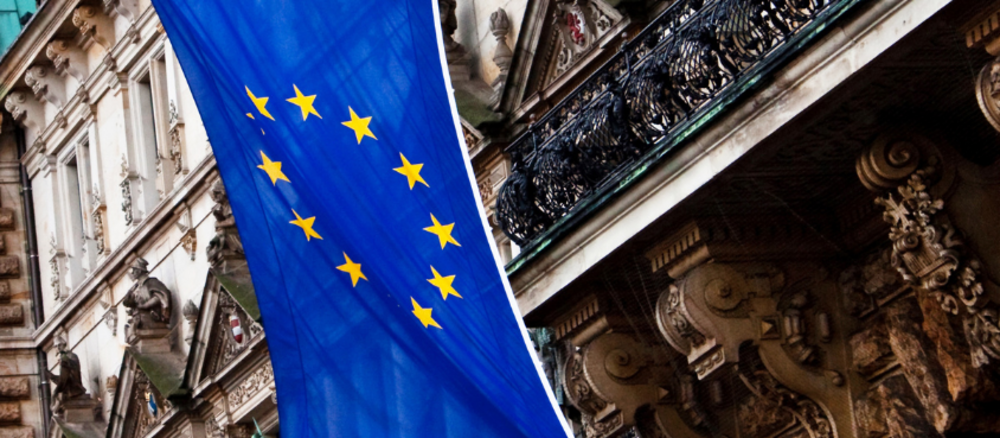
Unity and diversity are celebrated across Europe on 9 May. Europe Day commemorates the so-called Schuman Declaration of 1950, which laid the foundations for today's European Union. Together with 5 May, the founding day of the Council of Europe, these dates form the origin of the Europe Weeks, which take place every year in spring throughout Europe, including in Hamburg. The Hanseatic city has traditionally seen itself as a European city. As a world port, it has always been closely linked to its neighbours - politically, economically and culturally.
This European orientation is even enshrined in the preamble to Hamburg's constitution:
"As a world harbour city, the Free and Hanseatic City of Hamburg has a special task assigned to it by its history and location [...]. In the spirit of peace, it wants to be a mediator between all continents and peoples of the world. It promotes a united Europe and makes its contribution to a European Union that is committed to democratic, constitutional, social and federal principles as well as the principle of subsidiarity."
Accordingly, Hamburg sees itself as a mediator between peoples and is clearly committed to a united Europe. European integration has strengthened Hamburg in many respects. The common internal market, the dismantling of trade barriers and the introduction of the euro have contributed significantly to economic development. At the same time, the city also benefits from EU funding in a very tangible way: Hamburg has around 1.37 billion euros at its disposal for the period 2021 to 2027. The Senate Chancellery actively utilises EU funding, participates in European projects and develops its own initiatives in Hamburg. These projects aim to sustainably develop the city and improve the quality of life for Hamburg residents. Funding is provided for measures in the areas of climate protection, sustainable mobility, the circular economy and innovation, among others.
RescueME - climate protection on Neuwerk
The Hamburg island of Neuwerk in the Hamburg Wadden Sea National Park is at the centre of this project. Like many natural landscapes, it is not immune to the effects of climate change. With around 100,000 visitors a year, the UNESCO biosphere reserve is particularly challenged to harmonise nature and use. The EU project RescueME aims to protect natural and cultural heritage from the consequences of climate change. Together with partners from all over Europe and the local population, strategies are being developed on Neuwerk to make the island more resilient to extreme weather, rising water levels and other risks. Neuwerk serves as a model region in which concrete measures are trialled and further developed.
EU project DECISO - Utilisation of resources
As a densely populated urban area, the city of Hamburg faces the challenge of utilising resources efficiently and acting in accordance with the principles of circularity. Numerous sectors and areas offer potential for the circular economy - from construction, water management and waste management to the food industry, from start-ups to large-scale industry. However, financing remains a common challenge. This is where DECISO, which stands for DEvelopers of CIrcular SOlutions, comes in. As a pilot region, the city is working with European partners to develop new approaches to promote sustainable business models and facilitate investment. In the long term, the aim is to create a resource-conserving and climate-friendly city of Hamburg through a rapid transition to a circular economy.
AMIGOS mobility project
The EU project AMIGOS is committed to safe, environmentally friendly mobility in cities. In Hamburg, one focus is on journeys to school: Together with schools, parents and children, measures are being developed to make traffic safer and to strengthen children's independent mobility. In Hamburg-Bergedorf, for example, school travel plans have been drawn up for safer journeys to school. Measures have also been developed, implemented and evaluated in Eimsbüttel in order to defuse conflict situations between pedestrians, cyclists and car traffic, particularly due to pick-up and drop-off traffic in the school neighbourhood. In addition to such measures, car-free road sections are also planned in front of schools.
These examples show: Europe is not abstract in Hamburg, but can be experienced in concrete terms. Under the motto "Europe - On Course Together", this year's Europe Week programme in Hamburg shows how diverse and vibrant Europe is in Hamburg. It visualises the ways in which the European Union shapes life in the city and how joint commitment is created across borders. The BKHS is also involved in the Europe Weeks programme, for example with guided tours on Helmut Schmidt and Europe or with our interactive escape game on peace and security in Europe. You can find our full programme here.
To find out where else Europe is in Hamburg, you can use this overview map of the Info-Point Europe.