Following the first Arctic strategy in 2012, the EU updated its Arctic policy in 2016 and 2021. The current strategy is now based on three pillars: climate protection, promotion of Arctic communities and international cooperation. The aim is both to contribute to the Green Deal and to safeguard geopolitical interests. At the same time, the EU's role in Arctic governance is limited: It is merely an ad-hoc observer in the Arctic Council, the intergovernmental forum of the eight Arctic states.
It is striking that the strategy has not been adjusted since 2021 despite the Russian war of aggression in Ukraine, the NATO reassessment and Trump's re-election. In the language of seafaring, Europe's Arctic policy can be described as "tacking and bearing away": a safety manoeuvre in a storm in which the ship stops to sound out the situation - without a clear course for the onward journey. This is precisely the central problem of European Arctic policy. This inconsistency is highlighted below by taking a closer look at three dimensions of EU Arctic policy: the area of security and geopolitics, the subject area of the economy, energy and infrastructure, and the claim of a value-led policy.
Security and geopolitics
In terms of security policy, European Arctic policy is not failing due to a lack of commitment, but due to a lack of assertiveness.
In its strategy papers, the EU sees itself as a stabilising actor in the High North. The update of the Arctic Strategy 2021 marked an important step in this regard, as a strategic dimension was named for the first time in light of increasing Russian military activities. The EU thus cautiously broke with the principle of pan-Arctic cooperation established after the Cold War, which largely excluded military security issues. Despite the tougher security policy framework, the EU is sticking to the guiding principle of a "Low Tension Arctic", which is based on a rules-based order, multilateral cooperation and international law. The EU is striving for a stronger role in security issues, but continues to rely on cooperation, particularly with NATO.
In practice, this aspiration is increasingly clashing with reality. The EU has hardly any security policy competences of its own in the Arctic. Military deterrence, presence and strategic planning are the responsibility of NATO and are clearly led by the USA. Although this cooperation corresponds to the vision of a low-conflict Arctic, it does not reflect the geopolitical reality, in which internal contradictions and dwindling trust are weakening the alliance. Russia's militarisation, China's growing ambitions and the USA's territorial claim to Greenland require more than reactive action from the EU.
This is particularly evident in acts of sabotage against critical infrastructure. Between 2022 and 2024, the Nord Stream pipeline and data cables between Finland, Estonia, Sweden and the Baltic states were damaged several times. The EU's response was limited to situation analyses, coordination and official statements. Deterrence, surveillance and physical protection were the sole responsibility of national armed forces and NATO. The EU does not have its own operational instruments for preventive action or credible deterrence, which means that its ability to assert itself in terms of security policy remains severely limited.
Economy, energy and infrastructure
The EU wants to shape the Arctic economically, but without coordination its influence remains symbolic.
In economic terms, the EU is pursuing the goal of developing the Arctic as part of Europe's green transformation and strategic resilience. The region should contribute to the diversification of energy and raw material supply chains, particularly with regard to critical raw materials for the energy transition. EU funding programmes, the integration of Arctic regions into trans-European networks (TEN-T) and the European raw materials strategy underline the aim of combining economic interests with sustainability, climate protection and regional development. Infrastructure such as harbours, data cables and icebreakers are seen as the key to Europe's presence in the far north.
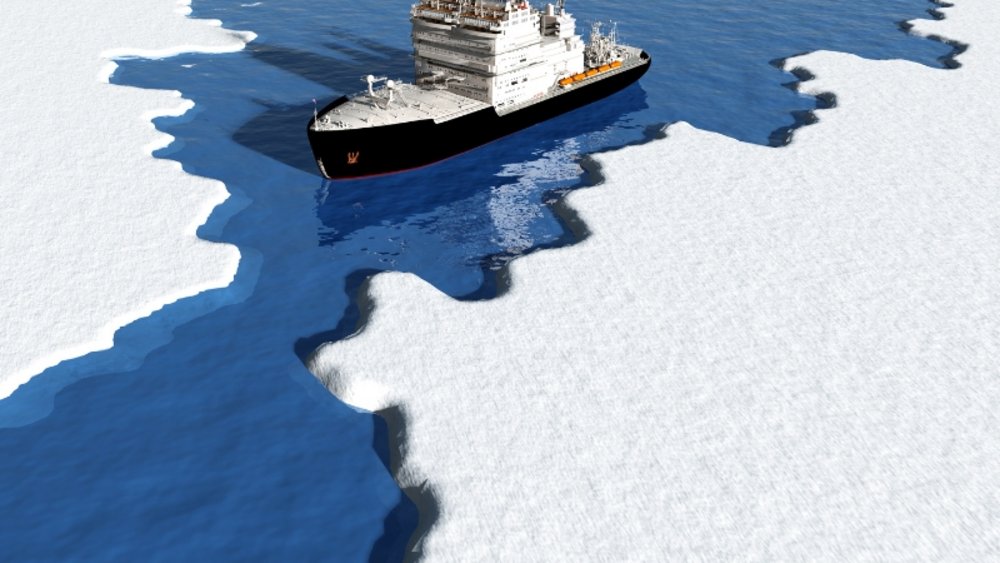
In practice, this claim remains fragmented. There is no coherent European industrial or infrastructure policy for the Arctic. Economic activities are primarily driven by national strategies and indirectly secured by the US security architecture. At the same time, Russia and China are making targeted, long-term investments in Arctic logistics, raw materials extraction and infrastructure. A particularly visible deficit can be seen in icebreaker capacities. While Russia has more than 40 icebreakers, including several nuclear-powered ones, and the USA is also expanding its capacities, Europe is reliant on a small number of national ships.
The limited realisation of its ambition is due less to a lack of objectives than to a lack of strategic coordination. The EU has neither a common financing strategy nor coordinated planning for key Arctic technologies. In addition, national economic endeavours often conflict with environmental protection interests, such as the expansion of the Kvanefjeld mine in Greenland. Joint European investment projects therefore remain the exception, which opens up additional room for manoeuvre in the Arctic for other powers such as China. The claim to strategic autonomy therefore remains largely symbolic.
Climate protection, cooperation and indigenous rights
It is precisely where the EU traditionally sees its greatest strength - in norms, values and cooperation - that a growing credibility problem is becoming apparent in the Arctic.
The EU is positioning itself as a normative power that combines climate protection, the protection of indigenous rights and international cooperation. It promotes scientific cooperation, relies on dialogue formats with Arctic communities and wants to include their perspectives in political decision-making processes. The Arctic is part of the EU's values-based foreign policy, in which environmental, human rights and multilateralism principles are intertwined. In its Arctic strategy, the EU also identifies climate change as the greatest threat in the region.
However, here too there is a clear gap between ambition and reality. The increasing competition for Arctic raw materials - such as rare earths, which are needed for the European energy transition - is in structural tension with climate protection and environmental conservation. A clear example of this is the planned mining project in Kuusamo, Finland, where economic interests, environmental and climate goals and the rights of the indigenous Sami people collide. The EU supports scientific studies, environmental requirements and dialogue formats, but cannot directly influence either the approval or the implementation. To make matters worse, the Arctic Council has been largely politically blocked since Russia's attack on Ukraine, meaning that key multilateral cooperation mechanisms are lying dormant.
To date, the EU has failed to capitalise on its civilian strengths and effectively implement a uniform and value-oriented Arctic policy through targeted investments in research and spatial monitoring as well as a coordinated approach at EU level. The EU's increasing focus on economic autonomy and securing resources raises the question of the extent to which operational guidelines explain its reluctance to enforce climate protection and protect indigenous interests and the extent to which economic interests are the decisive factor.
Outlook
In order to reconcile ambition and reality in the Arctic, the EU must recognise that the region is no longer a zone of cooperation, but part of hard power politics. Trump's transactional, nationally orientated foreign policy exacerbates this weakness, as norm-based appeals without their own means of power lose their impact. The EU is in danger of being doubly marginalised: dependent on the USA in terms of security policy and overtaken economically by more agile players. If it wants to be more than a normative bystander, it needs greater strategic autonomy and the dovetailing of climate, security and industrial policy.
The EU has announced that it will revise its Arctic strategy in the coming months. It is crucial to expand existing cooperation beyond NATO, for example in the areas of energy, raw materials, security and defence, with important partners such as Canada, Iceland, Norway and self-governing Greenland. In doing so, it must realistically assess its operational weaknesses, but at the same time actively shape the Arctic - ideally through the targeted and coordinated use of its civilian instruments: regulation, financing and science.
The entire BKHS Magazine #5 "Strengthening Partner Europe!", including the article by Fiona Kramer "Four Arctic Myths Debunked: Understanding the Arctic's Importance for Europe", is available online.