
Human security: the new norm?
Human security has been one of the central scientific concepts for researchers on international relations since the 1980s. However, they are also increasingly becoming an integral part of practical politics in Germany and worldwide. The Federal Foreign Office's guidelines on feminist foreign policy, for example, state that this "places human security more firmly at the centre of foreign policy action". The German government's first National Security Strategy also uses the term and at the United Nations, human security has been used for almost three decades to link development policy projects and peacebuilding. This interlinking of security and development policy is clearly recognisable in the policies of the German government. For example, the Federal Ministry for Economic Cooperation and Development (BMZ) has taken on important core tasks as part of the National Security Strategy, particularly in the area of crisis prevention and the prevention of potential threats.
The cross-departmental expansion of responsibility for security policy issues from the Ministry of Defence to the Federal Ministry of Economics to the BMZ is a logical response to the expansion of the concept of security. Security no longer only encompasses threats from physical violence from within and without, i.e. physical integrity. Rather, the understanding of security has expanded to include global threats.
From state security to human security
The concept of human security is used in a variety of policy areas, from foreign policy to economic and climate policy. The central idea is that securing the nation state is no guarantee for the security of citizens and people worldwide. Human security means an expansion of the issues that are understood as threats to the security of people, the necessary means to achieve this security and the actors who would need to act. Newly defined threats, such as poverty, resource scarcity or epidemics, are not tied to nation states but are globally linked.
The threats are also mutually dependent. Food insecurity and environmental pollution increase health risks, while state mismanagement and poverty are also a catalyst for armed conflict in many parts of the world. The global interdependence of dangers has been clearly observed in recent years and will be explained using three specific examples.
Pandemics do not stop at national borders
The Covid-19 pandemic has exposed the vulnerability of global trade chains like few crises before it and highlighted the drastic consequences of restrictive policies in favour of national interests. While rich countries stockpiled vaccines against the virus, only 32.9 per cent of the population in low-income countries have received one or more doses to date.
Instead of recognising the pandemic as a global challenge to human security, every country tried to find a national solution to a health policy problem - and failed. The dominance of power-political considerations and economic concerns about the negative consequences of temporarily suspending patent protection won out over a forward-looking and humanitarian policy. If the international community had focused on the fastest possible immunity at a global level from the outset instead of prioritising the situation at home, the pandemic would probably have been brought to an end sooner. The Covid-19 pandemic shows the need to understand security globally like no other event in recent years.
Respect for human rights reduces social ills
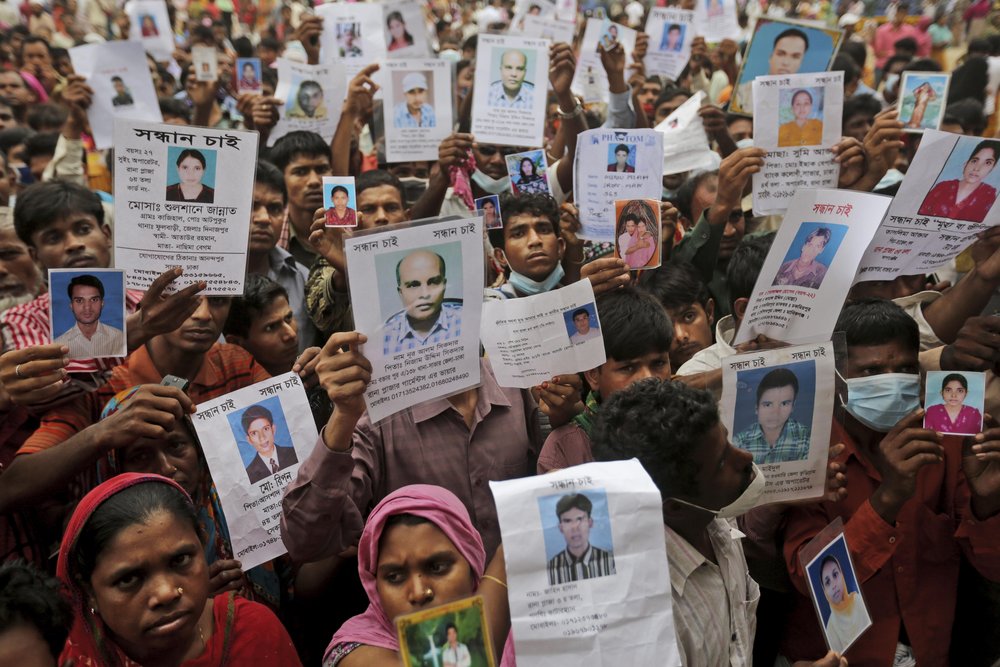
Several million people around the world - including many children - work along global supply chains. In many places, working conditions are catastrophic, the pressure on workers is high and salaries are often far below the national minimum wage, as the organisation Human Rights Watch highlighted in a 2016 report. As a late reaction to the Rana Plaza disaster - ten years ago, more than 1,000 workers died in the collapse of this textile factory in Bangladesh - the EU agreed on a supply chain law in December 2023. The aim is to hold companies accountable for respecting human rights along the entire value chain. A less strict law has been in force in Germany since January 2023; it was tightened on 1 January 2024 and now applies to companies with 1,000 or more employees.
An expanded understanding of safety can help to scrutinise and redefine the purpose of economic activities. The focus should be on improving human well-being worldwide, for example through secure income and improved healthcare. Emphasising fundamental human rights in trade relations is a central component of this. Through the associated reduction of grievances - which in many places are the driving forces behind social divisions and violence - human rights can also help to reduce drivers of conflict worldwide.
The climate crisis is a global security threat
The drastic change in the climate, with a massive increase in extreme weather events and natural disasters in recent years, poses an existential threat to the lives of people on Earth. According to Munich Re, the world's largest reinsurer, more than 70,000 people lost their lives last year alone as a result of natural disasters and extreme weather events. In socially unstable countries, the consequences of the climate crisis can also act as a driver of conflict and force people to flee, as the Secretary General of the Danish Refugee Council (DRC), Charlotte Slente, explains in an interview with Der Spiegel. The impact of the climate crisis on human security is therefore far-reaching. Especially as the effects of the climate crisis are being felt unevenly around the world. While the climate crisis is already threatening the existence of states and fuelling conflicts in some parts of the world, elsewhere it is primarily manifested in increased air pollution and extreme weather events such as heatwaves.
Consequently, the Federal Foreign Office calls the climate crisis "the greatest security threat of our time".
A multidimensional security policy approach is needed
The Covid-19 pandemic, the disregard for human rights along value chains and the global consequences of climate change make it clear that the security of people worldwide is not only threatened by armed conflicts, but rather by a multitude of dangers that are mutually dependent and increase the pressure in societies. As these dangers do not stop at national borders, global solutions are needed that place the well-being of every person at the centre. To make this possible, it is essential that different political institutions cooperate, such as national and international economic, development and security policy institutions, in order to tackle several sources of danger simultaneously.
Because one thing is clear: in a world shaken by multiple crises, the question of security has long since ceased to depend solely on the police and military. The present calls for multidimensional approaches at national and international level, the prioritisation of long-term strategies instead of the current permanent state of short-term crisis management and for global solidarity through a fair distribution of the financial burden.