
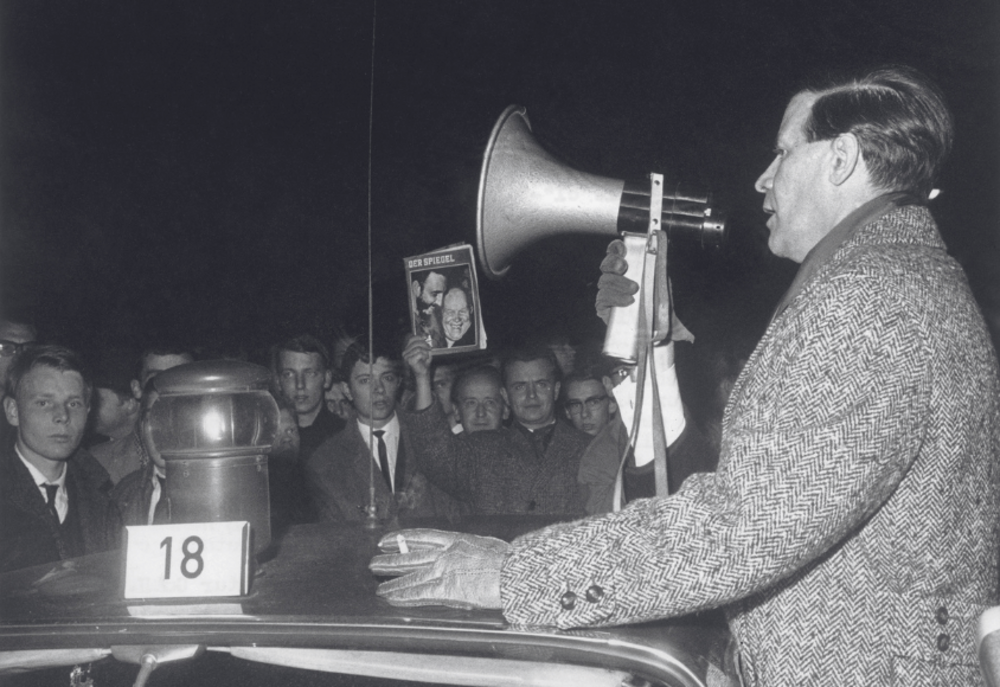
Hamburg's second "Spiegel affair" raises questions about former Senator Schmidt
21. May 2022
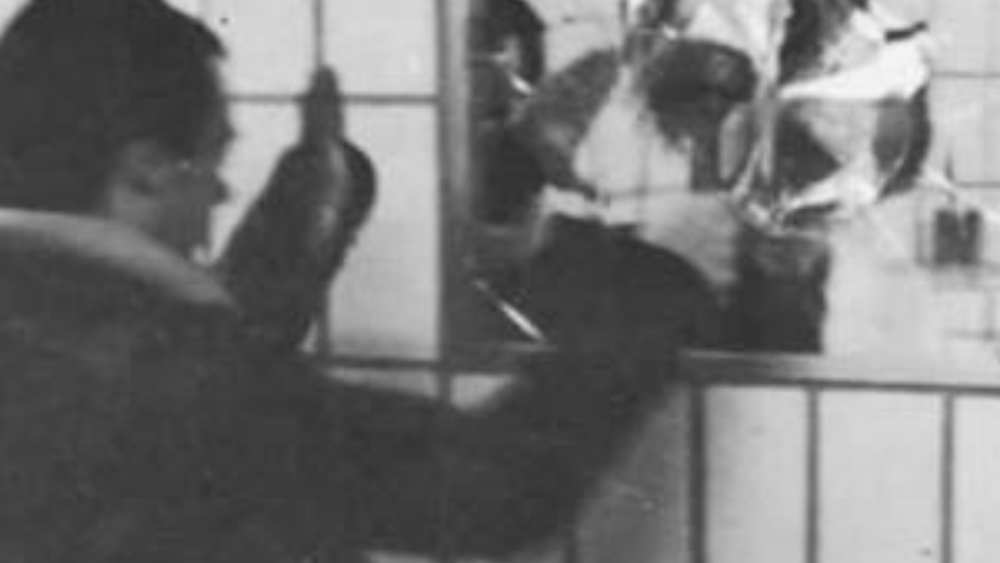
The first attempt with a hammer failed in two ways. The special glass of the toilet mirror on Spielbudenplatz did not give way, but a little later the mirror on Jungfernstieg did. One of the activists, Corny Littmann, then Hamburg's top candidate for the Green Alternative List in the Bundestag elections, had borrowed a hammer from a caterer and taken a photographer with him. He documented the action. The glimpse behind the mirrors triggered swift and vehement reactions not only in the media but also in politics. Relevant publications from the ranks of the gay movement in the years that followed, as well as press and radio reports of the day, were mostly very critical of the spying on public toilets by the police. Hamburg's First Mayor Hans-Ulrich Klose (SPD) was ashamed and called for the surveillance to be stopped immediately, while Werner Staak (SPD), Senator of the Interior, described it as a "relic from the time when homosexual acts were punished more severely" - all this seven years after a second liberalisation of Section 175 of the German Criminal Code (1973).
It is also worth noting in this context that in 1979, barely a year before this second "mirror affair", the parliamentary petitions committee had rejected a petition to remove the mirrors. Corny Littmann, long-time president of FC St. Pauli, head of the three Schmidt theatres on the Kiez and prominent head of the German gay movement, recalls the campaign in a telephone conversation and establishes a connection with the Hamburg Senate's repressive policy against homosexuals in the 1970s. Littmann wanted to finally create clarity with the campaign. His main aim, however, was to put an end to the "pink lists" that the city of Hamburg had always denied. The toilet surveillance actually served as the basis for repression against gays: bans and bans from the premises were issued, and the courts also initiated criminal proceedings (until 1969) for sex between gay men. The responsible authorities justified the surveillance internally by claiming that other toilet users sometimes felt harassed or that children and young people in particular needed to be protected from gay men.
Looking back to the 1960s
Ulf Bollmann, a member of staff at the Hamburg State Archives, and historian Gottfried Lorenz reconstructed the beginnings of surveillance for an exhibition project in 2013 and were able to prove that the first steps towards setting up the "one-way mirrors" were probably taken shortly before Helmut Schmidt took office as police senator (on 13 December 1961). in 2006, a study was published which proved that the first four mirrors were installed in Hamburg public toilets during Schmidt's term of office (from May 1962 as senator in the newly formed interior department) and six more afterwards (1966 to 1974). According to Bollmann's personal information, no files are known to date that could substantiate Schmidt's position and exact role during these years. It would be interesting to find out exactly what Schmidt knew about the matter, whether he was more likely to push or slow things down and what significance the issue may have had for him at the time.
In their publication, Bollmann and Lorenz use numerous examples to demonstrate the generally repressive climate against homosexuals in those years. This was evident, for example, in the fact that survivors of Nazi persecution who had been deported to concentration camps or penitentiaries because of their sexual orientation were generally treated as common criminals by Hamburg's compensation chambers - such applications were generally rejected. This was despite the fact that homosexuality was a highly political offence for the Nazi state. Gays in particular were regarded as carriers of a contagious disease that threatened to infect the "national body" and also jeopardised the nation's ability to defend itself. After the end of the war (and right up to the present day), such abstruse ideas persisted; Bollmann and Lorenz document a broad social consensus on homophobic attitudes and judgement patterns, especially in the 1950s and 1960s, from communists to prominent social democrats and far into middle-class and liberal circles. The first liberalisation of the 175 paragraph (1969) was pushed through by the grand coalition under Chancellor Kurt Georg Kiesinger (CDU) - presumably against a social majority at the time; since then, consensual sex between adult men has been legal.
First questions to Schmidt - 30 years after the second "Spiegel affair"
According to the authors, Helmut Schmidt's (in)action as a Hamburg senator did not set him apart from the social mainstream, but he bore political responsibility - also for the spying in those days. Much later, in 2010, Schmidt spoke to the weekly newspaper Welt am Sonntag about his attitude to the subject, but only in relation to his policies as Federal Chancellor (1974-1982). The journalist asked him about his position on a further liberalisation of Section 175, which the FDP, as a coalition partner of the SPD in Schmidt's third cabinet, wanted to introduce in 1980/81. According to press reports, both Federal Justice Minister Hans-Jochen Vogel (SPD) and the FDP ministers Hans-Dietrich Genscher and Gerhart Baum had stated that this reform had failed due to Schmidt's opposition - which he in turn denied in the Welt am Sonntag newspaper. He had considered the issue unimportant, saying that people's sexual orientation was a private matter and did not belong in the media. In other words, the ministers' statements contradict those of Schmidt. Further archival research will have to show whether more details can be found about Schmidt's positions during his time as Hamburg Senator or Federal Chancellor.
And today?
The final abolition of § 175 only came in 1994 during the chancellorship of Helmut Kohl (CDU). Since 1949, around 50,000 men had been convicted under this penal provision. In view of the downright murderous policies towards homosexuals and people with sexual orientations beyond heteronormativity in many countries around the world, the policies and measures in Germany in the immediate post-war decades may seem comparatively harmless - even against the background of the thousands of men, especially homosexual men, murdered during National Socialism. However, it is precisely the pressure that the liberal constitutional state is currently under (not only) in Europe that should sensitise us to the precious and hard-won good that tolerance and diversity offer in an open and pluralistic society, and not only in legal matters. The 17 May (after § 175) of the year is an important thought-provoking impulse for this in particular.

Magnus combines in-depth expertise on the life and political career of Helmut Schmidt with public history formats centered on the foundation’s exhibition projects. Central to this work is always the question of how history and the present are interconnected.
He studied history in Göttingen and earned his doctorate at the University of Erfurt on the everyday history of World War II. Since 2005, he has worked both independently and as a staff member and exhibition curator for institutions including the German Historical Museum in Berlin, the Foundation Memorial to the Murdered Jews of Europe, the Hamburg Institute for Social Research, and the University of Vienna.
More