Helmut Schmidt knew the value of free and independent media. He himself had been writing articles since the late 1940s, emphasising the need to explain politics and make it comprehensible. In the summer of 1949, he even wanted to work for the Hamburger Echo, but shortly afterwards noted succinctly in his documents: "Echo doesn't want me". Even though Helmut Schmidt later labelled journalists as "highwaymen" and accused them of (supposedly or actually) not working thoroughly enough, he used the logic of the press like hardly anyone before him and still became a part of it in 1983 as editor of Die Zeit. Some 20 years earlier, in October 1962, there was a historic restriction on freedom of opinion and freedom of the press. When the Spiegel journalists Conrad Ahlers and Hans Schmelz were arrested in Hamburg, Schmidt also found himself in the investigators' crosshairs. The accusation was: suspected treason, treasonous falsification and bribery - but what had happened?
The Spiegel affair - an attack on freedom of opinion and the press
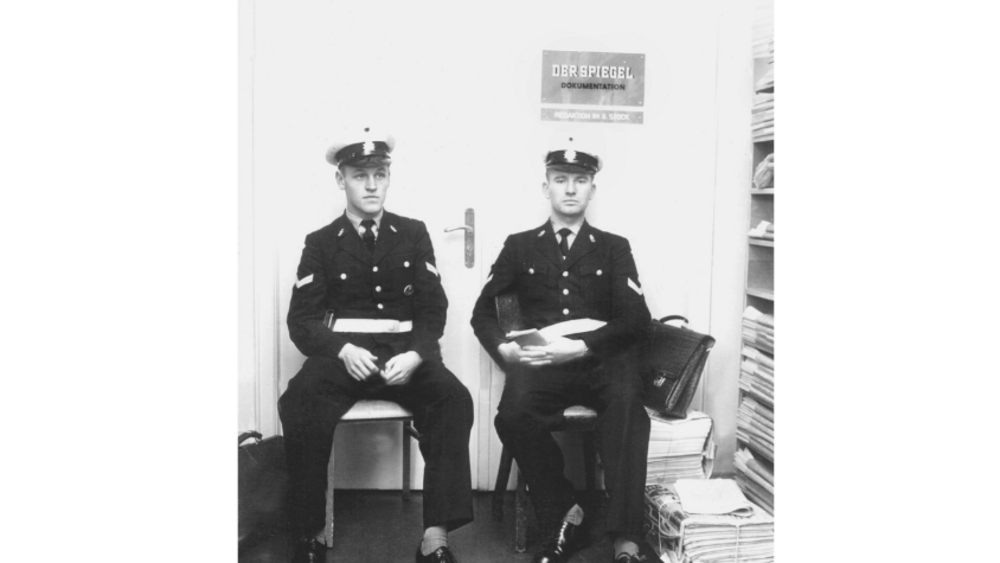
On Monday, 8 October 1962, the Hamburg magazine published a portrait of the Inspector General of the German Armed Forces, Friedrich Foertsch, on the front page. On the occasion of the NATO autumn manoeuvre "Fallex", the two authors judged in their article "Conditionally ready for defence" that the German armed forces would not be suitable for defence in an emergency due to their inadequate equipment. In doing so, they criticised above all Federal Defence Minister Franz Josef Strauß (CSU) and his military strategy of nuclear armaments policy. At Strauß's insistence and under the pretext of treason, the Federal Public Prosecutor's Office immediately opened an investigation against Rudolf Augstein, publisher of Der Spiegel, the editors responsible and their alleged informants. On the evening of Friday 26 October 1962, officers from the Federal Criminal Police Office, supported by Hamburg police officers, stormed the offices of the news magazine in Hamburg's Pressehaus on Speersort - where Die Zeit is now located and where Helmut Schmidt also had his office as publisher from 1983 to 2015. Today, the building bears his name.
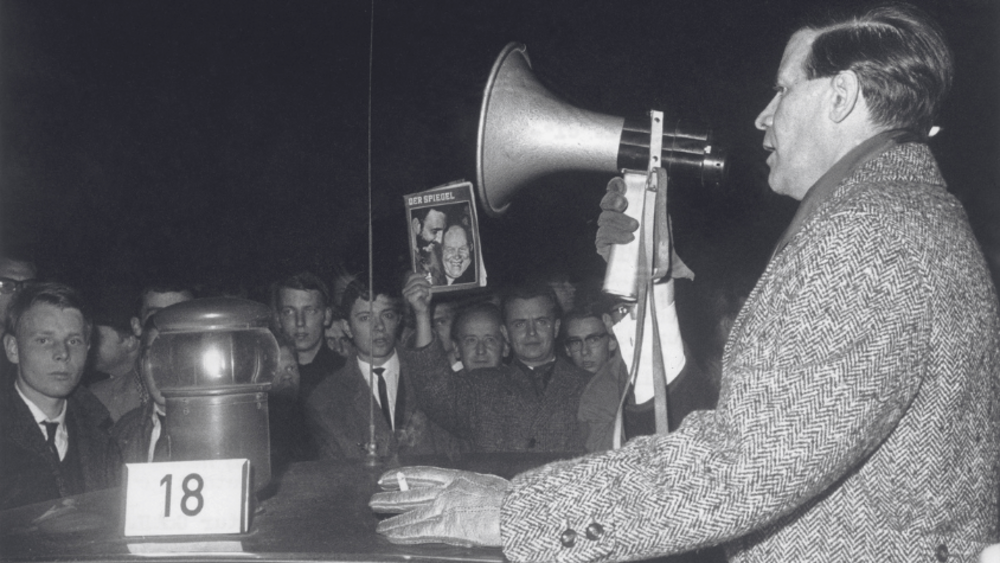
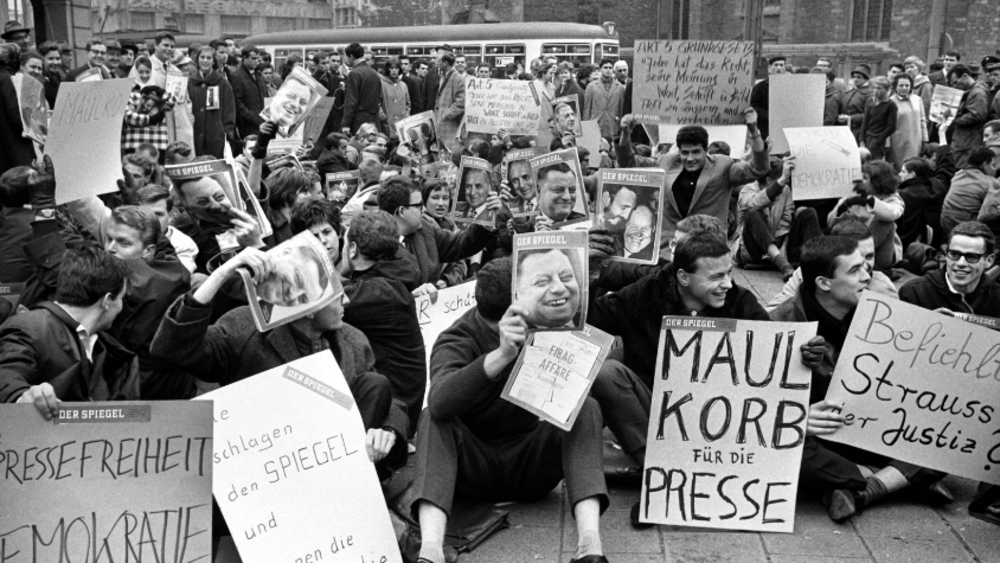
Because he had already known about the article before it was published, Hamburg's Senator of the Interior Helmut Schmidt was one of the informants and was accused of aiding and abetting treason. But the senator reacted calmly. According to Schmidt in a later interview, he had expressed his assessment of the investigation by not even hiring a lawyer. He wrote to Ahlers, who was imprisoned at the time, in a letter: "You will perhaps know that I have by no means always considered Der Spiegel to be pleasing, but nonetheless necessary." In doing so, Schmidt not only honoured the journalistic work, but also clearly positioned himself on the side of the media - and many citizens did the same. The military policy affair and the attack on press freedom triggered nationwide protests against state actors. Even to the extent that it grew into the first government crisis of the Bonn Republic: on 30 November 1962, Federal Defence Minister Strauß resigned from office under pressure from the cabinet - and thus ultimately by decision of Federal Chancellor Konrad Adenauer. But the investigation against Helmut Schmidt continued for another five years, longer than the one against Augstein. It was not until 1967 that the Federal Public Prosecutor's Office dropped the case against Schmidt.
"Traitor to the country" proves to be a champion of press freedom
The importance of freedom of the press in a democratic society was always beyond question for Helmut Schmidt. In a speech to the Hamburg Parliament in 1964, he described freedom of the press as a "fundamental function of democracy". Schmidt, who was "deeply offended" by the accusation of treason, campaigned to have a new liberal press law drawn up in Hamburg.
In his speech, Schmidt went on to say that the press played a major role in the development of democracy and the citizens' democratic sense of state. However, there is not only the freedom of the press, but also the responsibility of the press. Schmidt therefore emphasised the importance of a balance between the state and the media - between the authorities' duty to provide information and the diligence of the media in disseminating news. Schmidt emerged from the crisis of the so-called Spiegel affair as an "ardent fighter for press freedom" and played a key role in the strengthening and new self-image of the media through the new Hamburg Press Act.
Encouraging critical reflection
This attack on freedom of expression and freedom of the press was not only a profound turning point for media professionals and citizens, but also for Helmut Schmidt. Throughout his life, he campaigned for the inviolability of this fundamental right. At the same time, however, he also expected journalism that saw it as its goal to make connections transparent and encourage critical reflection. He saw the "Helmut Schmidt Journalism Prize" named after him, which was awarded for the first time in 2006, as a contribution to courageous journalism that asks uncomfortable questions and argues conclusively with in-depth expertise.