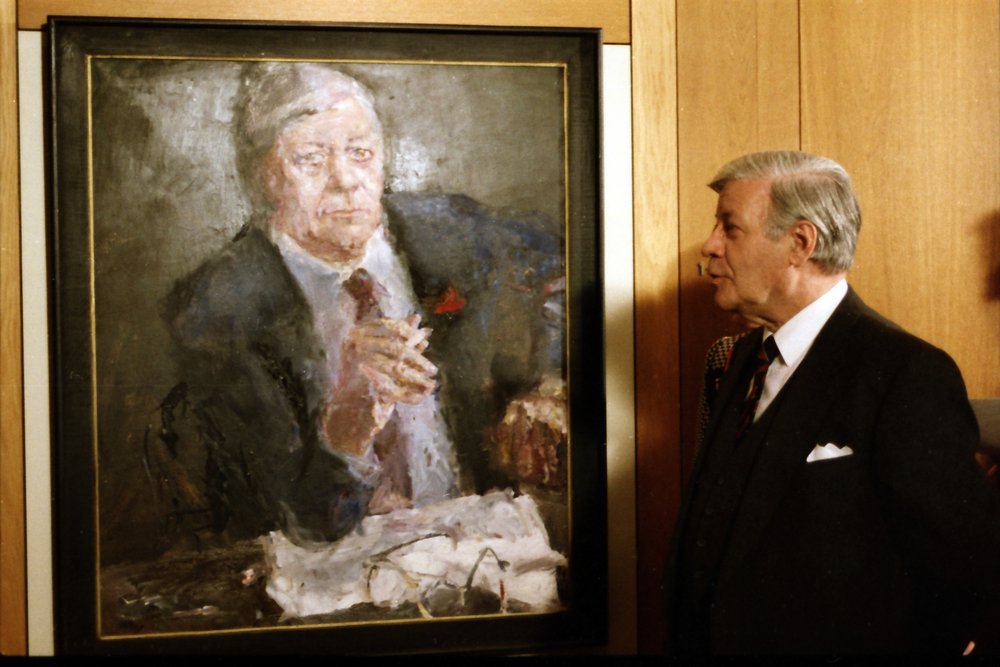
On 11 November 1983, more than a year into Helmut Schmidt's chancellorship, Minister of State Philipp Jenninger asked Schmidt to please continue the tradition and select an artist for a portrait of the chancellor. The fifth chancellor to date was missing from the gallery in the Federal Chancellery. As Die Zeit wrote, the idea for a series of oil portraits of chancellors apparently dated back to 1976 under the then Chancellor Schmidt. He was of the opinion that the new building of the Federal Chancellery resembled a "savings bank head office" and that there was a lack of art in the building. The search for the right painter began.
Bild helps with the searche
Who came up with the idea of publishing a note in the Bild newspaper on 8 December 1983 cannot be verified. "Schmidt. Good painter wanted. Helmut Schmidt (64) is looking for an artist to paint him. The oil painting should not cost more than 35,000 marks."
The offers were received from the very first day: "A great pleasure and honour to be able to paint a portrait of you, Chancellor", "By chance I read that you wanted to be painted. I thought of my mum, who is a fantastic painter" or "You're looking for a portrait painter. I've been painting in Hamburg since 1951 - captains and merchants, women and children." Well over 100 offers were received by 8 March 1984, and over 200 letters had reached the Federal Chancellery by 17 August. But no painter was able to convince Schmidt.
The choice finally fell on Bernhard Heisig. Schmidt recalled on the painter's 80th birthday: "After 1982, the Chancellery also wanted a portrait of me. While thinking about a suitable painter, I came across Bernhard Heisig, of whom I had seen several pictures and illustrations. I didn't know Heisig; he lived in Leipzig in the GDR. I thought it would be desirable for a GDR painter to be represented in the Chancellery in Bonn."
On 2 August 1985, Schmidt informed the head of the Federal Chancellery, Wolfgang Schäuble, that Heisig would be painting his portrait and asked for the utmost discretion. Finally, on 15 January 1986, a portrait contract was signed between the Federal Chancellery in Bonn and Professor Bernhard Heisig, represented by the State Art Trade of the GDR, for DM 40,000 and DM 4,000 travel expenses.
Not an unknown Leipzig painter
Bernhard Heisig was not an unknown painter from the GDR. Art in the other German state was hastily categorised as state or commissioned art by the West Germans, which was true, but only to a limited extent. The visual arts of the GDR were based on realist art.
Bernhard Heisig was an uncomfortable spirit. He gave up his studies in 1951 due to artistic constraints in the GDR and continued to work self-taught. His artistic work focussed on the Paris Commune of 1871 and later historical themes of war and its horrors. Heisig came to terms with the East German state and taught at the Leipzig Academy of Visual Arts from 1954 to 1966 until his own dismissal. He was awarded the National Prize, held leading positions in the Association of Visual Artists and was also a member of the SED. From 1976 to 1987, Heisig was elected rector of the Leipzig Academy. He exhibited at Documenta 6 in 1977.
Modelling in the GDR
The first sketches were made in October 1985 in Schmidt's private home in Hamburg-Langenhorn and served as a model for the later oil paintings. Schmidt travelled to Leipzig at the beginning of July 1986. The visit was meticulously planned. A convoy of up to six cars travelled from the West Berlin Dreilinden checkpoint, where they were individually and quickly cleared as "Category I personalities", into the GDR. Four cars from the GDR and two West German Merrcedes limousines with two drivers, two security officers, Loki and Helmut Schmidt, an editor from Die Zeit and an official from the Federal Chancellery made their way along the motorway to Leipzig at around 140 km/h in a high-speed convoy with GDR blue lights. Shortly before reaching their destination, the East Berliners swapped for Leipzig police forces in a car park, and they drove ahead into the city, past normal traffic and without stopping at traffic lights, to the Hotel Merkur, the most modern hotel at the time. A West German photographer later joined the visit to Heisig's studio. The State Security organised itself, from the GDR driver to the personally assigned employee of the Hotel Merkur, to prevent all conceivable incidents.
Live on ARD
Peter Merseburger from the ARD studio in the GDR got wind of the situation and wrote to Schmidt: "I have heard that you will be sitting with the painter Heisig in Leipzig on 3 and 4 July. Of course I'd like to shoot a few shots for the Tagesthemen or the report from Bonn on 4 July." Schmidt and Heisig agreed.
So the Tagesthemen of 3 July 1986 featured a relaxed two-and-a-half-minute piece with original sound from Helmut Schmidt: "For me it was crucial that a portrait like this, on the one hand, because it is in a prestigious location where there is public traffic, foreign traffic, that you still have to be able to recognise the portrait subject. [...] But secondly, it also has to be art. [...] So we actually came across Mr Heisig without any political ulterior motive, without any political intention, but then we thought it was a good idea to ask a painter from the GDR to do it." Heisig concluded: "I'm interested in the face, it's a face in which you can see a destiny."
The modelling sessions in Leipzig were not easy. When Schmidt said in retrospect: "I find it difficult to keep still", Heisig added: "You never did that either." The artist worked for three years on the preliminary sketches, studies and four portraits. During Schmidt's next visit to Leipzig on 24 October 1986, the former Federal Chancellor examined the four paintings and decided on the official portrait of the Chancellor.
A deep friendship
The fact that Helmut Schmidt chose the painter Bernhard Heisig for the portrait of the Chancellor proved to be a stroke of luck for the following 25 years. They shared the most formative experience of their youth: both had survived the Second World War as soldiers. The portrait sessions were followed by many invitations to Hamburg and the Brahmsee and return invitations to Heisig's exhibitions in West Germany. They maintained cordial contact until Bernhard Heisig's death in 2011.
In his obituary in Die Zeit , Schmidt described his sadness at the loss of a man whom he valued as a painter and a person. Schmidt characterised Heisig as a person who did not harm anyone, who made a number of compromises and was not a GDR resistance fighter, but was instead unbelieving in progress, pessimistic about history and artistically accusatory. "He remained an obsessive painter - even in a wheelchair". All in all, Heisig was "a very German painter". That means having experienced horrors and coming to terms with them - not suppressing and superimposing them, as many other Germans did in the 20th century.