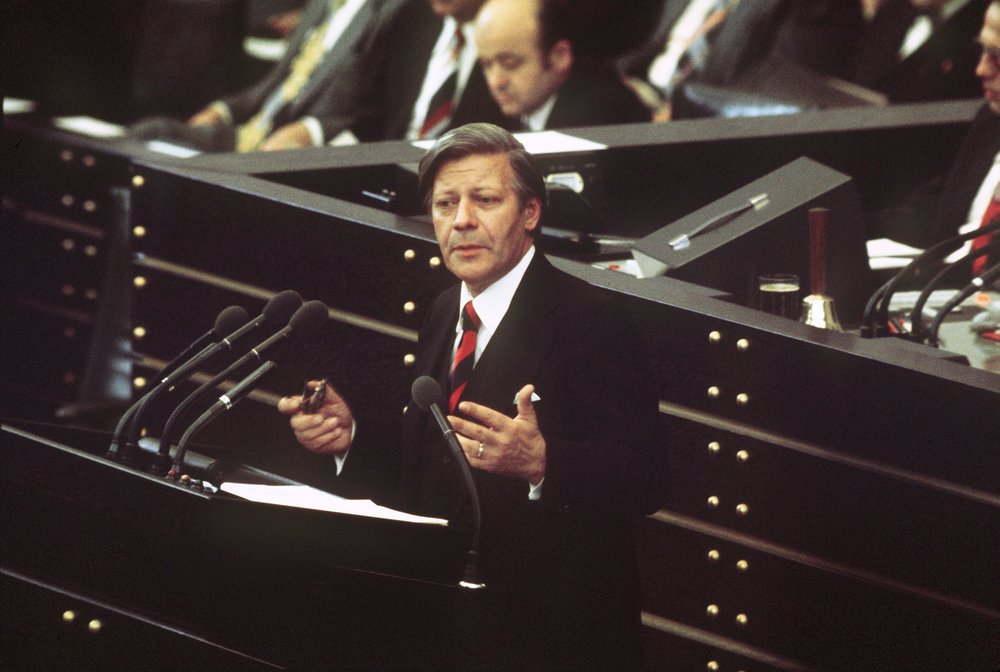
The Bundestag session began at 10:01 a.m. on 16 May 1974: Annemarie Renger (SPD), President of Parliament, congratulated two Members of Parliament on their birthdays and then explained the forthcoming election procedure in accordance with Article 63 of the Basic Law and the Rules of Procedure of the German Bundestag. After a short break in the session from 10.50 to 11.14 a.m. to count the votes, the result of the secret ballot was finalised: Helmut Schmidt had been elected Germany's fifth Federal Chancellor with 267 votes in favour and 225 against. He was sworn into office in the afternoon.
The resignation of Willy Brandt (SPD) as Federal Chancellor was ten days ago and everything was pointing towards Schmidt as his successor. He did not feel victorious over Brandt, as Schmidt revealed to a trusted capital city journalist in Bonn, but he had nevertheless reached the end of his career as Federal Chancellor. The leadership experience he had gained as a senator in Hamburg (1961-1965) and even more as chairman of the SPD parliamentary group in the Bundestag during the grand coalition (1966/67-1969), as well as the qualifications and skills he had developed in the Ministries of Defence, Economics and Finance during the first phase of the social-liberal coalition, recommended him for the chancellorship.
More realism and sobriety
On 17 May 1974, Helmut Schmidt gave his government statement under the motto "Continuity and concentration" and announced his intention to continue government policy together with the FDP as a coalition partner. In view of the global economic problems, however, realism and sobriety were more in demand than before. In terms of domestic policy, Schmidt focussed particularly on a socially just economic and tax policy and on securing energy supplies; in terms of foreign policy, he followed the tradition of the New Ostpolitik and called for an internationally coordinated stability policy to restore the global economy.
In the 1976 and 1980 Bundestag elections, Schmidt was challenged first by Helmut Kohl (CDU) and then by Franz Josef Strauß (CSU). He was able to prevail against both by a narrow margin in each case, after some very pointed campaign debates. He remained true to the foreign and domestic policy course that Schmidt had set out in his first government declaration throughout his time in office as Federal Chancellor.
New emphases in foreign policy
His close political partnership with French President Valéry Giscard d'Estaing (1974-1981) was extremely important for Schmidt's European and wider foreign policy. Ministers, state secretaries, parliamentarians and the administrative substructure in both states sometimes seemed to interfere with this smoothly functioning mechanism of the axis between Paris and Bonn. In 1974, Schmidt and Giscard d'Estaing advocated the institutionalisation of the European Council. In future, the heads of state and government of the European Community (EC) would meet regularly at summits. In view of their territorial size and economic strength, the Federal Republic of Germany and France almost inevitably assumed a leading role in the EC, which until 1981 consisted of only nine members. As a result, Giscard d'Estaing and Schmidt were easily able to push through the European Monetary System they had designed in 1978/79 against the other Council members. It was intended to ensure monetary stability. In addition, Schmidt and Giscard d'Estaing initiated the World Economic Summits as a forum for international crisis management, which met for the first time in 1975 at Rambouillet Castle near Paris. Although the concept for the meetings, soon to be known as the G7 summits, was based on a division of labour, Schmidt allowed his French partner to take the lead in public. He had no doubt that France, as a nuclear power and with a permanent seat on the UN Security Council, had a far stronger international position than Germany.
Schmidt was also quick to recognise the economic importance of China, whose global political significance he was convinced was steadily increasing. This would change the bipolar bloc confrontation of the Cold War. At the end of October/beginning of November 1975, Helmut Schmidt was the first German Chancellor to visit the People's Republic of China and subsequently placed particular emphasis on Far East policy. Schmidt was impressed by the economic development achievements of Deng Xiaoping in Beijing (1979-1997) and Lee Kuan Yew in Singapore (1959-1990), for which he was sometimes prepared to ignore the fact that both cultivated pre-democratic styles of government and based their rule on brutal force.
Domestic policy: crises and difficult decisions
The crises and difficult decision-making situations to which Helmut Schmidt had to react domestically as Federal Chancellor stood in partial contrast to his foreign policy successes and his international reputation. In November 1976, after the Bundestag elections, a massive funding gap in the pension scheme was revealed during the coalition negotiations with the FDP. Unfortunately for Schmidt, he had also made the wrong assumptions; such a major mistake shook his self-image, which was based on precise expertise and perfection. The political responsibility for the misery denounced by the opposition as a "pension lie" was assumed by the Federal Minister of Labour and Social Affairs, Walter Arendt (SPD), whose relationship with Schmidt was considered to be broken ever since.
Helmut Schmidt reacted to the terrorism of the Red Army Faction (RAF) with a tough stance. After the kidnapping of Hanns Martin Schleyer, President of the Employers' Association and Chairman of the Federation of German Industries, in Cologne on 5 September 1977, Schmidt refused to comply with the demand for the release of the prominent RAF members around Andreas Baader from the high-security prison in Stuttgart-Stammheim. The Chancellor was firmly convinced that the democratic constitutional state could not allow itself to be blackmailed. Even the parallel hijacking of the Lufthansa plane "Landshut" with 91 people on board to Mogadishu by a Palestinian terrorist group could not dissuade Schmidt from this intransigence for reasons of state. The hours between the liberation of the plane hostages on 18 October by a GSG 9 special unit and the subsequent murder of Schleyer were among his toughest times in office.
Between rearmament and the "zero solution"
Schmidt played a major role in the NATO Dual-Track Decision formally adopted on 12 December 1979. His conceptual considerations for this went back to his defence policy bestseller "Defence or Retaliation", published in 1961. The NATO Dual-Track Decision brought Schmidt a great deal of criticism from his own party and from the growing anti-nuclear and peace movement. What was lost in this wave of protest was the fact that the Federal Chancellor wanted the so-called "zero solution" as the result of negotiations between the USA and the Soviet Union, i.e. a renunciation of (nuclear) rearmament while at the same time continuing the efforts towards détente.
On 8 December 1987, five years after Schmidt left the Chancellery, US President Ronald Reagan and Soviet General Secretary Mikhail Gorbachev finally signed the INF Treaty on the mutual disarmament of the medium-range nuclear missile arsenal in Washington, which Schmidt confidently chalked up as a direct result of the NATO Dual-Track Decision. He did not accept other interpretations according to which this decision had intensified the Cold War with an uncertain outcome.
Constructive vote of no confidence
Several factors combined to seal the end of the social-liberal coalition in 1982, above all the increasingly liberal economic demands of the FDP, in particular those of party chairman Hans-Dietrich Genscher and Federal Economics Minister Otto Graf Lambsdorff. The reform potential of the governing coalition had been exhausted, the left wing of the SPD was reluctant to follow the Chancellor's security policy and Schmidt was unable to find a forward-looking response to the challenge and innovative political style of the new social movements. On 1 October 1982, Helmut Kohl (CDU) took over the chancellorship after a successful constructive vote of no confidence. Schmidt was overthrown. Taking stock, he stated with his typical Hanseatic understatement: "All in all, we didn't do too badly."