
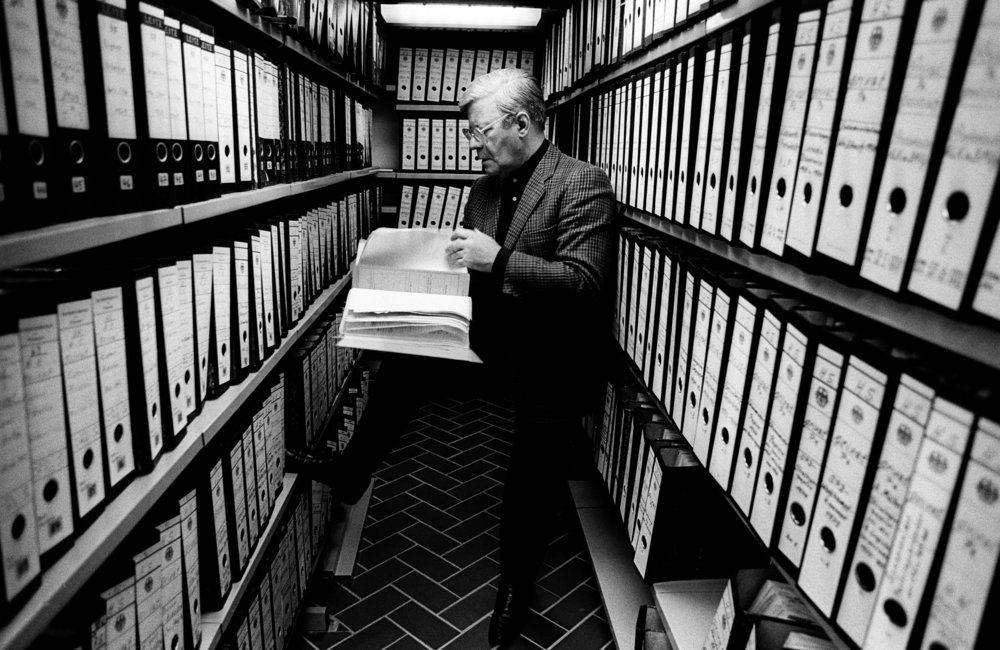
"History affects every citizen"
27. Aug 2022
The "shit war" - as Helmut Schmidt called the Second World War - had been going on for almost three years when the Allies began bombing Hamburg; on 24 July 1943, they launched "Operation Gomorrah". The massive air raids unleashed a destructive firestorm in which tens of thousands of people died and 280,000 homes were burnt out - including those of Loki and Helmut Schmidt. They lost most of their personal papers and family memorabilia in the flames. But the young Schmidt began to file his memories and documents again, thus creating the basis of his extensive private archive - today's Helmut Schmidt Archive.
Through his own biography, he knew the personal and socio-political value of archives: they are not only the indispensable basis for historical work, but also preserve "securitised law", such as contracts or documents, as well as everyday history. They are therefore an important instrument of the rule of law, an indispensable component of a pluralistic democratic society. Last but not least, archives offer cultural enrichment.
An attack on Ukrainian memory
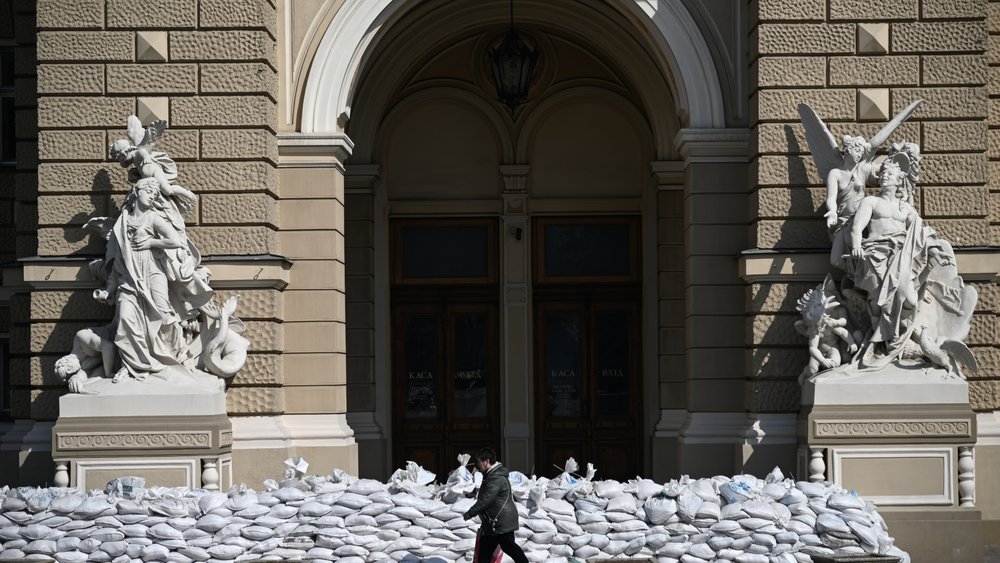
78 years later, war is once again raging in Europe. With the invasion of Ukraine by Russian forces on 24 February 2022 in violation of international law, the aggressor brought much suffering to the population. Millions fled from the destructive attacks, tens of thousands died in the first months of the war. And while the Russian government denies Ukraine's national identity, it has archives and other cultural sites destroyed - because they are the ones that preserve Ukraine's cultural memory and document its (political) actions.
More than 86 million document files are stored at various locations in Ukraine, according to Anatoly Khromov, head of the State Archive Service of Ukraine(interview in Der Spiegel). This makes the archive holdings one of the largest in Europe. However, documents relating to German war crimes during the Second World War, files on victims of Stalinist terror and evidence of Ukrainian independence have already been shot at, taken away or destroyed. The Russian invasion has thus torn an irreparable gap in Europe's tradition, which jeopardises the reappraisal of history and provides a breeding ground for anti-democratic parties.
The sympathy of Western countries in the face of the destruction of Ukrainian archives is great and is accompanied by a wave of aid measures: To prevent further irreplaceable documents from being abducted or destroyed and cultural websites from being irrevocably shut down, the SUCHO (Saving Ukrainian Cultural Heritage Online) initiative is uploading this data to external servers worldwide. Nothing would make him happier, says Quinn Dombwoski, head of the initiative, than if these files were not needed. But in the event that these backups are needed, he wants to put them back where they belong: in the hands of Ukrainian librarians, archivists and curators (from the press release). German and British archives are also donating packaging material, supporting the digitisation of archival materials and providing the necessary servers. All with the aim of enabling cultural restoration after the end of the Russian invasion.
The Hague Convention for the Protection of Cultural Property in the Event of Armed Conflict was actually intended to prevent this from being necessary in the first place. After the unprecedented destruction and disappearance of cultural property during the Second World War, the international agreement was intended to protect "movable or immovable property of great importance to the cultural heritage of all peoples" from tactical destruction. However, although the former Soviet Union signed the agreement in 1957, Vladimir Putin's government is not (or no longer) honouring it.
"History concerns every citizen," Helmut Schmidt appealed at the Historians' Day in Hamburg in 1978. After all, the basis of a united nation is a common historical past and a common aspiration for the future. The prerequisite for this is archives, which secure the present for the future and make it possible to refer back to the past. They not only store written documents, photographs, sounds and films, but also preserve traditions, language, artefacts and buildings. They make a society what it is and give it a foundation on which a nation can build and develop.
It is therefore not surprising that since their creation, archives have become objects of political contention, their pragmatic and symbolic value making them an attractive bargaining chip. Their disappearance and destruction can lead to the misuse of history - historical contexts can become invisible and incomprehensible for future generations.
Democracy needs archives
Following his conviction, Helmut Schmidt opened his private archive for research: in the Helmut Schmidt Archive in Hamburg-Langenhorn, the history of democracy is literally preserved for future generations to help them categorise the experiences of their time.
On 8 September, we would like to talk to you, dear readers, about the value of archives: How exactly can they counteract the transfiguration of history and strengthen the self-determination of individuals, and what role do they play for the rule of law?
Together with the German National Foundation (DNS), we are looking for answers to these questions at this discussion evening. Our guests are Professor Dr Dr Rainer Hering, Director of the Schleswig-Holstein State Archives, Gabriele Woidelko, Head of History and Politics at the Körber Foundation, and Dr Meik Woyke, Chairman and Managing Director of the Bundeskanzler-Helmut-Schmidt-Stiftung.
We cordially invite you to join us!

Franziska heads the correspondence project at the Helmut Schmidt-Archiv, where she combines archival description and cataloguing of the impressive collection of letters with issues relating to long-term archiving and historical and political education.
She studied German Studies, European History and History at Otto von Guericke University Magdeburg and the University of Hamburg. She has been with the Bundeskanzler-Helmut-Schmidt-Stiftung since 2017, where she previously oversaw the “60 Years of the Storm Surge” project.
More