
"If the third attempt fails, there won't be a fourth"
18. Dec 2021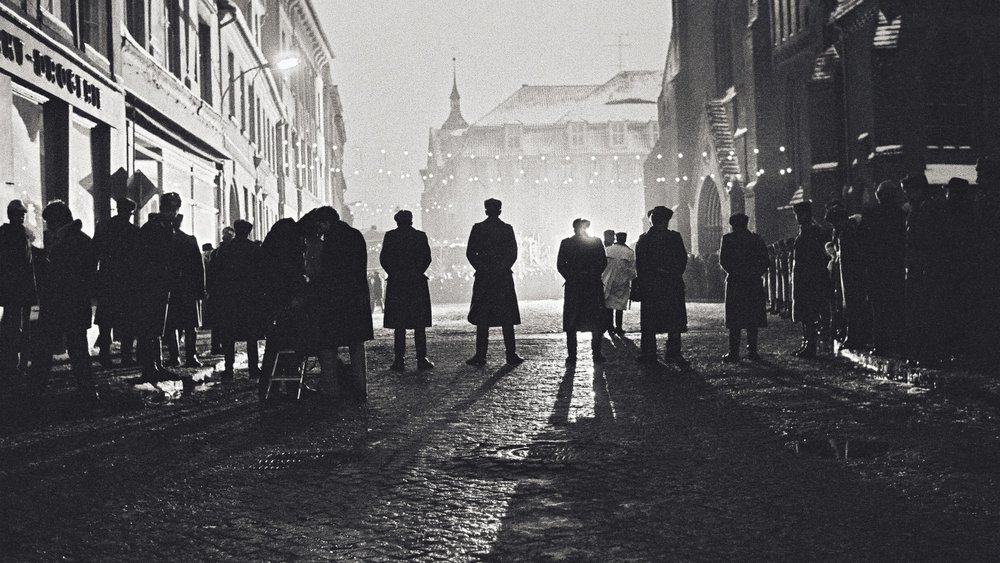
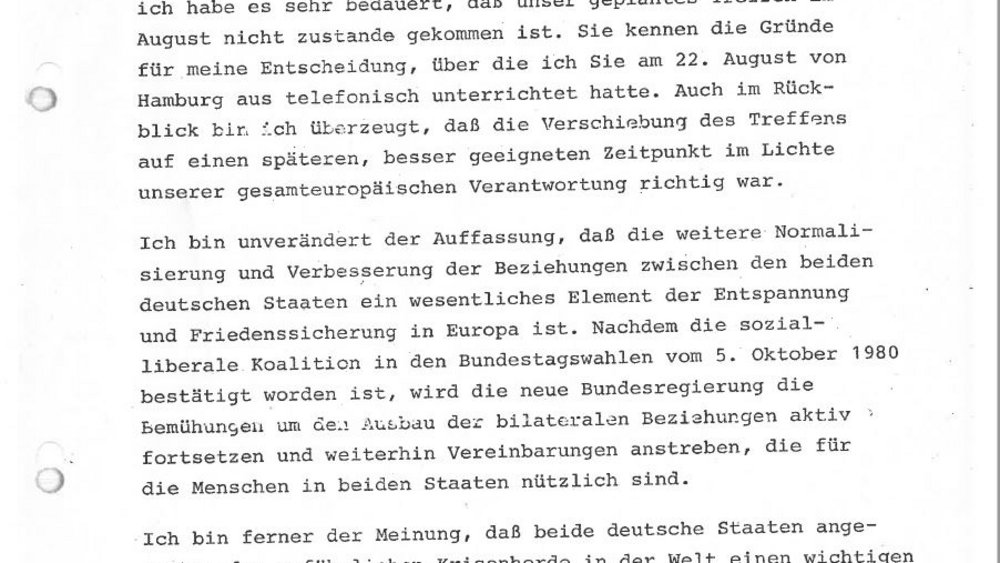
The light grey pencil case made of special cardboard lies on a heavy metal shelf. It is one of thousands in the Helmut Schmidt archive and yet it is something special. It contains a letter: Two pages, dated 5 October 1980 - the day of the Bundestag election. It bears Helmut Schmidt's signature. Sending it would be his first official act as confirmed Federal Chancellor, giving the letter great symbolic significance. It is these two pages that initiate the continuation of the German-German dialogue between the responsible politicians - after a six-year break.
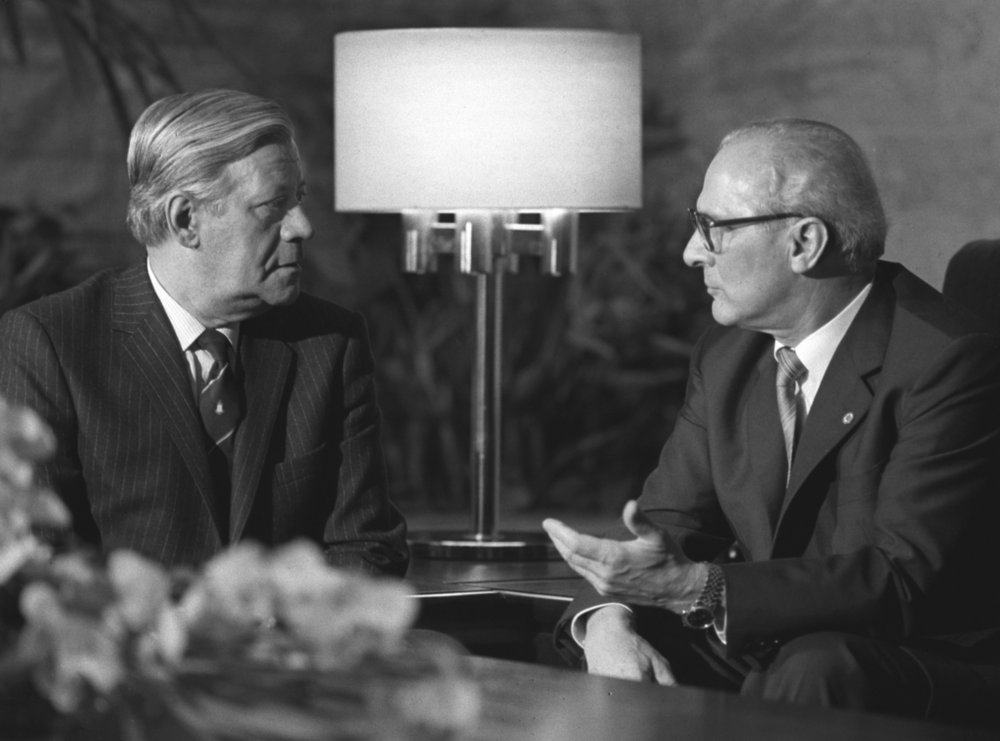
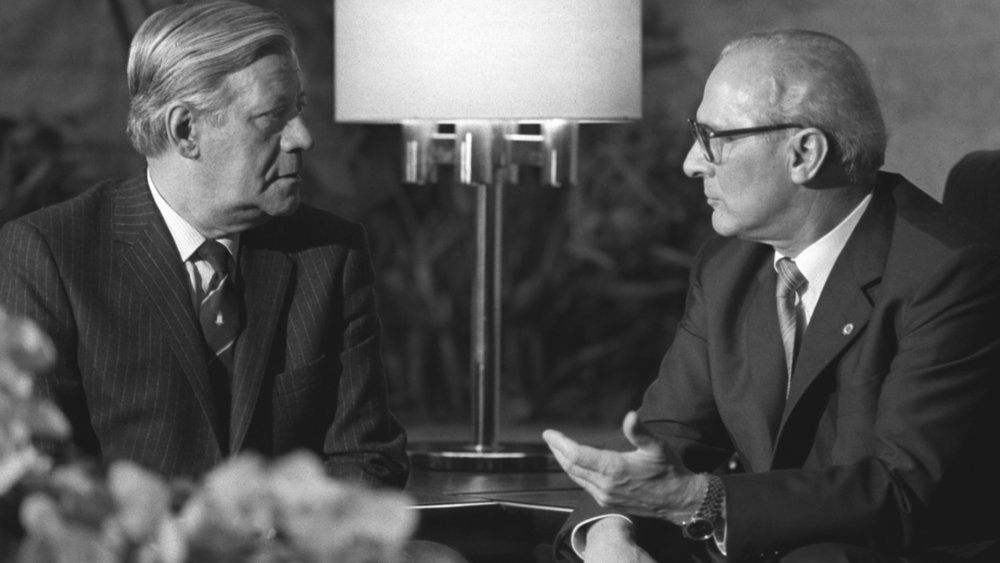
"I consider it to be as important as ever if we can have a detailed exchange of views on the further development of relations between our states and current international issues at a time that suits both sides," wrote Schmidt, addressing the General Secretary of the Socialist Unity Party of Germany (SED) and Chairman of the State Council of the German Democratic Republic (GDR), Erich Honecker. It was to be Schmidt's last attempt to arrange a meeting between the two statesmen. The visit had already been cancelled twice. The reasons for this included the cooling relationship between the USA and the Soviet Union and the heated situation in Poland following the founding of the first free trade union Solidarność.
Visiting the "other" Germany
Schmidt's letter had an effect: talks were resumed and preparations were finalised on both sides. But Wolfgang Vogel, GDR negotiator and Honecker's "postman", made one thing unmistakably clear: "If the third attempt fails, there will be no fourth!" - So this time nothing could go wrong.
On 11 December 1981, Schmidt travelled to the other, socialist Germany for the first time as Federal Chancellor on a working visit under the clear premise that it was more about establishing a relationship of trust than "more humanity for cash".
The first of three one-on-one talks between Schmidt and Honecker took place that very evening. They discussed the arms race between the "superpowers", adherence to the NATO Dual-Track Decision and the Soviet Red Army's invasion of neighbouring Afghanistan, according to Schmidt's memoirs. However, the talks remained superficial overall and no concrete results were achieved.
While the time on 12 December was used for further political exchanges, 13 December was dominated by external relations. After a press conference at the "Wilhelm Pieck" youth academy near Berlin, the Federal Chancellor and the Chairman of the State Council travelled together to Güstrow, as Schmidt had insisted - a mistake?
The programme included a visit to Güstrow Cathedral. Bishop Heinrich Rathke welcomed the visitors and explained that the impressive church, its North German brick Gothic style and Ernst Barlach were symbols of "what we have in common". For Schmidt, a great admirer of Barlach, this was a moving moment.
But just how tense the atmosphere was was clear for all to see on the market square. Erich Honecker and a large contingent of GDR state security prevented Schmidt from being received by the people. After the disaster in Erfurt in 1970, when thousands of GDR citizens celebrated Chancellor Willy Brandt with chants, the GDR leadership wanted to leave nothing to chance this time and avoid spontaneous cheers for the visit from the West, as well as the delivery of letters and calls for help. The consequences were enormous: Opposition members and those not loyal to the regime were arrested throughout the GDR, thousands of citizens were isolated and locked in their homes. In addition, 35,000 state employees besieged the small town, who were allowed to clap and wave, as well as shout "Erich Erich", which was only supplemented by occasional, commissioned "Helmut Helmut" shouts.
A sign in favour of German unity
After three days, the working visit ended at Güstrow railway station, where a special Bundesbahn train took the Chancellor back to Hamburg. Looking back, it was an oppressive experience for Schmidt. He later wrote that he had great doubts as to whether his visit had not harmed the people.
The understanding but inconclusive delegation talks on the one hand and the spectacle in Güstrow on the other seem symbolic of the difficulties of the German-German dialogue. But despite the fatal consequences, the meeting was an important step: for many citizens of the GDR, it was associated with the hope of a new phase of dialogue. With his visit, Schmidt became a beacon of hope for many and set an example for German unity. The town of Güstrow awarded him honorary citizenship in 1995 for his efforts.
The documentary about Helmut Schmidt's visit entitled "Three hours in Güstrow" can currently be found in the NDR media centre.

Franziska heads the correspondence project at the Helmut Schmidt-Archiv, where she combines archival description and cataloguing of the impressive collection of letters with issues relating to long-term archiving and historical and political education.
She studied German Studies, European History and History at Otto von Guericke University Magdeburg and the University of Hamburg. She has been with the Bundeskanzler-Helmut-Schmidt-Stiftung since 2017, where she previously oversaw the “60 Years of the Storm Surge” project.
More