
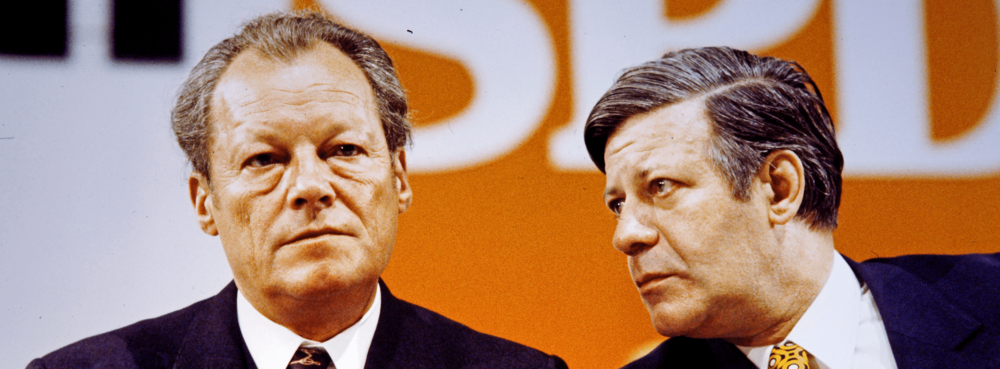
Partners and rivals: Willy Brandt and Helmut Schmidt
08. Oct 2022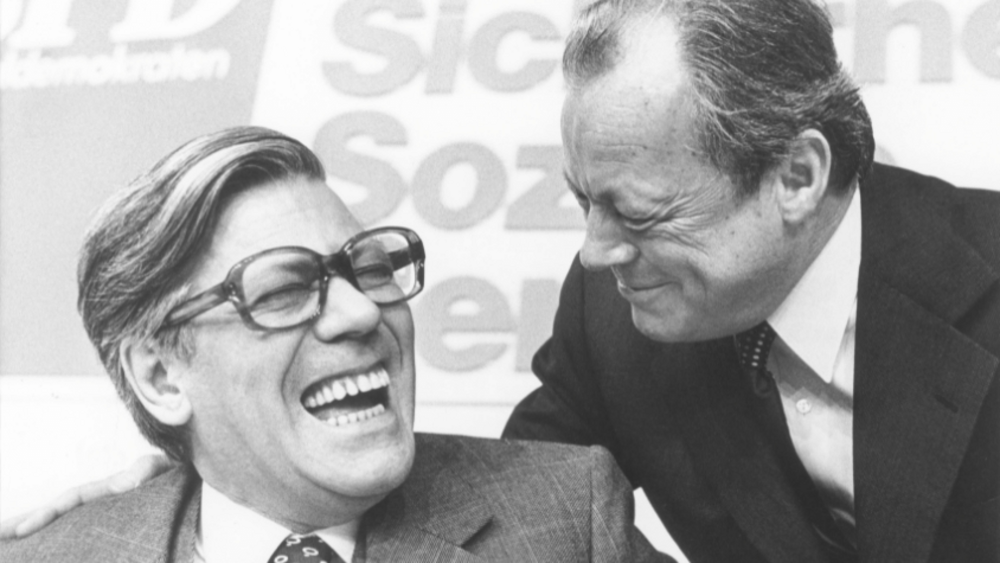
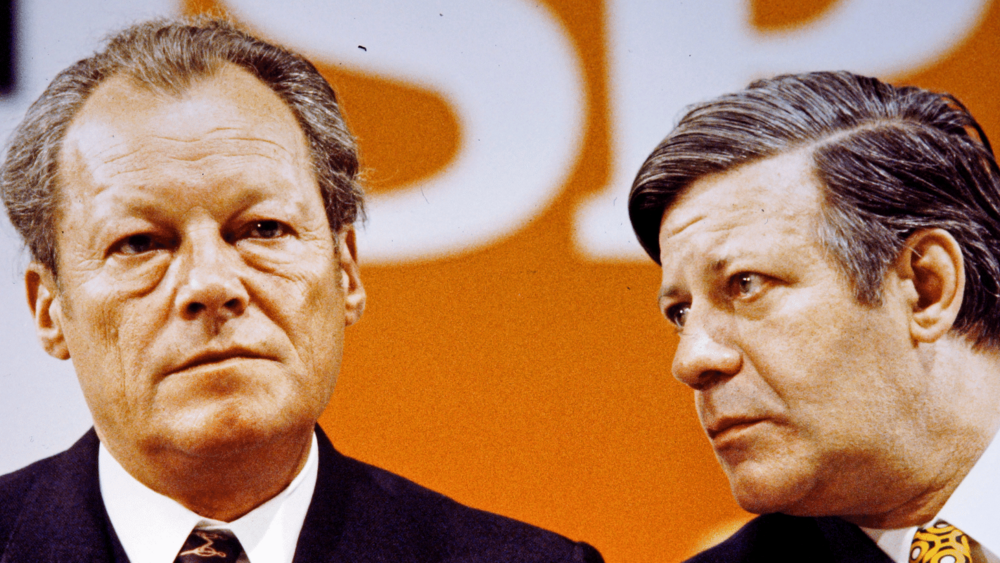
The relationship between Willy Brandt and Helmut Schmidt is considered to be complicated and difficult, even though both of them played a decisive role in shaping the history of the Federal Republic of Germany over several decades.
Even their socialisation was a contrasting process and gave them different backgrounds of experience. Brandt grew up in difficult family circumstances and became involved in the labour movement as a teenager in the Weimar Republic. He fought against Nazi rule and went into exile in Scandinavia, which is why he was later characterised as the "other German". Schmidt, who was five years younger, spent his childhood and youth in a middle-class home. His father, who managed to climb the social ladder as a student councillor, had him attend the reformist Lichtwark School. According to Schmidt's recollection, politics was not discussed at home. While Brandt experienced the National Socialists' rise to power as an independent-minded young man, Schmidt was still at school in January 1933. Like so many of his compatriots, he lived through the Second World War at the front, where he served the National Socialist regime as an officer in the German Wehrmacht.
After 1945, their lives crossed paths when Brandt and Schmidt both became involved in the Social Democratic Party and quickly rose to become leading figures in their party. As they wanted to change the Adenauer Republic and push through social reforms, they enjoyed a decades-long partnership, the highs and lows of which are reflected in their correspondence (1958-1992), which comprises more than 700 letters.
Opposites and temperament turn into rivalry
At the same time, however, Brandt and Schmidt's understanding of politics and their leadership style could hardly have been more different. Fuelled by their opposing natures and different political temperaments, a pronounced rivalry developed between them. Particularly after the formation of the Grand Coalition (1966-1969), they often took opposing positions. This tendency intensified during the social-liberal era, when they held the office of Federal Chancellor in succession (1969-1974-1982). Their differences and controversies about the SPD and its government policy, about the rearmament issue or the handling of the ecology and peace movement are the special charm of their personal and working relationship.
However, these conflicts did not cause Brandt and Schmidt's political co-operation to end or even turn into vehement opposition. On the contrary, as they continued to work together in favour of social democracy, a competition for power of interpretation, influence and prestige gradually developed that never called into question the respect they felt for each other. Schmidt, who was not lacking in self-confidence, usually took the more active part in these disputes. The higher he rose in the Social Democratic hierarchy during the 1960s, the more emphatically he claimed to be consulted and to have a say in the SPD's direction and personnel decisions. His resulting sense of status and competition manifested itself in various political constellations. From 1966 onwards, it no longer only affected party action, but also government action. Phases of fundamental unity and partnership-based co-operation were overlaid by fierce differences of opinion. The confrontations centred on substantive issues, but more often on questions of political style.
Schmidt never openly claimed the chancellorship for himself until Brandt's resignation following the Guillaume affair in May 1974. Categorically breaking with the Chancellor and sparking a power struggle that would damage the SPD was contrary to his loyalty and far from his mind. However, with growing annoyance at what he saw as Brandt's overly lax governance, Schmidt occasionally let it be known in party circles and to interested media representatives that he considered himself the better chancellor.
The "procrastinator" and the "doer"?
Political analysts of the social-liberal coalition regarded Brandt as a political visionary, while Schmidt evoked the image of a philosophically grounded ethicist of responsibility. It was in keeping with these ultimately stereotypical attributions that Brandt's first government statement as Chancellor in October 1969 had the leitmotif "Daring more democracy", whereas Schmidt, with far less reform potential, invoked "continuity and concentration" five years later. Obviously, the financial room for manoeuvre had become narrower. While Brandt, as a "statesman without a state office", opened up new fields of activity from 1976/77 as Chairman of the Socialist International and the North-South Commission and took up the cause of promoting global development co-operation, Schmidt, as Federal Chancellor, had to react to the rampant economic crisis and growing unemployment. He was also confronted with the escalating terrorism of the Red Army Faction in the "German Autumn" (1977).
Based on contemporary media reports, the long series of juxtapositions could easily be continued. Brandt, the "procrastinator", appeared increasingly "distant" as Federal Chancellor; Schmidt, on the other hand, appeared to be a "doer", supported by military-trained discipline, always on top of his game, decisive and extremely assertive. The formula that Brandt stood for the SPD and Schmidt represented the state was also often used.
Such ascribed characteristics, in which the view from the outside mixes with the self-image of a politician, always harbour the danger of slipping into cliché. Above all, they obscure the complex relationship of complementarity and tension in which Brandt and Schmidt found themselves as a result of their many years of co-operation. On closer inspection, their cooperation, coexistence and opposition was much more complex, especially if you broaden the focus beyond the 1970s.
Neither of them can be pigeonholed. Brandt and Schmidt both recognised and appreciated the strengths of their counterparts and saw their own weaknesses. This made them loyal companions and partners who complemented each other in the party, parliamentary group and federal government; at times, however, they also became bitter opponents and rivals who argued about the direction of social democracy and the right use of political leadership.
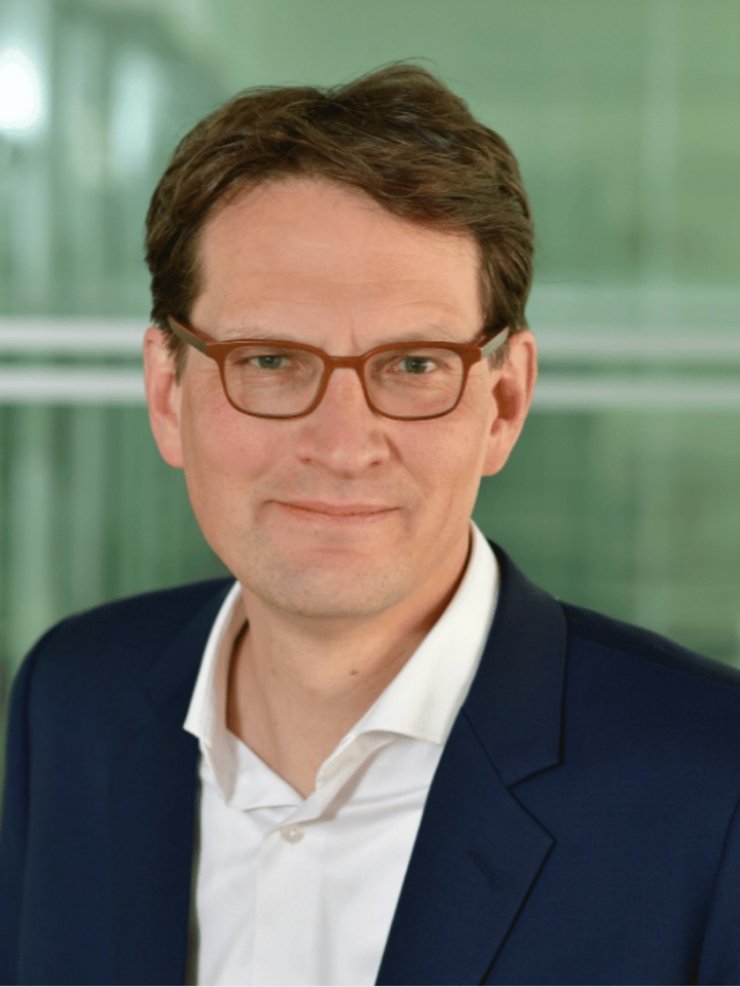
Author
Thinks of Helmut Schmidt as a visionary who certainly did not have all the answers for the 21st century, but who asked the right questions. As Chairman of the Board and Managing Director, Meik’s focus is on the Foundation’s strategic direction, the budget and staff development. He fosters networking across politics, business and culture, and is passionate about innovative projects. As a historian, Meik has edited the extensive correspondence between Willy Brandt and Helmut Schmidt and written a concise 100-page biography of Schmidt aimed at a general audience. He also has many years’ teaching experience, particularly at the University of Cologne.
More