Last week brought renewed turbulence to relations between Europe and the United States of America. This was triggered by the publication of the Trump administration's new National Security Strategy (NSS) and a subsequent interview between the US president and Politico. The strategy document warns of the "civilisational extinction" of Europe - caused by migration, but also by the "activities of the European Union". In the interview, Trump described Europe as "weak", "decaying" and as a player that "doesn't know what to do". On the subject of Russia, he was - unsurprisingly - exclusively positive about its strength, size and military advantages in the war against Ukraine.
As disturbing as the US government's attitude towards Europe is, it is hardly surprising in terms of content. Rather, it emphasises once again the need for Europe to invest more in its own capabilities and become as independent as possible from the USA.
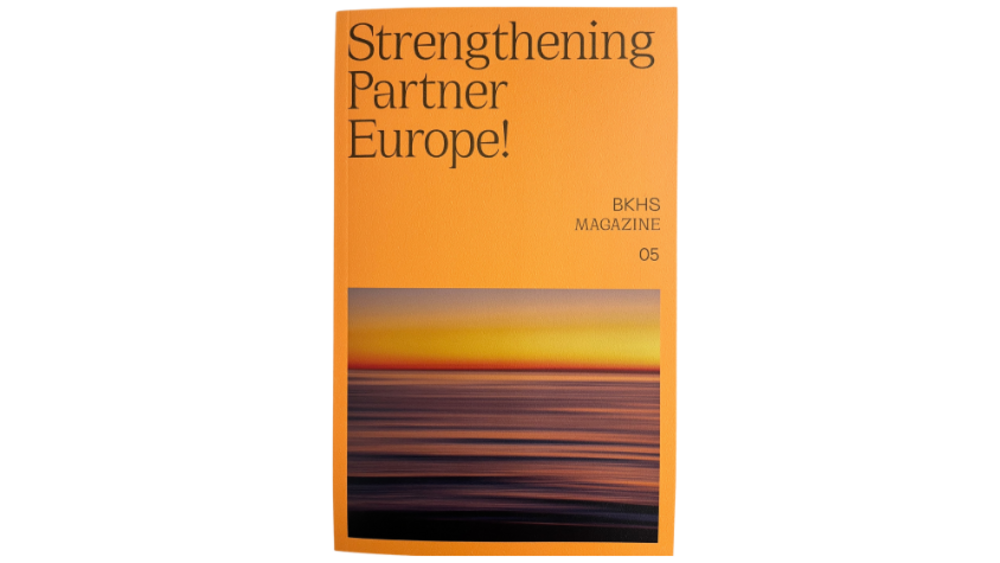
Our recently published BKHS Magazine deals with precisely this topic: How can Europe strengthen its ability to act together with like-minded partners? Under the motto "Strengthening Partner Europe!", BKHS experts and authors from think tanks and academia have developed concrete ideas on how Europe can gain new partners in various fields of cooperation and thus secure its influence in the new multipolar world order. The magazine brings together a wide range of thought-provoking ideas on the future of Europe in the form of essays, statements, photos and interviews. We provide you with some insights here and invite you to read the complete new issue.
The "second turning point"
The role of the USA must be emphasised once again, as it is probably the most important factor and driver for Europe's quest for greater independence and new partnerships. The historic change of course in US foreign policy under Donald Trump represents - as BKHS expert Dan Krause puts it in his essay and as it has now also been taken up in public discourse - a "second turning point" for Germany and Europe. The first turning point was marked by the Russian attack on Ukraine. Both events together have led to Europe being increasingly marginalised by other global powers - even on issues that affect key European security interests, such as the Russian war against Ukraine.
Whether the USA is actually striving for a new form of empire remains to be seen, argues the renowned foreign policy expert and Chair of the International Advisory Board of the BKHS Nathalie Tocci in her article. What is clear, however, is that the current rules-based order is eroding and the world is becoming increasingly dangerous for Europe - as it is for many other countries. Researcher Faith Mabera emphasises that one of the greatest challenges for Europe is to free itself from the "shadow of transatlantic hegemony" and achieve genuine independence, particularly in foreign and security policy.
A "window of opportunity" for cooperation with the Global South
As momentous and disastrous as the American change of course is for Europe and the world, there is one good thing about it: it opens a window of opportunity for Europe to deepen cooperation with countries of the Global South, especially with middle power states such as Brazil, India and South Africa. This assessment is reflected in various articles in the magazine. Tocci and Krause, for example, point out that a world of brutal power politics in which only the might of the strongest applies is just as contrary to Europe's interests as it is to those of the Global South. In fact, all non-major powers have an interest in an (at least minimal) kind of rules-based order that upholds the basic principles of the UN Charter.
In their contribution, the experts Harsh V. Pant and Swati Prabhu emphasise that both Europe and the Global South are critical of China's growing influence in international organisations. At the same time, they identify various points of contact for win-win cooperation - for example in health policy, vocational training and climate policy. BKHS expert Kirsten Hartmann describes another specific area of cooperation: the EU should work with partner countries to drive forward the implementation of the UN Youth, Peace and Security (YPS) agenda. Many countries in the Global South not only have large youth populations, but are also far ahead of Europe in implementing YPS - an ideal basis for mutual exchange and cooperation.
The continued importance of values
Europe is facing increasing pressure to soften its value orientation in favour of narrow material interests. On the one hand, there has long been criticism of the "double standards" of the West and the selective application of its values. On the other hand, power politics and economic competition are gaining in importance, leading some in Europe to see value-orientation as a strategic disadvantage.
However, experts Julia Ganter and Leonie Stamm warn in their essay that turning away from values would be a strategic mistake. Europe's normative commitments to democracy, the rule of law and human rights, for example, are an "expression of long-term collective European interests". Their consistent application would not only serve to strengthen Europe's credibility with partners, but also to secure social cohesion in Europe itself. Instead, Ganter and Stamm argue in favour of a principled yet pragmatic foreign policy. This should be based on partnerships and emphasise reciprocity, equality and shared ambitions. BKHS Fellow Dorothée Falkenberg also argues that sticking to values will prevent the EU from abandoning hard-won regulations to protect civil rights in the name of a truncated understanding of "competitiveness".
Social justice and social cohesion
Social cohesion and the unity of Europe are increasingly being challenged by right-wing populist forces from within and by hostile actors such as Russia - and, it is to be feared, the USA in the future - from outside. Against this backdrop, several contributions are dedicated to the question of how the stability, resilience and freedom of European societies can be secured as a prerequisite for Europe to act effectively in foreign policy.
In their essay, BKHS experts Lea Holst and Elisabeth Winter also criticise the current, abbreviated definition of economic competitiveness in the EU. The focus on pure efficiency threatens to undermine the foundations of the resilient European economic model - a model that is essentially based on strong social security systems and the principle of justice. Europe must therefore preserve social justice as a prerequisite for long-term competitiveness and as the basis of its own credibility.
BKHS experts Alisa Rieth and Merle Strunk approach the same questions from a different perspective - European identity - and yet come to the same conclusion: Europe needs more social justice and solidarity. In view of the existential challenges facing the continent, the EU must evolve from an elite-driven to a citizen-driven project that is able to inspire passion and commitment for Europe.
In his essay, digital expert Alexander Sängerlaub also argues in favour of active European citizens: He outlines a utopian future scenario in which Europe becomes a "resilient, sovereign information power" by 2050. He describes the corrosive effects of today's media ecosystems dominated by Silicon Valley algorithms and US tech oligarchs and outlines a possible way forward - including the creation of a European digital commons, more transparency in political communication, new journalistic models and universal media and information literacy.
This brief overview of some of the central themes of the magazine can only offer a first glimpse of the diversity of contributions to the debate on Europe's future. We invite you to take a look for yourself - and look forward to your feedback. We wish you a stimulating and enriching read of "Strengthening Partner Europe!"