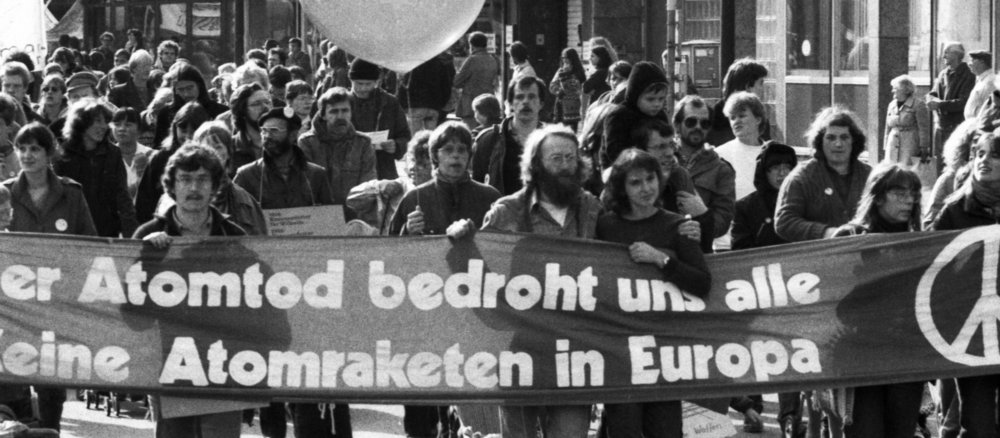
40 years ago, the German Bundestag passed the NATO Dual-Track Decision. This provided for newly deployed Soviet medium-range missiles of the SS-20 type to be confronted with its own nuclear missiles in order – according to the justification of the Western defence alliance – to compensate for a backlog in this area. In the 1970s and 1980s, the meaning and justification of nuclear armaments within and outside Europe was the subject of bitter debate – not only at the political level and among experts. The issue moved hundreds of thousands of people in the Federal Republic of Germany, and a peace movement, mostly supported by the churches, also emerged in the GDR.
Central aspects of the conflict were discussed in two academic forums at a conference organised by the Bundeskanzler-Helmut-Schmidt-Stiftung and the Bundeskanzler Helmut Kohl Stiftung on 11 October in Berlin. On the one hand, metaphorically speaking, the view from the commanding heights of politics, military strategy and armaments technology issues, and on the other, society's view of the issues and decisions of the time.
Shared concern for the strategic balance
Dr Michael Borchard, member of the board of the Bundeskanzler Helmut Kohl Stiftung, began by talking to Dr Tim Geiger, research associate at the Institute of Contemporary History and for many years one of the leading experts on the historical events surrounding the NATO Dual-Track Decision. This exchange was particularly exciting when Geiger questioned seemingly common certainties based on his in-depth knowledge of the files. In numerous articles, speeches and media reports, for example, the simplistic image persists to this day that Helmut Schmidt initiated the Dual-Track Decision in a speech to the London International Institute for Strategic Studies in October 1977. The fact is that Helmut Schmidt was one of the prominent pioneers of “rearmament”, but favoured a negotiated solution. However, Geiger pointed out that other factors also had to be taken into account in the genesis of rearmament. Technological constraints should also be taken into account: Old Western medium-range missiles in Europe often targeted their own territory due to their short ranges – an important reason for the alliance to modernise its own arsenal. Such a modernisation was on the agenda anyway – so less persuasion was required on Schmidt’s part vis-à-vis the US government under Jimmy Carter than is often reported.
Geiger pointed out another important point: Western Europe’s nuclear defence was (and still is) dependent on the USA. Schmidt had recognised that a nuclear strike by the Soviet Union using modernised medium-range missiles aimed solely at Europe could test the USA's resolve to retaliate. A counter-strike by the USA would inevitably have jeopardised US territory and thus its own civilian population. Schmidt saw a “credibility gap” here and accordingly the need for a balance in this weapons category between East and West – this is also an aspect that is rarely discussed in popular accounts of the events around 1980. This also includes the fact that since his standard works on military strategy issues from the 1950s and 1960s, Schmidt had always spoken out in favour of strengthening NATO's conventional, i.e. non-nuclear, arsenals in order to maintain a credible deterrent in this way.
Security policy in social negotiation
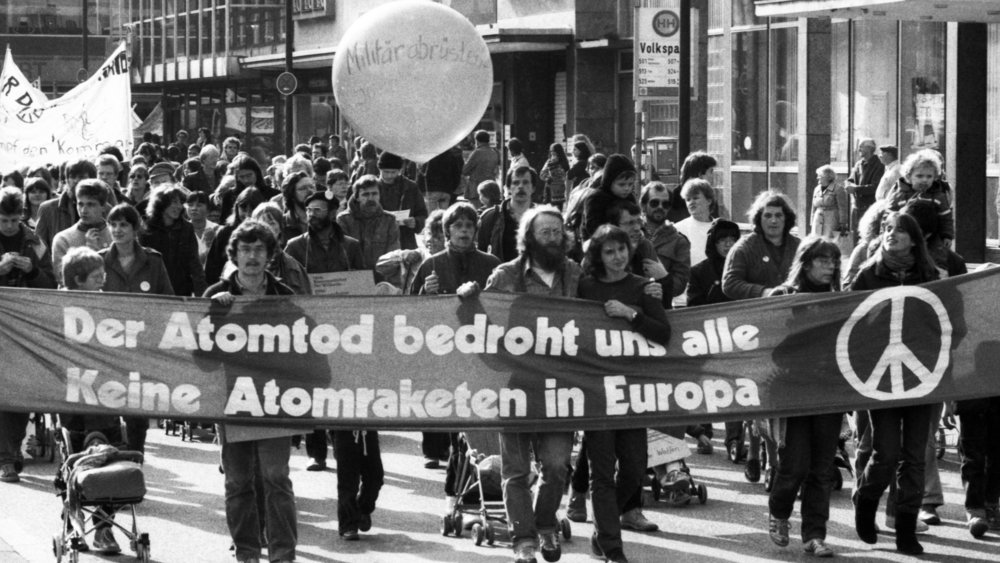
An interesting link to the second panel arose from a conceptual issue: in the aforementioned speech in London, Helmut Schmidt spoke a great deal about the role of social and political stability for comprehensive security in Western Europe. Both were the cornerstones for the preservation of Western democracies. For Schmidt, modern nuclear armaments and the “policy of equilibrium” that he emphatically advocated were only part of a more comprehensive security concept. In his short lecture, Prof Dr Eckart Conze, a contemporary historian at the University of Marburg, turned to concepts of security and security policy that were subject to constant change in the years surrounding the NATO Dual-Track Decision and to this day. For the Federal Republic of Germany, he focussed on the perceptions of an increasingly self-confident civil society. He spanned an arc from the discussions surrounding the first peace movement at the beginning of the 1950s (“Fight Nuclear Death”) to highly emotional debates about the country’s own Nazi past (for example, the broadcast of the US television series “Holocaust”) and the human chains and mass demonstrations in the wake of the NATO Double-Track Decision of December 1979, linking images of the mass murder of European Jews from the Nazi era with those of a nuclear catastrophe.
At the same time, Conze noted a deep mistrust of an over-technologised paradigm of progress, which was reflected in the rejection of nuclear armament in both East and West. For the strong voice of the churches in the ranks of the peace movement, the Schmidt and Kohl governments’ understanding of security did not go hand in hand with their ideas of peace: both were mutually exclusive because peace could only be achieved with trust. In addition, strong voices in the peace movement called for a democratisation of security policy: they had become too dependent on an “expertocracy” that hardly allowed people to have access to existential issues. Instead, the peace movement had called for a strengthening of direct democracy. However, the government coalitions before and after October 1982 did not want to open up to this.
The keynote speeches by Conze and PD Dr Claudia Kemper (LWL Institute at the University of Münster) were linked by the question of what the pursuit of an increasingly far-reaching concept of “security” meant in terms of democratic policy. Kemper put forward the thesis that the protest against the double decision was linked to resistance against a lack of political control in the face of increasingly difficult economic and social conditions in the Federal Republic around 1980. The movement against NATO’s “rearmament” was fuelled by the reservoir and experiences of other social movements. Hundreds of thousands – often organised in local and regional groups – demonstrated almost exclusively peacefully. This was also the achievement of a civil society following democratic rules. According to Kemper, the fact that this mass movement was not able to prevail in the early Bundestag elections in 1983 was also due to the fact that the coalition of CDU/CSU and FDP focussed on economic and social issues, which would have been closer to most people’s hearts than the fear of the consequences of a nuclear war. In the ensuing discussion, opposing points of view became apparent, which not only questioned theories (such as: “There is a connection between the territorial reform in the Federal Republic and the protest movements years later”), but also revived the contrast between contemporary witnesses and historical researchers.
From the NATO Double-Track Decision to the Turning Point
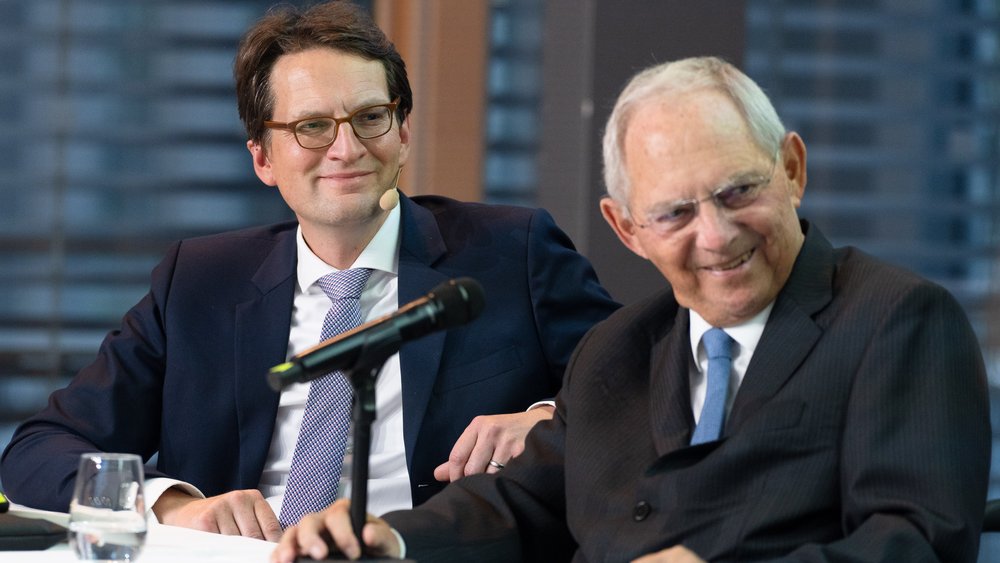
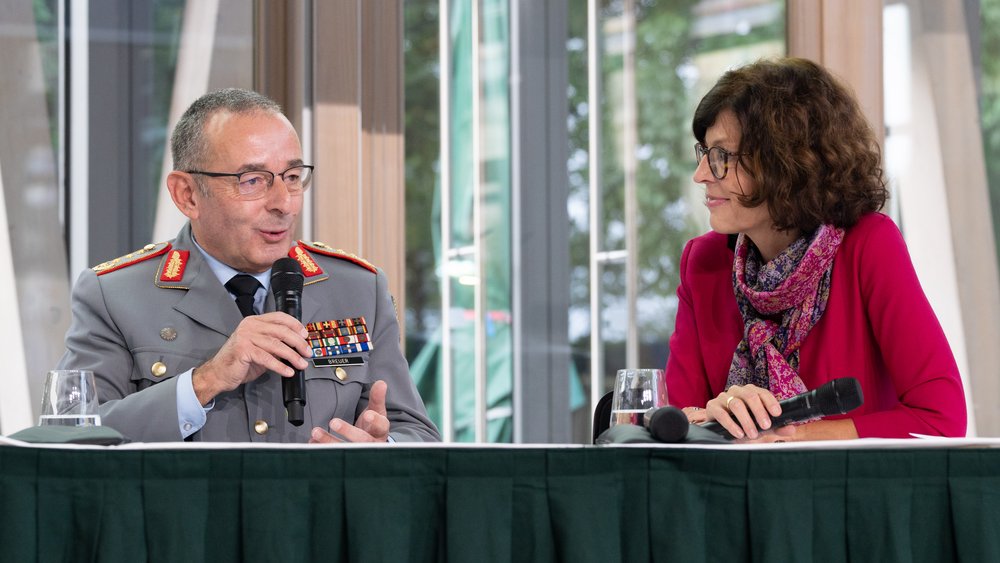
In the concluding evening event with representatives from politics and the Bundeswehr, the assessments shifted from the scientifically pondering mode to the politically exacerbating mode, with the panellists agreeing on the main points. The Chairman of the Board of Trustees of the Bundeskanzler-Helmut-Schmidt-Stiftung, Peer Steinbrück, made the connection between the historical events around 1980 and the recent wars in Ukraine and the Middle East. Today, as then, a clear distinction must be made between aggressive and peaceful forces. This assessment was also shared by the former President of the Republic of Latvia Egils Levits, who joined the event via video message, and the panel guests, former Bundestag President Dr Wolfgang Schäuble and the highest-ranking soldier in the Bundeswehr, Inspector General Carsten Breuer. Levits, whose home country in the Baltic states is directly exposed to Russia’s belligerent policies, took a particularly clear stance: freedom and democracy here, oppression and dictatorship there. Building a historical bridge, he noted that Schmidt and Kohl had defended the liberal social order back then – and that the same must be done today. In the ensuing discussion, Schäuble and Breuer were in demand both as political actors and as contemporary witnesses. The former has been a member of the German Bundestag for the CDU for over 50 years and worked closely with Helmut Kohl in various top positions in the party and state, while the latter was a young soldier in the 1980s and is now a general in the Bundeswehr. Both agreed that the determination of Western governments to push through the NATO Dual-Track Decision, even in the face of massive protests, had made it clear to the Soviet Union and the Warsaw Pact states that the USA and Western Europe could not be separated. This not only led directly to the INF Treaty on the scrapping of all medium-range missiles in Europe in 1987, but also to the end of the bloc confrontation around 1990.