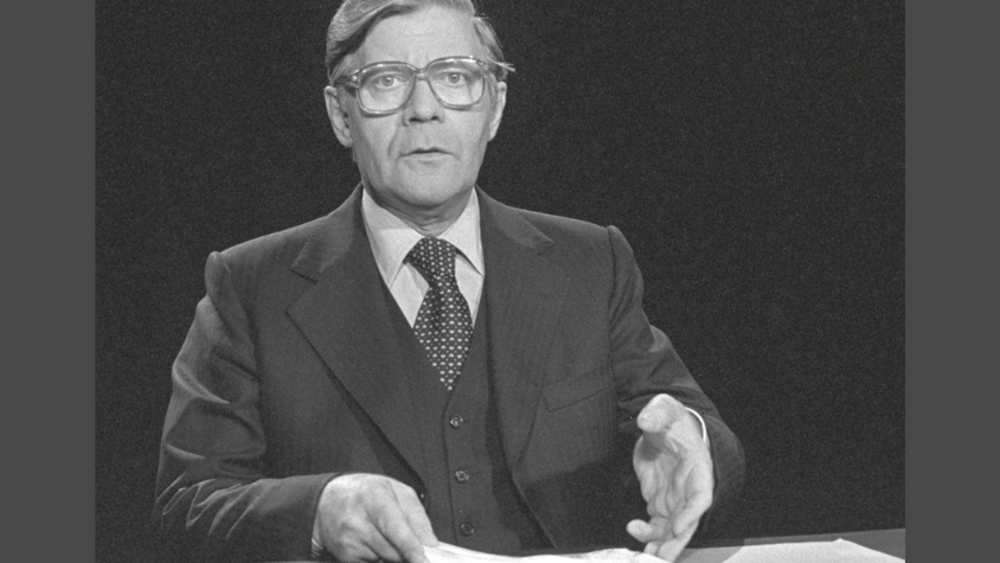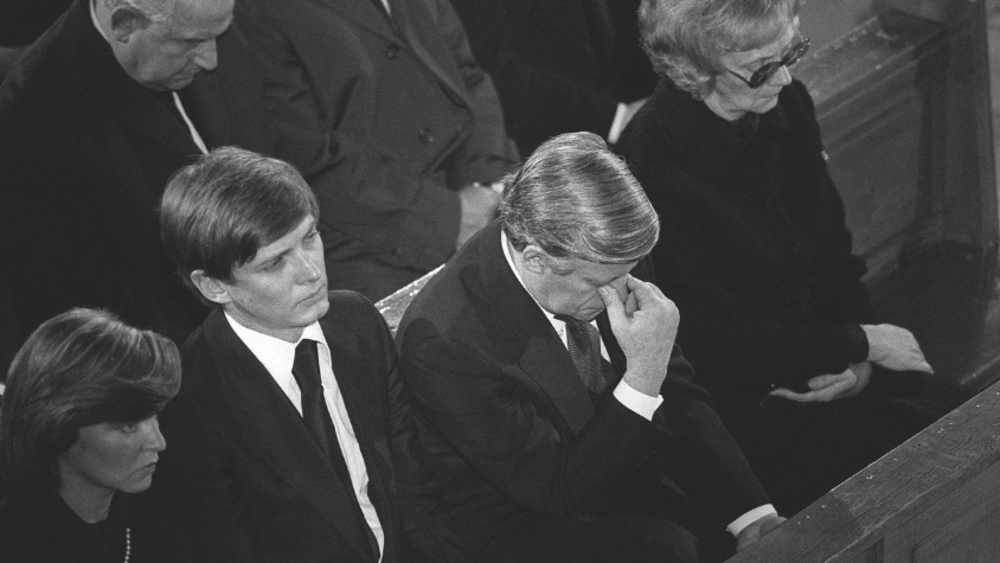
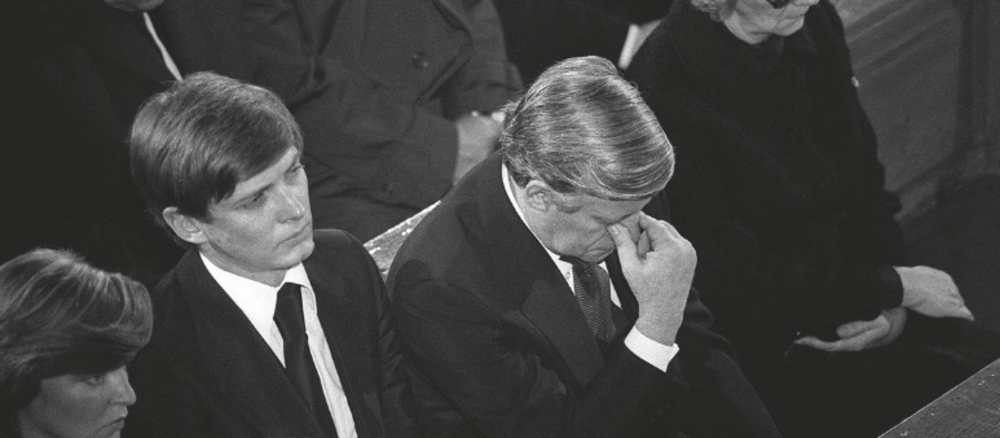
They are familiar images: Hanns Martin Schleyer in captivity of the Red Army Faction (RAF) on the cover of Der Spiegel, the poster with the wanted photos of the terrorists, Helmut Schmidt with a serious expression as he declares in his televised speech: “The will of the entire people stands against terrorism”, queues of cars in front of road checks during the dragnet. And again Helmut Schmidt, visibly affected, at the funeral service for the murdered employer president between Schleyer’s widow and one of his sons. RAF terrorism has become deeply inscribed in Germany’s collective (visual) memory. This is not only due to the fact that the RAF, as an “image machine”, always focussed its actions on their media impact. It also shows the seriousness with which politicians and authorities confronted left-wing terrorism and the extent to which it shook the population. Today, the RAF is the subject of school lessons, and the “German Autumn” is featured in the media on round anniversaries.
The situation is quite different when it comes to right-wing extremist violence in Germany. For a long time, there were hardly any memorials. If teachers deal with these events in the classroom, they may be met with hostility. The relatives of the victims of the NSU complex, the largest series of right-wing terrorist murders and attacks since 1945 with ten fatalities between 2000 and 2007, are still fighting for a complete reappraisal of the crimes and the commemoration of the victims. It is mainly thanks to their persistent commitment that a public debate about the “National Socialist Underground” is still taking place after the end of the trial in 2018.
The acts of the NSU are part of a long chain of right-wing extremist acts of violence in Germany, which were often not initially treated as such in their full dimension and did not trigger the public outrage and political consequences that would have been appropriate for their scope. This ignorance created a distorted image of history for decades.
“They did everything except look to the right”, said Gül Pinar, a lawyer for relatives, in 2015 at a conference on the work of the Hamburg State Criminal Police Office following the NSU’s murder of Altona grocer Süleyman Taşköprü. Instead of considering the possibility of a racist and right-wing extremist motivated crime, the family itself was placed at the centre of the investigation. Such serious misconceptions are symptomatic and highlight continuities in the handling of right-wing violence in Germany. Even in the early post-war years, a pattern emerged in state behaviour towards right-wing extremist crimes: they were often underestimated.
Right-wing extremist structures after 1945
The history of right-wing structures does not end with Germany's capitulation in 1945. National Socialist continuities in personnel, for example in politics, the judiciary and administration, were normality in the young Federal Republic and society did not change abruptly either. National Socialism was a mass movement. Its misanthropic ideas were correspondingly widespread. Above all, the economic success that went hand in hand with the establishment of the parliamentary system increased the level of accommodation with the new democratic system.
Against the backdrop of efforts to integrate the West, it was important for the federal governments to distance themselves from National Socialism. The Socialist Reich Party, which saw itself as the successor to the NSDAP, was banned as early as 1952 and other groups, mainly consisting of people with a Nazi past, were smashed – but not always consistently prosecuted. The proceedings against the so-called Gauleiter circle around Werner Naumann, Joseph Goebbels’ last state secretary, who endeavoured to infiltrate the FDP in North Rhine-Westphalia, were dropped as early as 1954.
The neo-Nazi movement grew significantly in the 1950s. Right-wing extremist ideas were passed on, particularly in the supposedly pre-political sphere of cultural and youth organisations such as the Viking Youth. in 1959, a wave of anti-Semitic incidents, such as swastika graffiti on the newly inaugurated Cologne synagogue, brought the issue to the attention of a wider public for the first time. Although the acts were immediately condemned and led to the creation of the criminal offence of “incitement of the people”, Chancellor Adenauer trivialised the perpetrators as “louts”. The government blamed the GDR state security for the graffiti, without any concrete evidence. Such trivialisation and externalisation is one of the reasons why there are considerable gaps in the memory of right-wing extremist violence after 1945.
Radicalisation in “combat groups”
As a result, the 1960s and 1970s saw the formation of increasingly violent combat groups. These so-called military sports groups were initially tolerated in some federal states. The starting points for the constant radicalisation of these groups included their growing anti-communism and the rejection of Willy Brandt’s Ostpolitik, but also the failure of the movement to gain a foothold legally: in 1969, the NPD failed to enter the Bundestag due to the five per cent hurdle.
In the 1970s, right-wing extremist organisations repeatedly carried out attacks. Members of the “European Liberation Front” (EBF) kept “blacklists” of people from politics and journalism. In 1970, EBF member Ekkehard Weil murdered a Soviet guard in Berlin-Tiergarten. He was categorised as a lone offender and released from prison early after four of six years. A misjudgement: the supposed lone offender Weil later committed further attacks, also in association with Austrian right-wing extremists. Other groups such as the “Wehrsportgruppe Hengst” and the “Nationalsozialistische Kampfgruppe Großdeutschland” planned attacks against political enemies in the 1970s and stockpiled weapons and explosives – the NSKG members were only sentenced on probation. The “Ludwig Group” carried out nine attacks in northern Italy and one in the “Melamara” discotheque in Munich.
Reference point RAF
These and other offences did not escape the attention of the authorities. However, since 1977 at the latest, right-wing terror was measured against the terror of the left-wing extremist RAF. From then on, it was regarded as a benchmark for extremist attacks in Germany. If offences did not conform to the familiar pattern, for example by leaving behind letters of confession, politicians and authorities did not treat them with the same attention. This also applies to media coverage. However, right-wing extremist terror has always had other forms of expression than that of the left.
For Interior Minister Gerhart Baum (FDP) in the Schmidt cabinet, “the threat to our internal security posed by right-wing extremism did not have the same quantitative and qualitative weight as that posed by left-wing extremism”. In 1979, 1,483 offences by right-wing extremists were registered, 117 of which involved the use of violence – more than at any time since the end of the Second World War. in 1980, this terror increased again: two residents died in an arson attack on a refugee centre in Hamburg. In September, a right-wing extremist kills 13 people at the Munich Oktoberfest and 221 are injured, some of them seriously. The attacker is thought to be a lone offender. This assumption is still highly controversial today, as he has been proven to have clear links to the Wehrsportgruppe Hoffmann and other neo-Nazi organisations.
Dangerous pattern: trivialising and depoliticising
Under Federal Chancellor Helmut Schmidt, the SINUS study on right-wing extremism was commissioned in 1980, with alarming results: 13 per cent of the population showed an “ideologically closed right-wing extremist world view”. However, the findings were politically devalued and questioned from various sides. Schleswig-Holstein’s Minister of the Interior, Uwe Barschel (CDU), felt that this publication would damage Germany's reputation abroad. The “danger of right-wing extremism”, he wrote in Die Zeit in 1981, lay in the fact that “individuals or small groups that are difficult to control spontaneously undertake senseless acts of violence”. Barschel was thus catering to the myth of the lone right-wing perpetrator.
The trivialisation and depoliticisation of right-wing extremist violence continued in the following years. It contributed to the NSU being able to organise itself in the increasingly xenophobic climate of the 1990s and finally carry out its attacks from 2000 onwards. After being unmasked, the NSU was treated as a trio for a long time. Extensive right-wing extremist networks were not recognised. Another misjudgement: the NSU did not consist of three people, but was surrounded by a close network of support. Comparatively low sentences were imposed on parts of this network. This was one of the reasons why many people protested against this treatment of right-wing extremist networks after the end of the trial and demanded that “no line be drawn”.
The terror from the right must be read in the context of these continuities: in order to create clarity in the politics of remembrance and to formulate new guidelines for dealing appropriately with right-wing extremist violence and its victims in the future.
“Bloody Ground” exhibition at the Altona Museum
The memory of the victims of the NSU Enver Şimşek, Abdurrahim Özüdoğru, Süleyman Taşköprü, Habil Kiliç, Mehmet Turgut, İsmail Yaşar, Theodoros Boulgarides, Mehmet Kubaşık, Halit Yozgat and Michèle Kiesewetter is slowly but steadily finding its place in the German culture of remembrance. Relatives, civil society organisations and artists are helping to give expression to the often still image- and speechless memory of these crimes.
In 2013 and 2015/16, photographer Regina Schmeken visited the crime scenes where the NSU committed the murders. Her large-format black and white photographs show the disturbing normality of the scenes of hatred and violence in the centre of German cities. Until July 2026, her pictures are on display in the exhibition “Bloody Ground. The NSU crime scenes” at the Altona Museum in Hamburg.
In cooperation with the Altona Museum, themed tours of our exhibition “Schmidt! Living Democracy” in the Helmut-Schmidt-Forum: “Right-wing extremism in the FRG 1945 to 1990: ruptures and continuities”. We will shed light on the history of right-wing extremism after 1945 and its historical contexts.