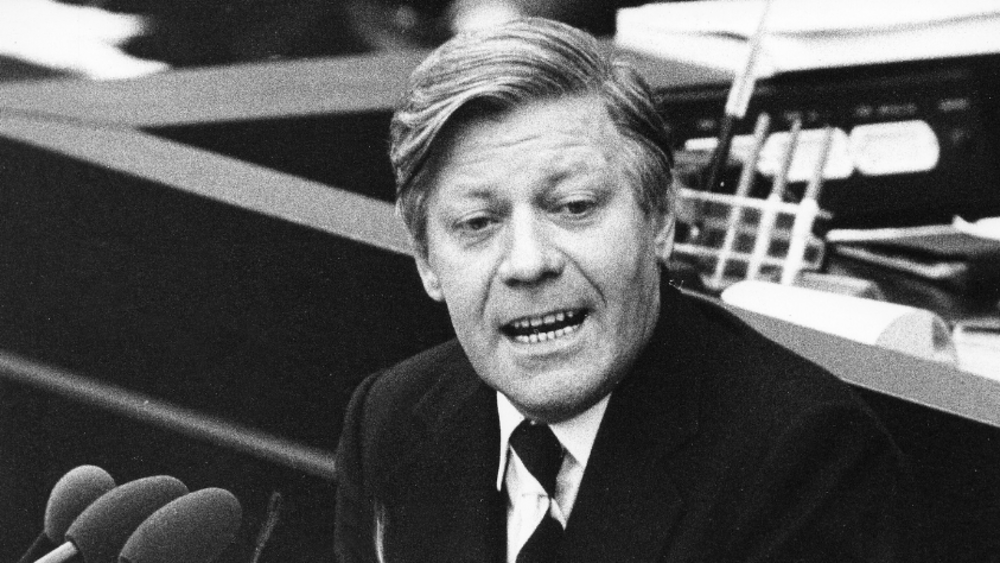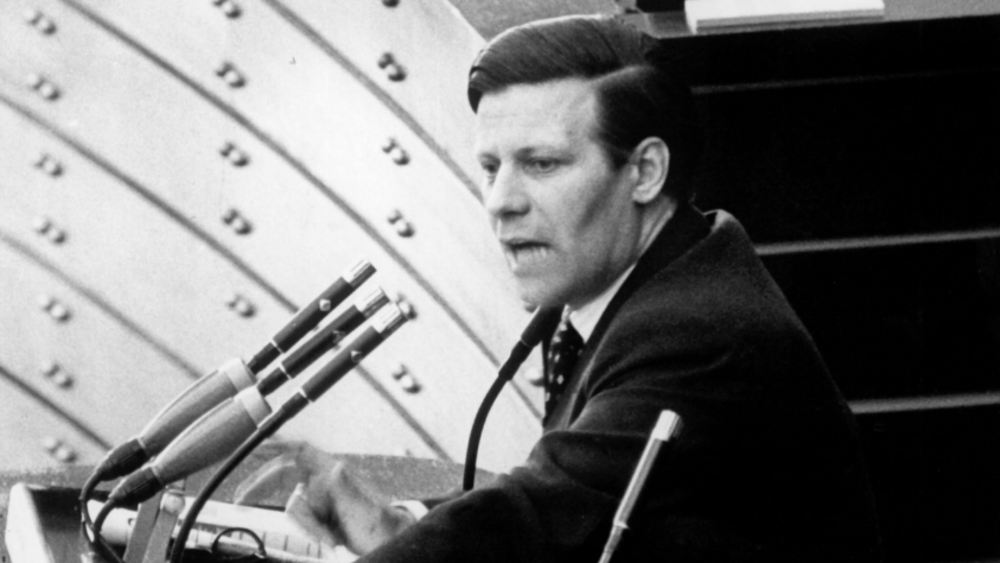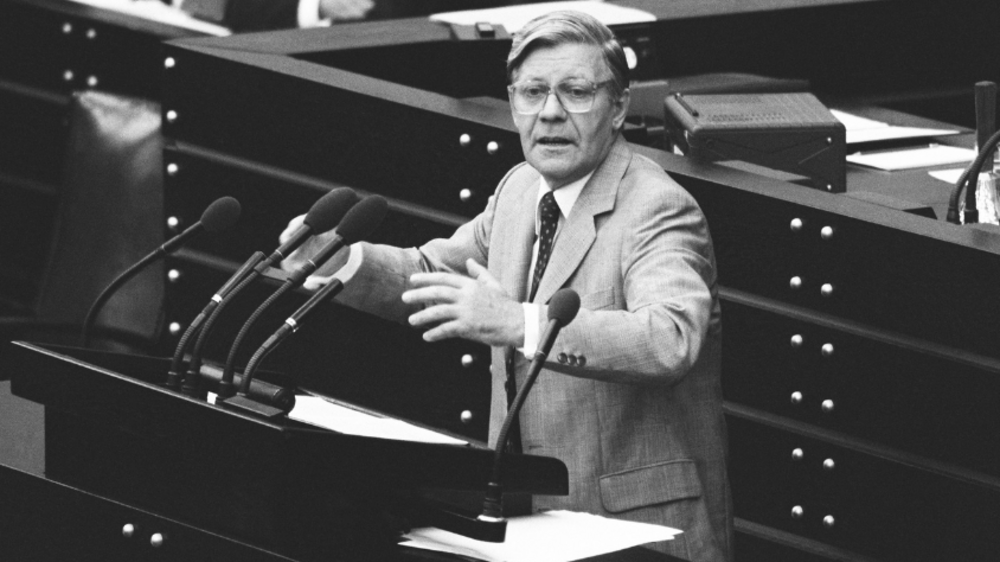
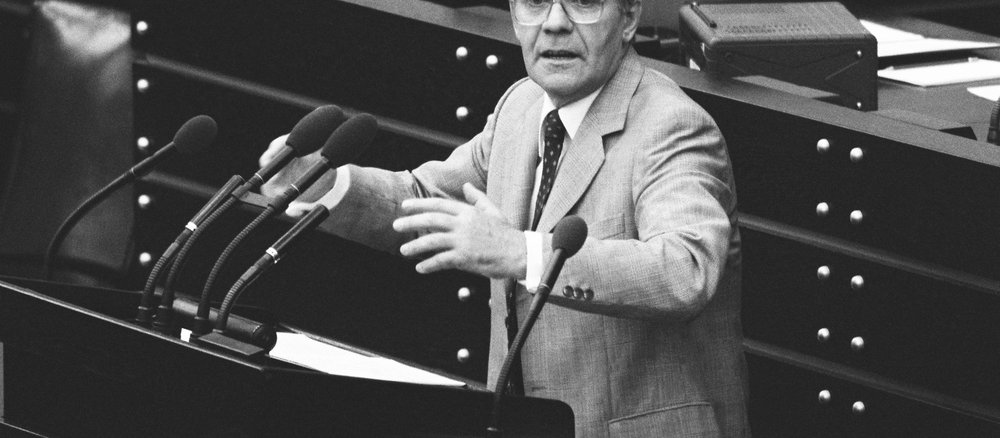
Under the headline “Schmidt-Schnauze doesn’t avoid the storm”, the Süddeutsche Zeitung of 7 September 1965 referred to a characteristic feature that still shapes the public memory of Helmut Schmidt today: “His oratorical talent is of such a solitary top class that he is still able to cover areas with sovereign ease where others would have long since stumbled and had to look for opportunities to retreat.” At the time the article was published, Helmut Schmidt was still working as Senator of the Interior for Hamburg. However, it highlights Schmidt’s special rhetorical talent, which would also come to the fore at the highest political level when he took on party and federal offices.
However, parts of the well-known phrase “Schmidt-Schnauze” had already appeared a few years earlier. An article in the same newspaper on 17 January 1957 noted Schmidt’s “oratorical temperament” and quoted him as saying: “I am the man with the quick mouth.” Schmidt took up the term again two years later when he remarked in a letter to the Frankfurter Allgemeine Zeitung on 29 July 1959 that the political opposition had nicknamed him “Schnauze” (snout). Parliamentary debates at the time were sometimes polemical, which was also linked to the prevailing political constellation at the time: the CDU/CSU saw itself as the governing party, while the SPD was only able to assume co-responsibility at federal level in 1966 and, as the largest opposition party until then, sharply attacked the course of the CDU/CSU/FDP coalition. It was in this political climate that the rhetorician Helmut Schmidt matured and achieved cross-party fame. A remark made by CDU MP Walter Brookmann during a debate in the Bundestag on 9 May 1957 is indicative of this: the young MP from Hamburg was “sufficiently well known in this House for his rhetorical escapades”.
First clues
However, it is difficult to date the first mention exactly. An important clue is provided by an interview with Helmut Schmidt in the magazine mobil from July 2010, in which Schmidt referred in retrospect to the common practice in parliamentary work in the 1950s of adding their respective constituencies to members of the Bundestag with frequently occurring surnames in order to distinguish them from one another: “Schmidt” became “Schmidt-Hamburg”. The decisive factor in the creation of “Schmidt-Schnauze” was then a dispute with the CSU MP Richard Jaeger. In the 1950s, Jaeger had publicly championed the political interests of Taiwan, often referred to as Formosa at the time. In the course of a “very polemical parliamentary speech”, according to Schmidt, he referred to him as “Mr Jaeger-Formosa”. Jaeger then returned the favour and “turned Schmidt-Hamburg into Schmidt-Schnauze. That’s how it was”.
A brief look at the speech in question makes this origin story seem entirely plausible. During a debate lasting several days in March 1958 on the occasion of the “FDP’s major question on the ‘summit conference and nuclear-free zone’”, the CDU/CSU argued about the nuclear armament of the Bundeswehr, which had officially been in existence since November 1955. The SPD parliamentary group rejected the plan due to the tense military situation between East and West and the feared negative effects on overcoming the division of Germany. Schmidt intervened in the debate on 21 and 22 March 1958 as a heckler and speaker. By the time of his first official speech, a total of nineteen representatives of the governing parties and only eight speakers from the opposition had had their say.
Verbal exchange of blows in the Bundestag
Selected sequences from the speech and from Schmidt’s numerous interjections, which must be regarded as the most aggressive from the ranks of the opposition, emphasise his oratorical skills and political instinct in the context of a highly emotional debate. Only a fraction of his statements were devoted to a specific issue, namely the SPD-supported plan to develop a zone of conventional troop reduction from a nuclear-free zone in Central Europe. Instead, Schmidt focussed on individuals, above all on the aforementioned CSU politician Richard Jaeger. Schmidt accused the latter of “pig-like agitation” and was called to order for this statement. A reference to Jaeger’s political commitment to Taiwan (Formosa) can also be found in the minutes of the Bundestag debate: “Send him back to Formosa, that’s where he belongs!” Schmidt did not shy away from drastic comparisons either: the “decision to arm the two parts of our fatherland with nuclear bombs against each other would one day be regarded in history as just as serious and disastrous” as “the Enabling Act was for Hitler at the time”. At the end of his speech, which was interrupted by numerous interjections, Schmidt once again attacked the CSU MP personally: “Let’s protect our community from demagogues like the Westerner Dr Jaeger!”
This sparked a flurry of heckling from both the government and opposition parliamentary groups, which almost led to the session being interrupted. There was talk of the “gravedigger of democracy”, of the “cheekiest lout in the whole House” and of the “most primitive speech ever made here”, of a “single bucket of dirt that has been poured over this House”. The inglorious climax was marked by the statement made by CDU MP Kurt Schmücker, who indirectly equated Schmidt with the former National Socialist propaganda minister Joseph Goebbels: “Sportpalast! This was a sports palace!”
He doesn’t put up with anything
It is clear that the young parliamentarian Helmut Schmidt knew how to draw attention to himself in the German Bundestag early on, with his contributions to the debate in March 1958 in particular representing a turning point. Almost overnight, “Schmidt-Schnauze” seemed to have become a personality of national importance. In the course of the parliamentary debate, he received over 400 congratulatory letters and telegrams. Schmidt presented himself to a nationwide public as an excellent, but when necessary quite polemical speaker, who gained political profile through the verbal exchange of blows with CSU MP Richard Jaeger. It is therefore not surprising that Schmidt summarised in an interview with the magazine mobil in 2010 that he “didn’t particularly like” his nickname “Schmidt-Schnauze”, but: “At the same time, I also took it as a kind of recognition: he doesn't put up with anything!”