
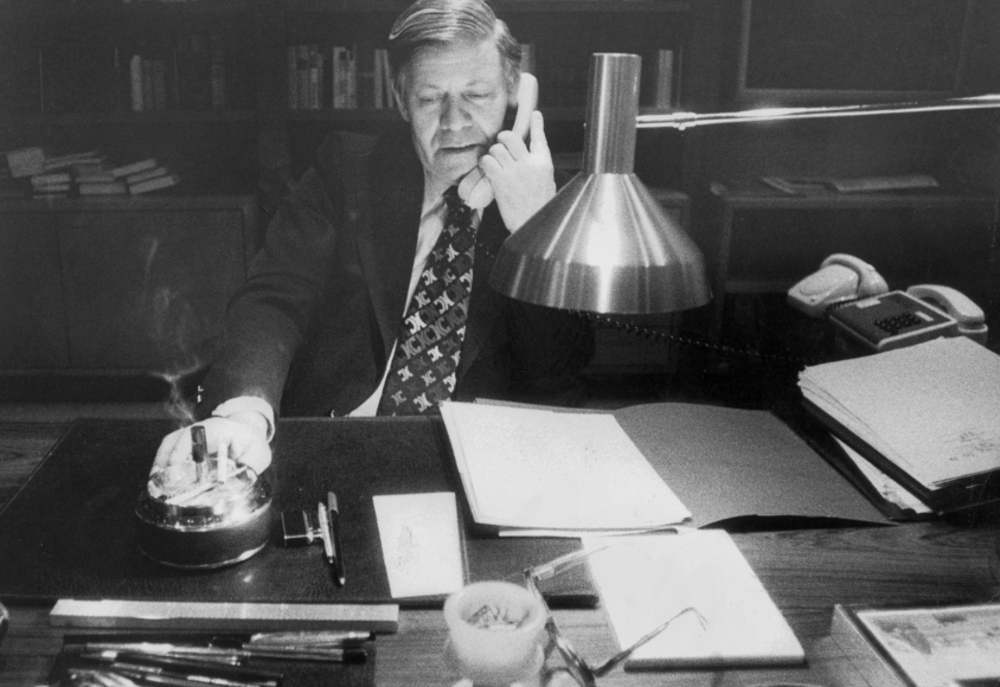
"What is a terminal device?" Helmut Schmidt wrote this question on his private telephone bill in 1999 with his famous green felt-tip pen. Throughout his life, he was reluctant to embrace technical innovations in telecommunications, especially the Internet. He did not own a computer. Schmidt wrote his manuscripts by hand and had them researched. He was also known for his sceptical attitude towards television. in 1978, he advised German citizens to take a day off from television each week to enjoy family life. Nevertheless, as Federal Chancellor, Helmut Schmidt almost became a pioneer in the field of telecommunications and data transmission.
30-year plan for the expansion of the fibre optic network
"For the expansion of an integrated broadband fibre-optic telecommunications network, an annual investment of DM 3 billion would require a period of 30 years. From 1985 onwards, one thirtieth of Germany would be wired in this way every year." This was the optimistic view of the Federal Minister for Post and Telecommunications Kurt Gscheidle at the beginning of the 1980s regarding the future of fibre optic network expansion in the Federal Republic of Germany. This statement has been preserved in the cabinet minutes of the Federal Government dated 13 May 1981, which can be found in the Helmut Schmidt Archive in Hamburg-Langenhorn and provides an insight into a long-forgotten project of the SPD. As chancellor, Helmut Schmidt supported the plans of his post minister to replace the old telephone cables with a modern fibre optic network.
Fibre optic network in Germany today
Do you, dear reader, often despair of a slow Internet connection? Then you will realise that Kurt Gscheidle's plan has not been implemented after all. In an OECD comparison of fibre-optic network expansion, Germany ranks 36th out of 38, making it one of the bottom performers in the ranking of industrialised countries in this area. Only 8.1% of all stationary broadband connections in Germany were connected to a fibre optic cable in 2023. Back in the early 1980s, Der Spiegel reported under the headline "Full speed ahead" that fibre optics was the technology of the future and promised much faster data transmission. But the expansion would have been lengthy and would have taken over 30 years. The then Postal Minister Gscheidle was also aware of this when he presented his plans in 1981. For technical reasons, it would not have been possible to start the expansion until 1985. Western Germany would then have been completely covered by a fibre optic network by 2015. The connection components would no longer be usable due to today's technical requirements, but the passive infrastructure, i.e. the fibre optic lines, probably would have been.
Helmut Schmidt, the "fibre optic chancellor"?
helmut Kohl became Federal Chancellor in 1982 and opted for copper cables instead of fibre optics, which opened up the world of private cable television to Germany with more than 30 channels. Coaxial cables were cheaper and promised a faster solution than fibre optics, whose technical development had not yet been completed. At the time, a heated dispute broke out between the SPD and CDU over media policy issues. The CDU accused the SPD of being hostile to technology, while the SPD wanted to refute this claim by expanding the fibre optic network.
So did Helmut Schmidt almost go down in history as the "fibre optic chancellor"? There is no clear answer to this counterfactual question. The 30-year plan would have meant an enormous investment over several decades. Even if it had been implemented, the fibre optic infrastructure would have had to be upgraded and brought up to date. In addition, the plan at the time was of course only limited to West Germany. After the fall of the Berlin Wall, a larger area would have had to be developed. Either way, the change of chancellor in 1982 prevented the plan from being realised.
Abolition of the service charge privilege
The topic is particularly topical today. On 1 July 2024, the so-called ancillary cost privilege will be abolished. Cable connections may then no longer be billed on the basis of collective contracts for ancillary rental costs. When cable television was introduced 40 years ago, the legislator wanted to make access easier for citizens through this billing method. Today, fewer and fewer Germans watch television via a cable connection, but some still pay for it due to the collective contracts. In future, tenants will have to conclude their own contract if they want to receive cable television. The option of digital reception and streaming providers on the internet have replaced the once modern cable television.