
The "Battle of Brokdorf" was also a fight for basic democratic rights
27. Feb 2021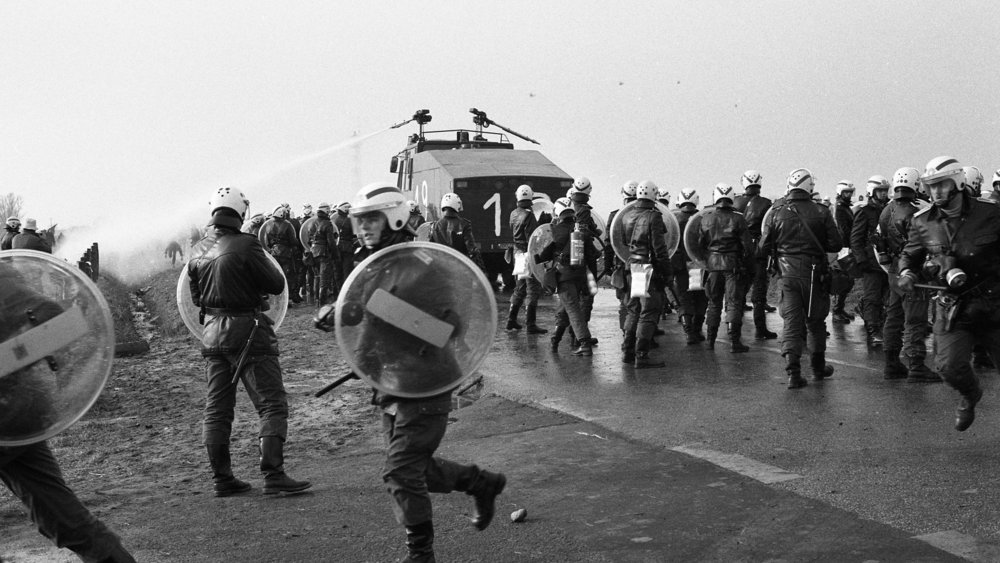
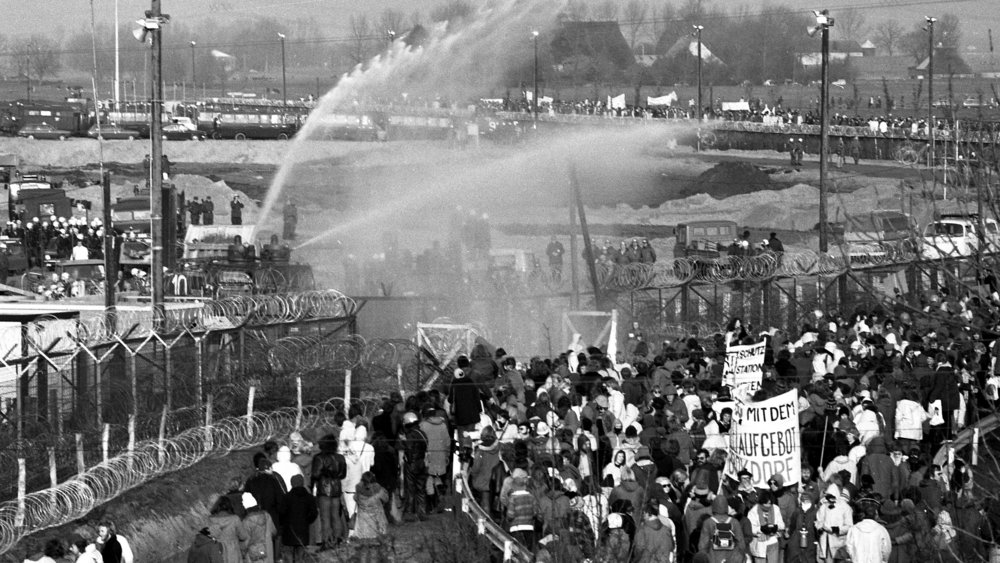
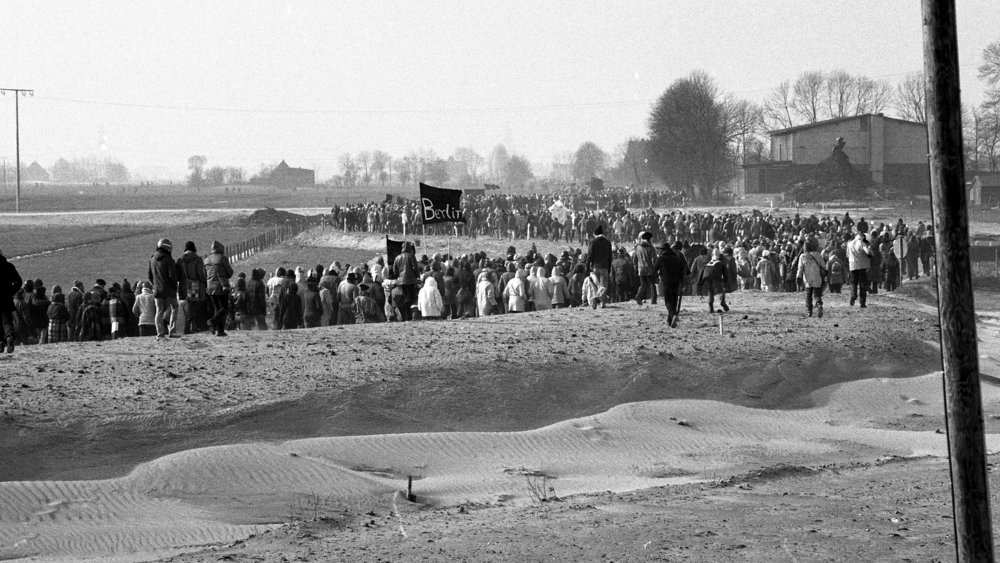
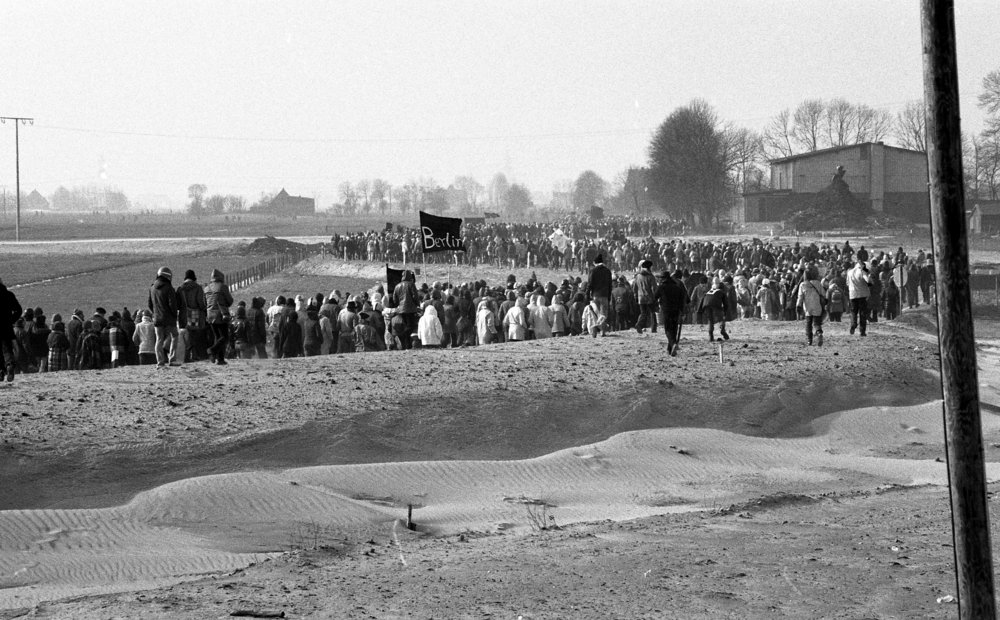
"The right to assemble unhindered [...] has always been regarded as a sign of the freedom, independence and maturity of the self-confident citizen." This sentence has been frequently quoted again in recent months when the pros and cons of demonstrations during the pandemic are debated. It comes from the so-called Brokdorf decision, a landmark ruling by the Federal Constitutional Court in May 1985, in which it subsequently declared a ban on a large demonstration at the construction site of the Brokdorf nuclear power plant (NPP) to be unconstitutional, thereby overturning a decision by the Joint Higher Administrative Court (OVG) for the states of Lower Saxony and Schleswig-Holstein. However, when the OVG announces this decision on the eve of the planned protests, tens of thousands of people are already on their way to the Elbmarsch. Finally, on 28 February 1981, 100,000 people demonstrated against the planned power plant on the Lower Elbe in wintry temperatures and with a massive police presence - and against Chancellor Helmut Schmidt's nuclear policy. In a televised speech beforehand, he called on people not to take part in the protests. However, the fact that the ban on assembly was later declared unlawful and Schmidt's actions were penalised was a Pyrrhic victory for the anti-nuclear movement: despite their tenacious resistance, the power plant went into operation in October 1986.
Nuclear energy and democracy
The "battle for Brokdorf", which had been fought on the streets and in the courts for many years, may thus come to a temporary end, but it is by no means forgotten: Brokdorf - like Gorleben, Wackersdorf and other places of protest against nuclear power plants or repositories - becomes a symbol whose significance extends far beyond the confrontation with risk factors for people and the environment. The Brokdorf decision draws attention to an aspect of the German anti-nuclear movement that many actors at the time paid just as much attention to as the danger of radioactive radiation. However, one aspect that often fades in historical retrospect - especially under the impression of the last major reactor accident to date in 2011 in Fukushima, Japan - is the potential impact of nuclear energy on the constitutional and democratic order. In the 1970s, this new dimension played a decisive role in further intensifying the already highly controversial debate.
Fear of the "nuclear state"
In this context, the publicist and futurologist Robert Jungk coined the term "nuclear state" in his 1977 book of the same name. According to Jungk, the massive state security measures to protect nuclear technologies lead to the surveillance of the population and the undermining of fundamental rights.
From the perspective of the anti-nuclear movement, these fears appear to be confirmed: The construction of the Brokdorf nuclear power plant in 1976 already began in a night-time action with a large police deployment. The clashes of the following years also seem to support the theory of the "nuclear state": construction sites cordoned off with barbed wire, police units in riot gear, water cannons and helicopters deployed against demonstrators - and at the same time protesters, some of whom were prepared to use violence, were helmeted and armed. The state's use of violence and threats, especially against activists in non-violent resistance, leads to an intensification of the conflict. As a result, the anti-nuclear movement becomes even more popular, many people are politicised and sensitised to issues of basic democratic rights. With the abolition of nuclear energy, this multifaceted movement shares a common goal - and with Chancellor Helmut Schmidt, who defends nuclear power to the end, also a common enemy.
The SPD and nuclear energy
Particularly under the impression of the oil price crises, Schmidt advocated the approach of "risk diversification" in energy policy: domestic coal, but above all nuclear power, would also have to be used to cover Germany's constantly growing energy needs. In 1979, Schmidt even predicted the future of e-mobility as an argument in favour of nuclear power: "In 2010, we will no longer have any oil. Then all cars will run on batteries. We will need nuclear power plants for this so that we can charge the batteries from the socket," Der Spiegel quoted him in June 1979 under the headline "Nuclear energy: the chancellor goes the whole hog".
For Schmidt, the nuclear energy debate was being conducted with too much emotion. In a speech at the 1979 Protestant Church Congress, for example, the Chancellor accuses critics of transferring their "fear of life" to nuclear power. He often paints this picture: an irrationally arguing anti-nuclear movement versus a government acting on the basis of objective scientific findings. Although, at the time, the authority over the construction of nuclear power plants lay with the federal states and the resentment of nuclear power plant critics was therefore often directed at the responsible state governments, in the case of Brokdorf against Schleswig-Holstein's Minister President Gerhard Stoltenberg (CDU), Schmidt attracted the anger of activists with this kind of rhetoric in particular.
The issue was also explosive within the party: the SPD found it increasingly difficult to convince its members that nuclear power was a clean technology of the future and that the vision "that in the nuclear age man can make his life easier, free him from worries and create prosperity for all", as the "Godesberg Programme" of 1959 still stated. In the course of the Brokdorf controversy, several state associations abandon the federal party line. In Hamburg, First Mayor Hans-Ulrich Klose announces his resignation, saying he does not want to follow Schmidt's course. Schmidt, on the other hand, stood by his decision and even linked his chancellorship to his support for his nuclear policy. He describes the change of direction within the party in connection with the growing anti-nuclear movement as "opportunistic".
A late victory
When Schmidt lost the chancellorship at the beginning of October 1982, the final battle over Brokdorf had not yet been fought: three years later, the Brokdorf ruling by the Federal Constitutional Court reinforced the view of many activists that nuclear policy could only be enforced against important fundamental rights. Even after the plant was commissioned, there were repeated complaints and vigils. The anti-nuclear movement never came to a complete standstill in Germany. After the nuclear disaster in Fukushima in 2011, this was the only way to mobilise large numbers of people in a very short space of time to take to the streets against the lifetime extensions decided the year before. Many of the demonstrators had not experienced the conflicts of the 1970s and 1980s themselves. However, they were able to draw on the rhetoric and infrastructure of a movement that had become part of the political culture.
In the same year, the German government decided to phase out nuclear power for good. This success of the anti-nuclear movement is also due to the Brokdorf demonstrators, who set an example in 1981: not only against nuclear power, but also in favour of the basic democratic rights of a civil society that has developed over the decades. So when the Brokdorf nuclear power plant is shut down in 2022, there will be more than just radioactive waste and painful memories: Brokdorf will also have become a place of democratic history.
Merle Strunk, M.A., is a historian specialising in knowledge transfer in museums. She has been involved in exhibition and publication projects in various institutions, including the Museum der Arbeit. As a history mediator at the Bundeskanzler-Helmut-Schmidt-Stiftung, she works on building bridges between historical events and the present. She also works on questions of visual and public history.
More