in 1973, the members of the Organisation of Petroleum Exporting Countries (OPEC) imposed an oil embargo on many Western countries, plunging economies around the world into crisis. West Germany was confronted with the fact that it had to expand its energy capacities if it wanted to avoid an economic shock. In order to become as independent of oil as possible, Helmut Schmidt decided to expand the German coal industry and drastically increase funding for nuclear energy. Although the first commercially utilised nuclear power plant in Germany was connected to the grid in 1960, issues of reactor safety and later the final disposal of radioactive waste remained unresolved. Nevertheless, Schmidt and his government revised the Atomic Energy Act, reached international agreements on reactor technology and spent millions on an information campaign to explain the need for an expanded nuclear energy network to the population.
First protests in Wyhl in Baden
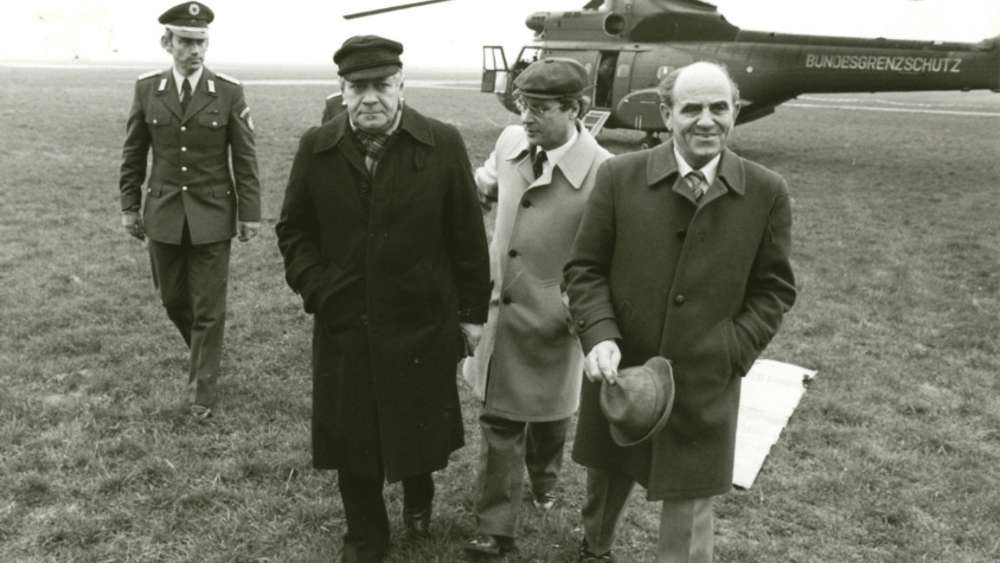
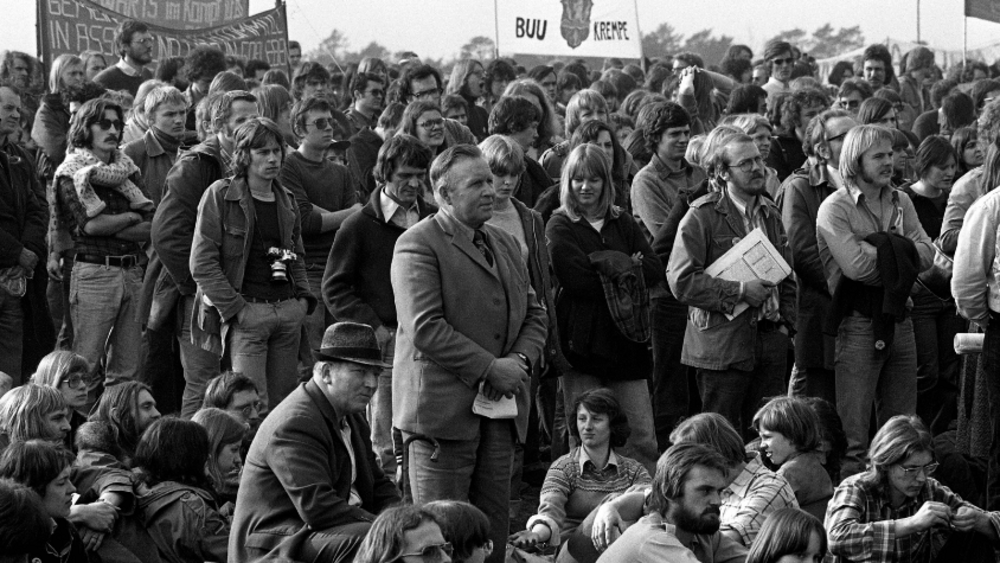
The social-liberal coalition under Schmidt worked hard to expand West Germany’s energy options, but these decisions quickly met with resistance. The first major protest began in February 1975 in the village of Wyhl in Baden at a planned nuclear reactor site. It was the first of many anti-nuclear actions and many demonstrators, unsettled by the nuclear risks, organised themselves against the efforts of the federal and state governments. The Wyhl protests were ultimately successful and were an important reason for the construction of the reactor being halted. Chancellor Schmidt and his government reorganised themselves, with the Federal Foreign Office and the Federal Ministries of the Interior, Research and Technology and Economics working closely together. The aim was to expand West German nuclear technology both at home and abroad and to convince the public of the potential of nuclear energy.
Helmut Schmidt favoured nuclear energy
In the further course of his chancellorship – and in the face of a second, even more severe oil price crisis since 1979 – Helmut Schmidt continued to advocate nuclear energy and argued the necessity of diversifying energy sources. Schmidt firmly believed that nuclear energy, alongside coal and even renewables, would be the key to West Germany’s energy independence. It was also hoped that nuclear energy would give the Federal Republic of Germany further economic and technological prestige, and that the export of nuclear technology could become an important source of revenue for the German economy. Although they recognised the risks, Schmidt and his research minister Hans Matthöfer (SPD) supported nuclear energy. They argued that the probability of meltdowns was low, that the issue of final storage could be resolved and that the economic and political benefits were far greater than the risks of the technology. Despite the super-GAU at Three Mile Island in the United States in 1979, which was only narrowly averted, Schmidt and his government pressed ahead with their plans for further nuclear reactors in Germany. In the meantime, anti-nuclear activists saw increasing participation in their protests, especially in Brokdorf and Gorleben. in 1980, they had established themselves as a future parliamentary force with the founding of the Green Party. Three years later, they entered the German Bundestag for the first time. The split within the SPD increased.
Helmut Kohl maintained his energy policy course
When the social-liberal coalition fell apart and the CDU/CSU together with the FDP achieved a majority in the 1983 elections, the new Federal Chancellor Helmut Kohl maintained the course Helmut Schmidt had set in energy policy. Kohl wanted to preserve the jobs created and secure the funds already invested. As early as 1984, the Greens introduced a bill to decommission all nuclear power plants in West Germany, but this was rejected by the Christian-Liberal majority in the Bundestag. The nuclear disaster in Chernobyl in 1986 marked an important turning point for nuclear energy in Germany. The meltdown in the Soviet nuclear power plant led to a significant shift in public opinion, and even the SPD changed its party programme in 1987. It also introduced a bill to phase out the commercial use of nuclear energy, but this was also rejected by the majority of the CDU/CSU and FDP.
Farewell to nuclear energy under Gerhard Schröder
After the 1998 Bundestag elections, the coalition of SPD and Alliance 90/The Greens led by Gerhard Schröder initiated the phase-out of nuclear energy. The coalition banned the construction of new plants and stipulated how much energy the existing reactors could still produce. After Chancellor Merkel softened this decision in 2010 by extending the operating life of nuclear power plants, she corrected the decision a year later after the nuclear disaster in Fukushima: inspections of German reactors revealed numerous safety gaps and Angela Merkel announced the final phase-out of the technology.
Nuclear energy still controversial in the EU
Although the issue was controversial during his time as Chancellor, Helmut Schmidt was generally in favour of nuclear energy. Nuclear energy did harbour risks due to the unresolved issue of nuclear waste and possible accidents. However, energy independence and security were the more important arguments for Schmidt. Renewable energies had not yet been systematically developed as an alternative during his chancellorship. Schmidt also argued in favour of a coordinated approach to this complex issue with international partners; he rejected a unilateral exit by Germany – even in his old age. Nuclear energy continues to be controversial in the EU: Germany’s most important partner, France, is sticking to its stance unwaveringly. In addition, many countries such as the USA, China, Finland and Poland are increasingly investing in nuclear energy, meaning that the debate remains as lively as ever – especially in view of the need to reduce global carbon emissions. Nevertheless, 15 April 2023, when the last three reactors in Germany were shut down, is an event that the anti-nuclear movement has been working towards for more than 40 years – in historical terms, the dispute over the issue was an important test for the second German democracy.