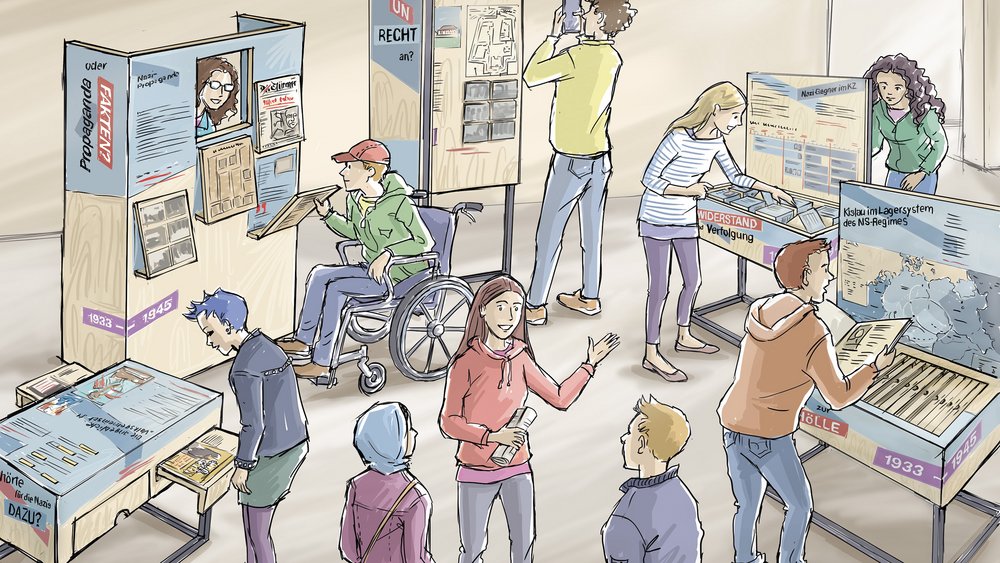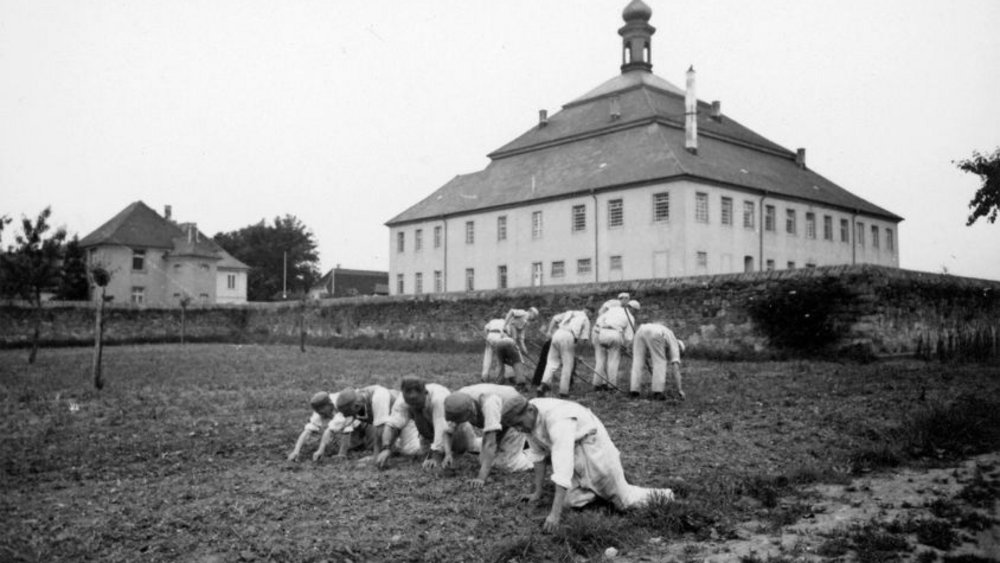
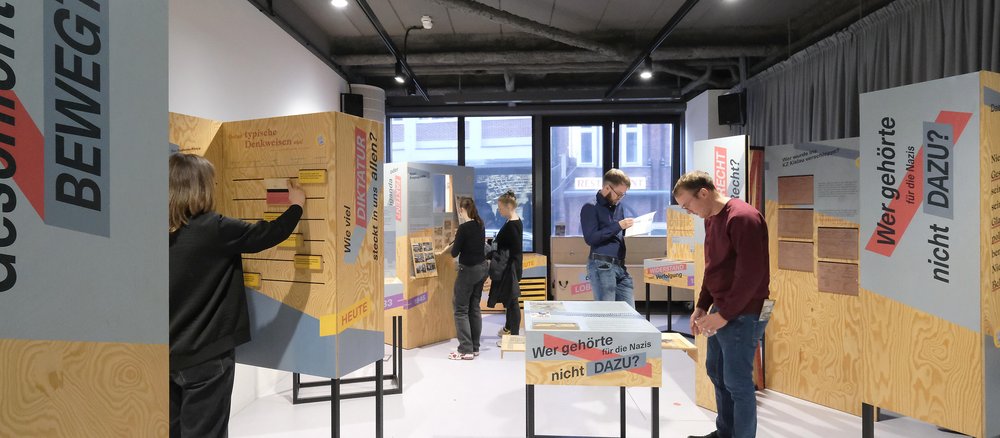
A baroque hunting and pleasure palace, the remains of a historic castle complex, an impressive pyramid-style roof – these are not images one typically associates with a concentration camp. However, this is exactly the case with Kislau Castle in the district of Karlsruhe. The Kislau concentration camp was established in April 1933 in the former bishop’s residence and was one of the so-called early camps that were set up in the first weeks and months of the Nazi dictatorship. Many opponents of the Nazi government who were taken into protective custody after the “Reichstag Fire Decree” was issued were brought to these camps. The Nazis staged Kislau as an exemplary camp and presented it to the press. However, the prisoners experienced humiliation and mistreatment there and performed forced labour. Kislau and other early camps thus formed the “prelude to the terror” of National Socialist rule. The exhibition “Where does injustice begin? The mobile history laboratory on the Kislau concentration camp” traces how the camp came into being, how injustice became justice in the Nazi state, who was imprisoned and persecuted and what role the media played in this. At the same time, the exhibition uses interactive stations to show that issues of propaganda, discrimination and the rule of law are still highly topical for our democracy.
The story of the concentration camp in a castle thus shows that injustice does not always come in the guise we expect and draws attention to the various dimensions of the dismantling of democratic structures.
No aliens
“The Nazis did not land on a UFO in 1933”. The very first sentence of the exhibition emphasises its topicality. Extremism and contempt for humanity do not arise in a vacuum, are not forces of nature and certainly not extraterrestrial threats. They are man-made, often before our very eyes, and they are based on old ideas.
For example, not everything about the “new right” today is new. Their ideology and codes utilise familiar patterns. The National Socialists also built on the völkisch movements of the German Empire and established tools to dismantle democracy as early as the Weimar Republic. And they did so using means within the legal framework. Hitler’s path to the top was not a pure “seizure of power”, but also a transfer of power in which many actors were more or less consciously involved over a longer period of time.
The transition to autocratic structures often happens step by step. This can currently be observed in Hungary, for example. Over the years, the judiciary and free press have been undermined, the parliament restructured and the system of an “electoral autocracy” established. Members of the European Parliament criticised as early as 2021 that the European Union was not acting consistently enough to counter this development.
Looking ahead and looking back
What point marks the beginning of a dictatorship? Where does injustice begin? This is not always easy to answer and is what makes creeping developments so dangerous. Legal steps towards dictatorship are often accompanied by an increasing normalisation of certain ideological assumptions, a shift in values and a social climate of agitation and hostility.
So when is democracy in danger? How resilient is it? This is currently the subject of much debate in Germany. A group of academics is analysing these questions using the example of Thuringia. They ask: If an authoritarian populist party were to win the next state election in Thuringia (the state AfD is currently polling at 34 per cent), what steps would it take to dismantle democracy? For example, according to Maximilian Steinbeis from the “Thuringia Project” in an interview with the Süddeutsche Zeitung, the state media treaty could be cancelled. Public broadcasting has been repeatedly criticised from various sides for years. Would people who accuse the public service media of lacking objectivity, for example, object to the abolition of the ÖRR?
This process with its consequences is easy to visualise. At first glance, many other possible steps to destabilise democracy sound less invasive, perhaps somewhat abstract and nowhere near as threatening as the measures implemented by the National Socialists in the first few weeks after coming to power – such as the establishment of special courts or the destruction of the trade unions. Nevertheless, their effects could be fatal. Such considerations are still hypothetical for us in Germany. Nevertheless, they are important in order to realise where the risks lie and to find answers to the question of what can be done preventively to protect democracy. In addition to looking forward, looking back at history is one of our most valuable tools. Of course, it is not possible to derive any inevitabilities from this. Rather, looking back should be an incentive to take a closer look today.
Making history tangible
The mobile history laboratory makes an important contribution to this and links history with current issues. Using the example of Kislau, the lab provides insights into the development of the unjust state from 1933 onwards. The National Socialists misused the emergency decree issued by Paul Hindenburg as the “Decree of the Reich President for the Protection of the People and the State” as a basis for arbitrary arrests and had people deported to concentration camps on the basis of their faith or party affiliation. One such person was the Jewish SPD politician Ludwig Marum. He and other Social Democrats were driven through Karlsruhe on the back of a lorry before being taken to the Kislau camp. Thousands of onlookers watched this public humiliation on the street. There were hardly any protesters. The propaganda paper “Stürmer” had already been spreading anti-Semitic incitement among the population for ten years at the time. At the same time, there was a fear of becoming a victim of the wave of arrests.
The exhibition shows that the Federal Republic of Germany learnt lessons from this period and enshrined prohibitions on discrimination in its Basic Law. However, visitors can also throw balls into tubes at one station: red if they have already experienced discrimination themselves, blue if they have observed it in others, for example on the basis of gender, disability, political views or faith.
A few steps further on, Nazi propaganda writings and the mechanics of fake news are juxtaposed. The station provides visitors with assistance in recognising distorted or fake information. Fake news, as you realise here, quickly comes close to propaganda. The exhibition does not equate past and present. However, it draws attention to the levers of democracy that we should keep a close eye on today. It also shows what makes our constitutional state and our democracy strong and brings young people in particular into dialogue with each other at interactive stations. In this way, the exhibition not only makes a contribution to democracy education, it also encourages one thing above all: courage.
The “Mobile History Lab” is an exhibition organised by Lernort Kislau e. V.