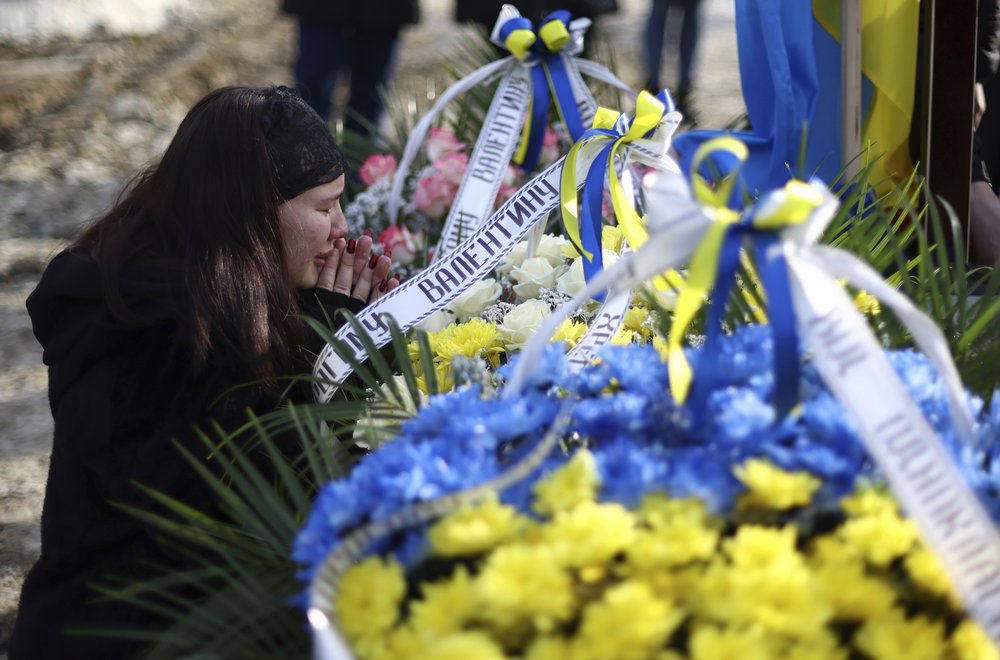
Russia's war against Ukraine has been raging for three years, producing victims, suffering, crime and displacement on a daily basis. Donald Trump, who wanted to end the war within 24 hours, has now sent a high-ranking team to the Munich Security Conference (MSC) taking place this weekend. His Vice President JD Vance, Secretary of State Marco Rubio and the Special Representative for Ukraine, Keith Kellogg, will be part of the delegation and will discuss Trump's plans with allies and partners. While Ukraine is seeking a ceasefire and robust security guarantees - including accession to NATO and the European Union (EU) - Russia wants a "peace treaty" that largely fulfils its demands and objectives with regard to Ukraine. This means that Ukraine is to become a "buffer state" in which Russia can continue to exert influence at any time. To this end, the country is to be territorially shrunk, politically restructured through a change of government and largely demilitarised. In addition, Kyiv is to permanently renounce membership of NATO and the EU. The future European security order and the status of the EU and its member states in international politics will largely depend on the end of the war in Ukraine, its outcome and its agreements. But is (EU)ropa capable of acting in terms of foreign and security policy?
The "return of the zones of influence" and the failure of Western concepts of order
In December 2023, the European Council decided to start accession negotiations with Ukraine, which were opened in June 2024. A signal of support and proof that the EU intends to adhere to the principle of free choice of alliance. With Trump's return to the Oval Office and following initial reports on the alleged content of his "peace plan", what political scientist Herfried Münkler described shortly before the Russian invasion of Ukraine as the "return of the zones of influence" could now possibly become a reality: the grudging acceptance of the restriction of freedom of alliance in certain buffer zones between areas of different political order, which is necessary for peace and stability.
For Münkler, the "return of the zones of influence" was the consequence of the failed attempt to expand the Western "liberal, rule-based order" globally, due to double standards and non-acceptance outside the "Global West". But even in Europe itself, there had never been a pan-continental security order. There was a lack of common values - especially, but not only, with Russia - and trust was gradually lost due to mistakes on all sides. Warnings from the Kremlin were overlooked, as was the dominance of (military) force and authoritarian tendencies in Russian foreign and domestic policy. The historical experiences of the Central Eastern European states, in combination with the unattractiveness of the Russian state and social model, led to almost all of these countries actively seeking NATO protection and turning away from Russia. Historical events are multi-causal and history is contingent, so there is never no alternative to developments and the future is something that we help to determine through our actions. It is clear that the previous European security order no longer exists; Putin has smashed it. His brutal imperialism is in clear contradiction to the 1990 Charter of Paris (the final document of the CSCE process) and violates central principles of the United Nations. Russia is responsible for the biggest war in Europe since 1945, has pushed back borders by force and broken the taboo on the threat of using nuclear weapons. It is striving for an exclusive zone of influence and wants the USA to withdraw from Europe.
Subject or object of international politics?
None of this is in the interests of most members of the EU and NATO. But how does the EU intend to uphold the principle of free choice of alliance and the principles of the UN Charter if the US President takes zones of influence for granted and has declared territorial growth, with the current focus on Greenland, Panama and Canada, to be his country's goal? Does Washington still recognise that not only the EU is dependent on partners, but that the influence and power of the USA is also based on its global network of alliances, including the extended nuclear deterrent? Following a peace agreement that has yet to be reached, especially one that is acceptable to Ukraine, a new European security order needs to be established that must offer protection from Russia for the time being. Who will guarantee this order and how can it be prevented that this and the end of the war are largely decided without Ukraine and the Europeans? Is a return of the zones of influence for parts of Europe necessary, unavoidable or will it even turn into a new global Cold War? The latter is rejected globally by an overwhelming majority of states and is also dependent on Europe's ability to find partners for a co-operative, forward-looking international order.
In order to be perceived in the future as an independent, self-determined and equal subject in international politics under considerably tougher conditions, decisive political leadership is required that strives for a European ability to act in foreign, security and defence policy in a clever, prudent, forward-looking manner and with clear strategic goals. In addition to the partnership with the USA, this requires more resilient cooperation with other regional organisations and important middle powers such as India, Brazil, South Africa, South Korea and Japan. Like the EU, these countries are dependent on multilateral structures, international organisations, rules and cooperation in order to pursue their interests and solve (global) problems. Maintaining Europe's economic strength, competitiveness and capacity for innovation, serious efforts to significantly improve its defence capabilities and internal reforms and deepening of the EU's structures and mechanisms are prerequisites for this. Unfortunately, it is anything but certain that European and German politicians, who have been preoccupied with themselves for a long time and are currently struggling with internal disputes and challenges, will succeed.