
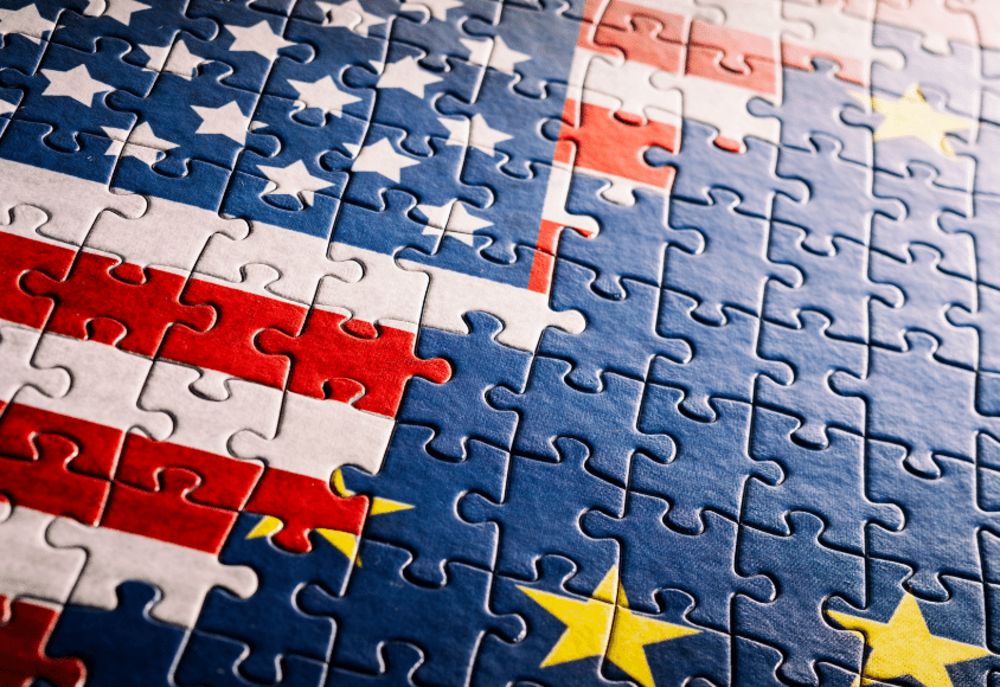
Transatlantic relations make a comeback
24. Sept 2022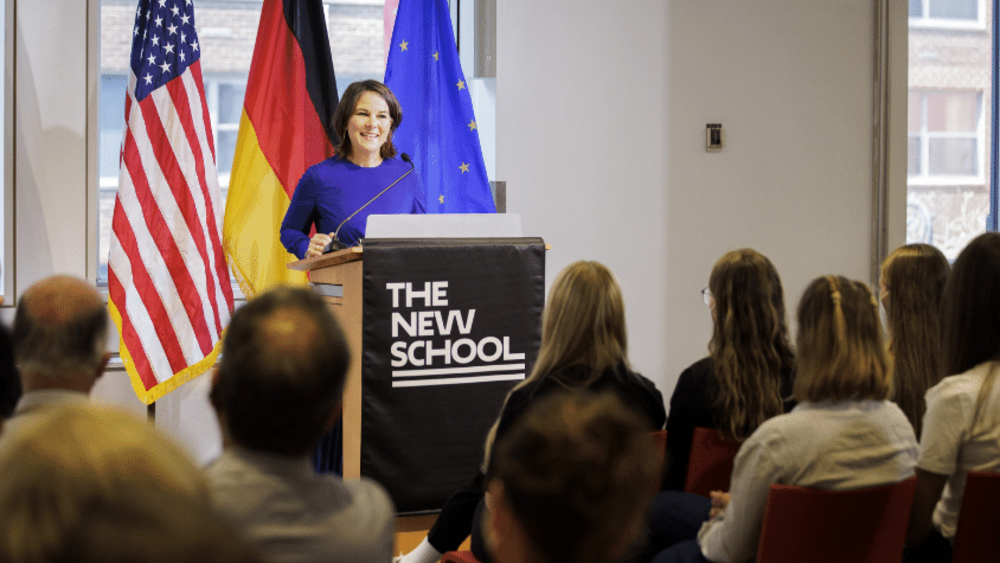
The EU and the USA have moved closer together again, not only in view of the Russian war of aggression against Ukraine. The transatlantic relationship has also warmed up again under the pressure of intensifying competition with China - which can be observed both bilaterally and in formats such as the G7. We see that despite - or perhaps because of - the low point in transatlantic relations under US President Donald Trump, the current fears of a shift to the right in the midterms in autumn 2022 and Trump's possible re-election in two years' time, the transatlantic partnership must be maintained. To do so, however, it must be modernised.
German Foreign Minister Annalena Baerbock clearly emphasised this during her visit to New York in August 2022: "We must seize this transatlantic moment. And that is to build a stronger, irrevocable transatlantic partnership for the 21st century." Foreign Minister Baerbock is not only striving for a partnership, but explicitly a "joint leadership partnership" with the USA, which should be based on three pillars: Security, the defence of the rules-based international order and the strengthening of European and American democracies and their resilience. It does not break completely new ground, but it does provide key impetus for sustainable transatlantic cooperation.
Utilising the foreign policy toolbox
The call for a concrete instrument to build this leadership partnership is growing louder: the USA and the EU should try their hand at a joint trade agreement. The idea is that such a transatlantic agreement could reduce economic dependencies on Russia and China, make European and American democracies more resilient and at the same time strengthen the current rules-based international order.
When calling for a transatlantic trade agreement, the idea that all foreign policy instruments should be included in such an ambitious US and EU foreign policy project is correct. It would be a fatal mistake to focus a new partnership exclusively on classic security policy issues such as cooperation within NATO or to focus primarily on liberalising trade policy. Instead, current domestic policy challenges should also be included in the debate on the necessary diversification of global supply chains. Because, to put it provocatively: what use is it to us to reduce economic dependencies on autocracies if our own democracies are becoming increasingly ailing?
No TTIP 2.0, please
The last attempt to get a transatlantic free trade agreement off the ground was not so long ago. The so-called TTIP (Transatlantic Trade and Investment Partnership) was mainly negotiated by the Obama administration with the EU. Even before Donald Trump entered the White House, negotiations had stalled as both sides were unwilling to engage with each other on fundamental and, above all, regulatory issues. Under President Trump, who believed that trade wars were good and easy to win for the USA, the negotiations were discontinued, or as the EU Commission put it: they initially ended up in the freezer and were finally officially declared over.
Simply picking up where the last round of negotiations left off is therefore out of the question from the outset. However, in order to fulfil the demand for resilient democracies, a strengthening of the rules-based order and the reduction of economic dependencies on authoritarian states, a fundamentally new approach is needed - especially for a common trade policy, which forms a central interface for a value-based transatlantic leadership partnership.
Transatlantic cooperation for greater inclusion and social justice - tackling domestic policy challenges together
All too often, transatlantic cooperation stops at foreign policy issues such as security and the economy. In doing so, it fails to recognise the interdependence of foreign and domestic policy on the one hand and the domestic policy problems shared on both sides of the Atlantic on the other. This is because the USA and the EU are currently facing very similar domestic policy challenges: the increase in social inequality, the rise of racism and populism, deepening political polarisation and the increasing weakening of democratic institutions.
Of course, we must not lose sight of security and trade policy issues, but a new transatlantic cooperation must take their close interactions with these supposedly soft, domestic issues seriously and expand our joint commitment in this area as well. Security and trade policy debates often seem far removed from the everyday lives of people on both sides of the Atlantic. However, issues such as unemployment as a result of globalisation, the effects of climate change and deepening social inequalities are challenges that young people in particular identify as particularly pressing.
In many cases, right-wing populist forces are able to capitalise on existing structural problems, fears and dissatisfaction. The experiences of the COVID-19 pandemic have clearly exposed these structural problems. The pandemic ruthlessly exposed the social ills in Europe and the USA. It made visible the inequalities that all too often run mercilessly through all areas of life for the socially weak and disadvantaged. The effects of climate change and the economic consequences of the Russian war of aggression against Ukraine have further exacerbated this situation.
Respect for human rights, the rule of law and democratic co-determination are still far from being a matter of course in the USA and the EU. People affected by multiple forms of discrimination in particular suffer as a result. A transatlantic agenda for greater inclusion must address this issue, put a positive spin on the shared values and ensure, through broader social support, that the so often made commitments to basic fundamental rights do not remain lip service.
Transatlantic commitment to multilateral trade cooperation - even beyond like-minded states
A transatlantic leadership partnership can only credibly advocate an international values-based order if it does not act as a taskmaster, patron or even ruler and ruthlessly asserts its interests: The rules-based international (economic) order must not be an order of the West. At the same time, however, the EU and the USA should confidently admit that they are of course trying to realise their own interests within the framework of these alliances.
What is needed is a strong transatlantic commitment to multilateral cooperation, to international cooperation for the benefit of all. However, it is not enough to simply put a "2.0" behind every alliance and hope that this will solve today's complex problems. The USA and the European Union should approach other countries as partners on an equal footing. An inclusive, values-based transatlantic leadership partnership must be willing to openly communicate its multilateral message to international partners and invite them to work together.
This makes it all the more important for the transatlantic trade partnership to be open to third countries in whatever form - and not just in theory, as was the case with TTIP. Rather, the current momentum in the G7 must be utilised from the outset to expand cooperation from two to seven partners. Cooperation with selected like-minded, democratic states is necessary, but must only be a step towards international cooperation at multilateral level. Despite all the difficulties caused by the membership of many authoritarian regimes in the World Trade Organisation (WTO), the declared goal of the transatlantic partners must remain the regulation of the global economic system within the framework of the WTO. The EU has already shown a great deal of commitment in recent months; now it is up to the Biden administration to step up its involvement.
A transatlantic leadership partnership for the 21st century
In order to capitalise on the transatlantic moment and develop a joint transatlantic leadership partnership, as called for by the German Foreign Minister, we need an economic partnership that is based on inclusion and positive self-definition and that is prepared to leave the status quo behind in order to boldly tackle change. This applies to both domestic policy, bilateral relations and cooperation in international alliances.

Author
Elisabeth combines economic security and geoeconomics with issues of social inclusion and international cooperation. Her research focuses on EU-U.S. trade policy and the distributional effects of international economic policy.
She studied in Nuremberg, Berlin, and at Indiana University, and earned her Ph.D. in International Relations from the Free University of Berlin. Her professional career has taken her to the German Marshall Fund and to various research positions at the Europa-Kolleg Hamburg, the Bertelsmann Foundation in Washington, D.C., as well as at Princeton University and Georgetown University.
Elisabeth teaches International Relations and U.S. Foreign Economic Policy at HTW Berlin and the Free University of Berlin.
More