
A serious mistake: the state had become vulnerable to blackmail
26. Feb 2022
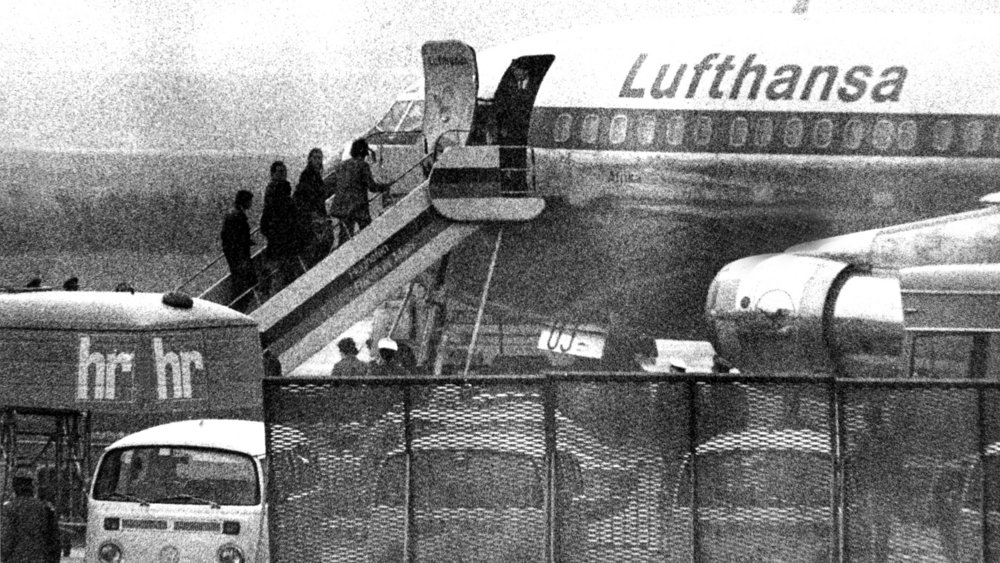
The "German Autumn" has become a cipher for the attacks and murders of the "Red Army Faction" (RAF), in which 34 people died before the group disbanded in 1998. It also symbolises one of the most serious crises in Helmut Schmidt's political career, inextricably linked to his reputation as a crisis manager. His televised speech of 5 September 1977 is still referred to today. The occasion was the kidnapping of Hanns Martin Schleyer, President of the Confederation of German Employers' Associations (BDA) and, since 1977, also Chairman of the Federation of German Industries (BDI) and Chairman of the Board of Management of Daimler-Benz AG. This was linked to the hijacking of the Lufthansa plane "Landshut" on 13 October by four Palestinian terrorists. Both acts of terror kept Germany in a stranglehold from 5 September to 20 October. The aim of the terrorists was to free 26 imprisoned like-minded people. As is well known, the German government under Helmut Schmidt decided not to give in to their demands. In doing so, it accepted the death of Schleyer and the "Landshut" passengers. Schleyer was killed after the plane's passengers were freed thanks to a risky operation by the GSG 9 counter-terrorism unit during a stopover at the airport in Mogadishu, Somalia. Schmidt would have resigned as Federal Chancellor if the rescue operation had failed. The underlying attitude was not to negotiate with terrorists, not to respond to their demands, not to make the state vulnerable to blackmail. Schmidt's message at the time: "The state must respond [to terrorism] with all necessary rigour."
A role model for the RAF?
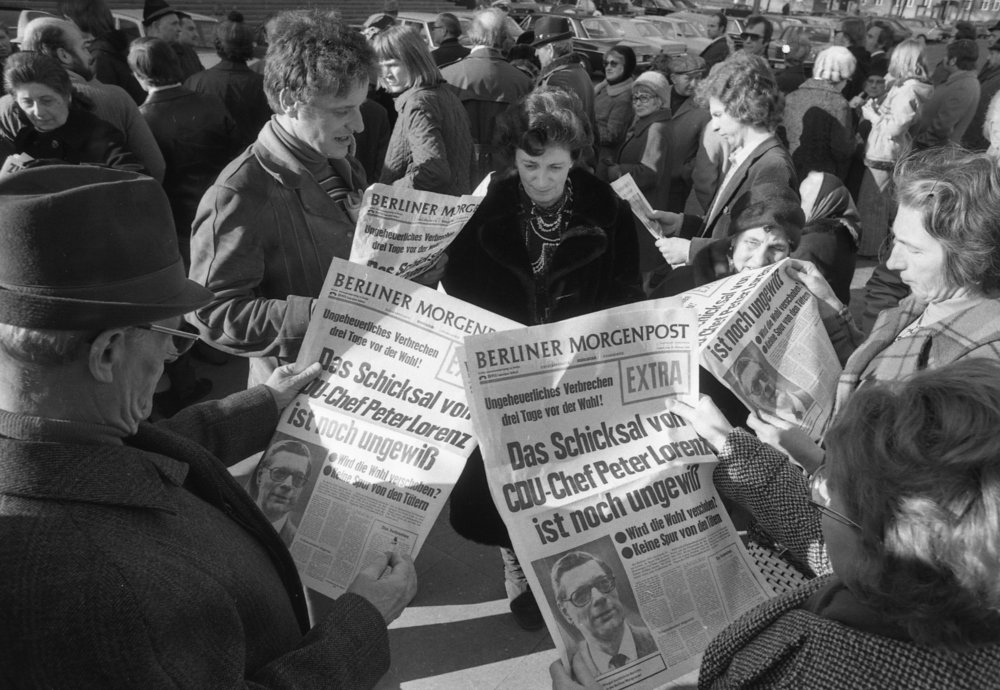
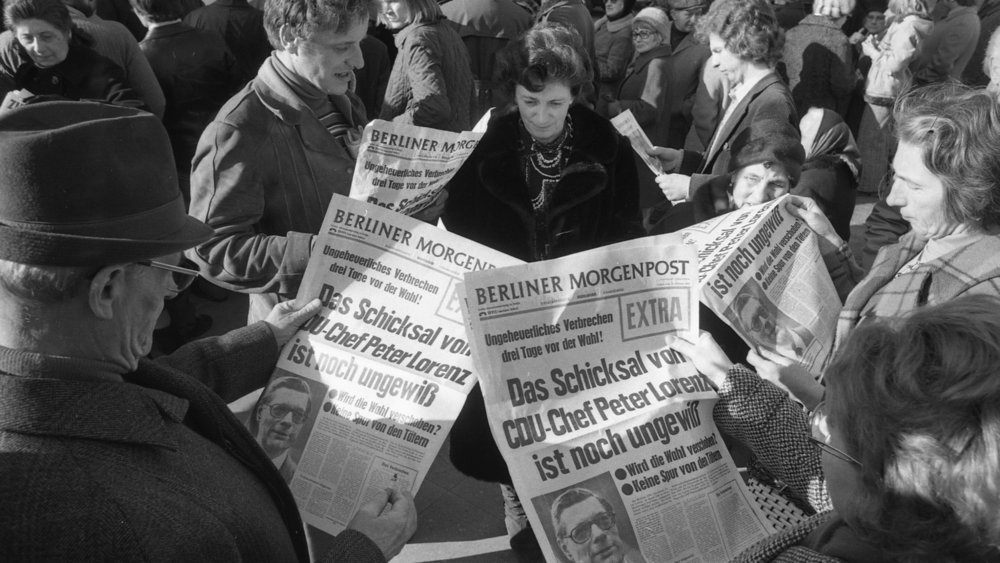
The politicians did not just develop this principle during the dramatic days of autumn 1977, but two years earlier. What had happened? Three days before the Berlin House of Representatives elections, on 27 February 1975, the CDU's promising candidate for mayor, Peter Lorenz, was kidnapped and held captive for five and a half days in a cellar ("people's prison") at Schenkendorfstraße 7 in Berlin-Kreuzberg - opposite the local CDU office. Six imprisoned terrorists, convicted of involvement in bomb attacks and attempted murder, among other things, were to be released and flown out, including Horst Mahler, a founding member of the RAF. The terrorists issued an ultimatum of 72 hours. The "2nd June Movement" was responsible - an autonomous group with little hierarchical structure that committed bank robberies and carried out bomb attacks, particularly in West Berlin. This made no difference to the political leaders. What's more, their behaviour set an example for the RAF.
The Lorenz kidnapping also set a precedent for the government. For the first time, a German government was confronted with the question of whether to give in to terrorists when human lives were at stake. After the kidnapping was publicised, crisis teams met in Berlin and Bonn. These advisory bodies would later play an important role in the "German Autumn". The "Ministerial Committee for Special Situations", commonly known as the "major crisis team" or "major situation", did not meet for the first time, contrary to many claims. It was a format of people from the government, the opposition parties and individual ministers that had already been established in 1968 under pressure from NATO. In contrast to the events of 1977, the crisis team decided to give in to the demands in view of the Lorenz abduction. All but Horst Mahler, who did not want to be replaced for ideological reasons, were flown out to Aden in the People's Democratic Republic of Yemen along with 120,000 Deutschmarks in travel money.
A decision with serious consequences
Helmut Schmidt, who is said to have been fighting a fever of over 40 degrees at the time of the kidnapping, had previously asked for a more in-depth, fundamental debate in such an extraordinary situation and was opposed to an exchange. He himself was in a very unfavourable position, not only because of his illness, which prevented him from attending many a meeting of the committee, as he had previously made fun of Lorenz's security concerns and sense of threat during the election campaign. Above all, Helmut Kohl, then party chairman of the CDU and Minister President of Rhineland-Palatinate, and the Governing Mayor of West Berlin Klaus Schütz (SPD) - both personal friends of Lorenz - argued in favour of an exchange. As the decision had to be made by the Berlin Senate rather than the federal government, in the end the votes in favour of meeting the terrorists' demands prevailed. Schmidt went along with this decision, partly in order to present a unified public image and probably also to avoid the appearance of a personal defeat.
The consequences of this decision were not only evident in 1977: just two months after Lorenz's release, RAF members ("Holger Meins Commando") occupied the German embassy in Stockholm. Modelled on the Lorenz kidnappers, they demanded the release of 26 terrorists, including the RAF heads Andreas Baader, Ulrike Meinhof and Gudrun Ensslin. The politicians on the crisis teams had now realised their previous mistake. Helmut Kohl later wrote: "The state had become vulnerable to blackmail. [...] an untenable situation." In 2007, Schmidt subsequently described it as a "serious mistake". After the embassy in Sweden was stormed, the demands were not met, to the horror not only of the terrorists but also of his Swedish counterpart Olof Palme: Schmidt cancelled the extraterritoriality of the embassy, forcing him to act. Schmidt himself presented himself as a hands-on, tough crisis manager. In a contemporary Spiegel interview, he said: "They had to be shown that there is a will that is stronger than theirs." The experience gained in the Lorenz kidnapping set the direction for state action in the coming confrontations. It was to be the last time that the state gave in to such demands, as the RAF found out again two years later in the "German Autumn".
BKHS theme week: The RAF and the "German Autumn"
The terrorism of the RAF reached its peak with the "German Autumn". To mark the publication of our learning module "German Autumn 1977", we are dedicating a BKHS theme week to the RAF and the "German Autumn" from different perspectives and in various formats. The learning module, which was developed in cooperation with the Collaborative Research Centre "Threatened Orders" at the University of Tübingen, uses selected media and documents to bring the history of the "German Autumn" into the classroom. Learners address decision-making situations in the past and are encouraged to tell the story of this period themselves. The publication is accompanied by a discussion on the consequences of terrorism for the Federal Republic of Germany and its society. In addition, a pop-up map of the interactive Schmidt city map shows the locations of the RAF in Hamburg.
From the perspective of the exhibition organisers at the Federal Chancellor Helmut Schmidt Foundation, the history of terrorism also provokes questions: how to deal with it, how to present it? The exhibition team talks about hurdles and challenges in the first episode of the new podcast series "Schmidt! Makes History".

Hendrik Heetlage is a historian and was a research assistant in the “Global Markets and Social Justice” programme of the Bundeskanzler-Helmut-Schmidt-Stiftung until March 2023. He specialises in (German) contemporary history and the history of modern China. In addition to historical exhibition projects, he is involved in history and history communication in the digital space.
More