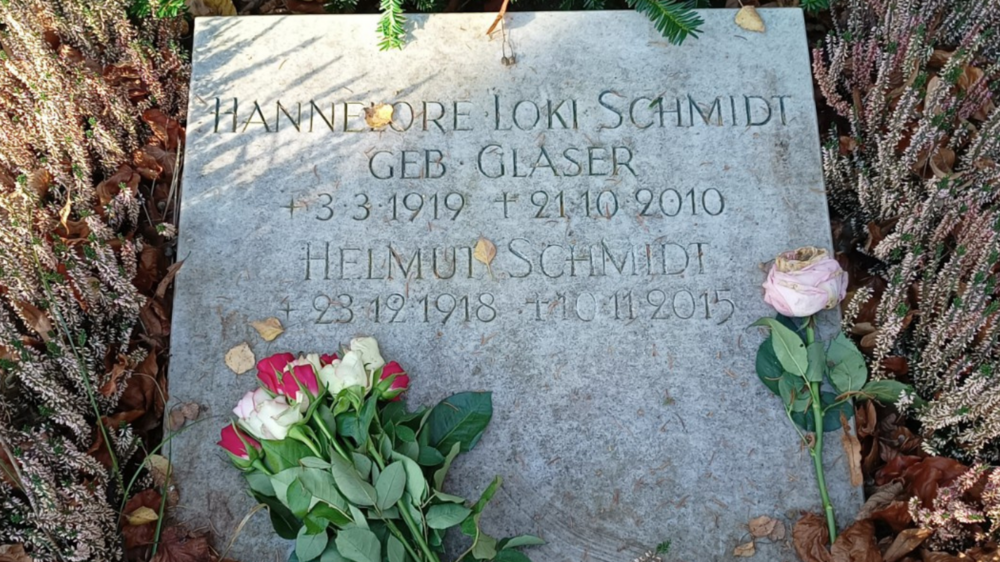
The graves of Hannelore and Helmut Schmidt can be found under the coordinates GISX3 in grave site U 33 at Ohlsdorf Cemetery in Hamburg. They are among the many graves of celebrities in the cemetery, which was established in 1877 and today contains 202,000 graves with 1.4 million graves. The grave is marked on the cemetery map and marked with a signpost. It is located on a small footpath near Chapel 10, behind a bus stop on the 179 bus route. The area on which it is located is part of a family burial ground laid out in 1913 to the east. The spacious park cemetery had already become too small by this time.
Heinrich Koch, the father of Ludovika Schmidt, Helmut Schmidt’s mother, acquired the grave site in 1916 when his eldest daughter Frieda died of tuberculosis. The family grave comprises six coffin graves. The original grave letter bears the number 87371 and is preserved in Helmut Schmidt’s estate. The fee for the grave was 180 marks.
Who were the members of the Koch family?
Heinrich Koch was a trained typesetter and worked for a time for the “Hamburgischer Correspondent”. He came from Elsheim/Rhine-Hesse and had been married to Amalie Beyer, who was born in Rhena, since 1884. She was a trained cook and worked in England for some time before her marriage. Together they had five children, four daughters and one son. The family belonged to the educated working-class families in Hamburg. The daughters pursued gainful employment from an early age. In their free time, they sang in various choral societies and choirs. Heinrich Koch always endeavoured to secure the family’s livelihood. For this reason, he took over the Dreckmann white goods shop at Mundsburger Damm 30 in 1908 and ran it as the general partnership Heinrich Koch & Co together with his wife and daughters.
The registration certificate from the Hamburg police authority for his daughter Louise from 1908, which has been preserved in the archives, confirms this. The business takeover is also evident in the Hamburg address books from 1908 to 1910.
Marianne, the second eldest daughter, was a trained singer. She gave singing and piano lessons and lived in Boston/USA for some time in the early 1930s. Louise, the third-born daughter mentioned above, was a cleaner, while Ludovika, the fourth daughter, earned her living as a servant and nanny before marrying Gustav Schmidt, Helmut Schmidt’s father, in 1914. Her service book is preserved in the archive in the estate of her son Wolfgang.
Heinrich, called Heinz, the only and last-born son, was a model maker and could play the guitar. After the First World War, when he was unable to find employment in his profession, he joined his parents’ business. Marianne also worked there after her return from the USA at the end of the 1930s.
After Heinrich Koch’s death in 1933, his widow Amalie continued to run the business. Her passport from 1938 shows her as the owner of the business. But it was Louise in particular who “ran the shop”, recalls Margret Morgner, a friend of the family. After the death of their mother in 1945, Heinz and Louise took over the management of the business. Together with their sister Marianne, they continued to run the business. At this time, it was already located in Sasel at Frahmredder 7, but the house on Mundsburger Damm was in ruins after the bombing of Hamburg in 1943. The family had been able to bring some of the goods to Sasel shortly beforehand with the help of helpful neighbours.
The range of goods on offer can be seen in an overview from 1950, which has been preserved in the archive, showing the conversion of the Reichsmark into the D-Mark. There are textile goods such as coats, dresses, aprons and shirts or jewellery and fashion goods, including buttons, tobacco tins, leather flowers and perfumes, as well as haberdashery, toys and jewellery. in 1959, 50 years after it was founded by Heinrich Koch, Heinz and Louise sold the shop in Sasel to the company Adolf F. C. Becker.
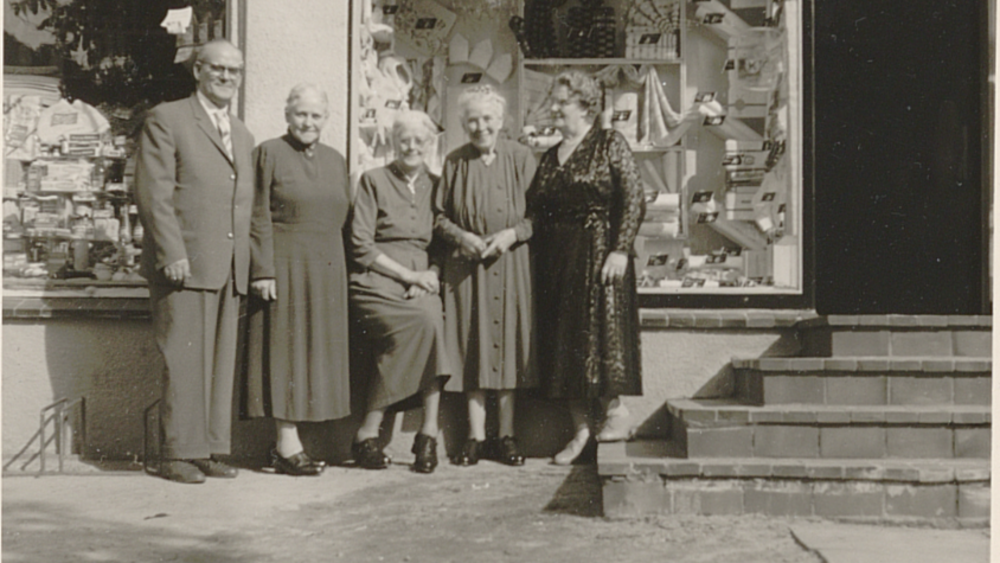
Numerous photos show that the Koch family enjoyed being together, were involved in clubs and associations and generally led a good life in Hamburg. The joint management of the white goods shop for 50 years probably contributed to this.
Back to the Ohlsdorf cemetery and the family grave
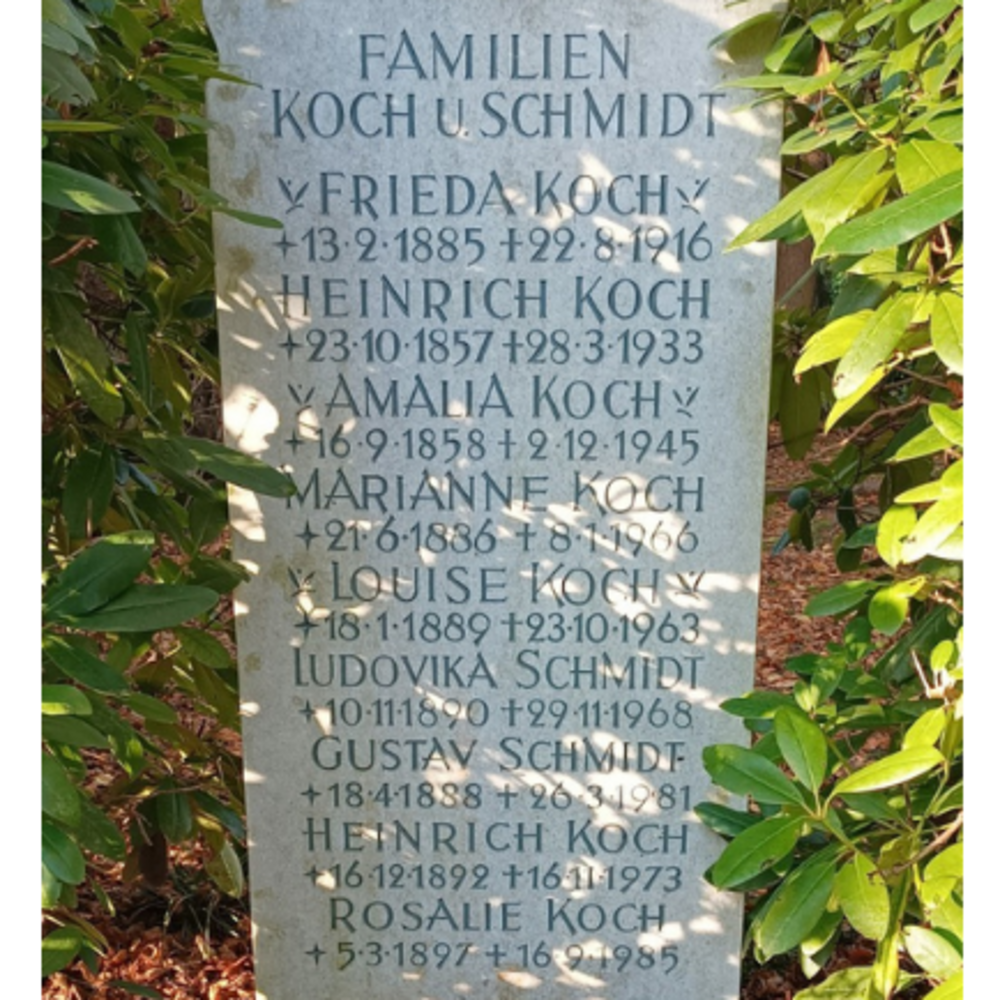
The grave letter from 1916 states that the grave was intended for the purchaser, his wife and his children. The name Schmidt is not mentioned in the grave letter, although Ludovika had been married to Gustav since 1914. A closer look at the inscriptions on the white marble stone, which bears the inscription “Families Koch and Schmidt” at the top, reveals that although it begins with the death of Frieda in 1916 and continues with her parents Heinrich in 1933 and Amalie in 1945, the order of the names thereafter no longer corresponds to the chronology of the years of death.
Marianne, who died in 1966, comes before Louise, who died in 1963, followed by Ludovika, who died in 1968. The daughters’ names appear to have been engraved in the order of their years of birth. Ludovika is followed by her husband Gustav, who lived until 1981. Son Heinz, who died before Gustav in 1973, is only named below him. His wife Rosalie, who died in 1985, follows last.
Between 1916 and 1985, nine people were buried in the family grave, which was purchased as a coffin grave. Only urns were used. As a grave plot at the Ohlsdorf cemetery can be purchased for a maximum of 25 years, the grave certificate was extended at the end of this period for a fee and older grave plots were re-occupied.
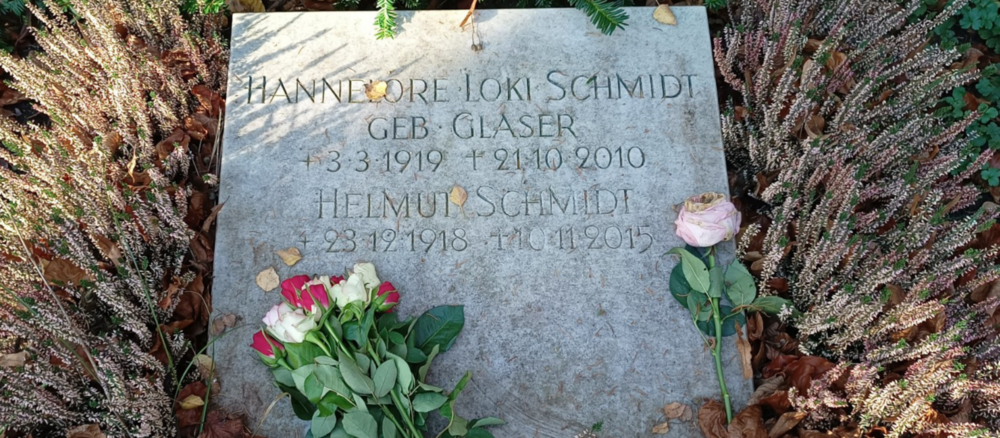
After the death of sister-in-law Rosa, Hannelore and Helmut Schmidt took over the rights of use for the grave in 1985, as they wanted to be buried in the family grave. Both have their own joint headstone, which was placed in the centre of the grave. Hannelore “Loki” was laid to rest here in 2010 and Helmut Schmidt in 2015.
The grave, which was simply planted in accordance with the wishes of the deceased, would certainly not be noticed by anyone without the signpost. However, as it is one of the celebrity graves at Ohlsdorf cemetery, many visitors visit it. From time to time, flowers are deposited, but also figurative memorials and commemorative pieces. Sometimes the objects do not really fit in with the character of a grave and have to be removed by the cemetery gardeners.
Heinrich Koch acquired this family grave for himself and his relatives in 1916 out of care. After more than 100 years, the grave bears witness to his family. Naturally, son-in-law Gustav and daughter-in-law Rosalie were included in the family circle and after their death in the family grave. In this way, beyond the celebrity grave, a piece of Hamburg’s history is kept visible and alive.