
Turning points in the year invite us to look ahead and change. Rarely does the separation between past and future seem so clear that the next day can demand different actions, a different way of thinking or even a new person. In terms of the history of ideas, the mouldable future is an inherently modern matter and is not solely the responsibility of the individual. Yes, the whole world can become a different one and people can shape it. This does not have to be a stroke of luck. In anticipation of something negative, this promise also seems to trigger fear: What if our actions make tomorrow's world worse? This fear has become particularly entrenched in the discourse of recent years. Decades of research into climate change have made it clear that positive progress such as the industrialisation of Europe and North America has its downside, the worst effects of which are still to be feared. Every day of inaction or not doing enough can seem like a day wasted, which in all its paradoxicality leads to paralysis. The past and the future are therefore not sharply separated, but are interdependent. Anyone who wants to learn something about our world today or even shape its future should go to the archives.
Schmidt's forecast for the world of the future
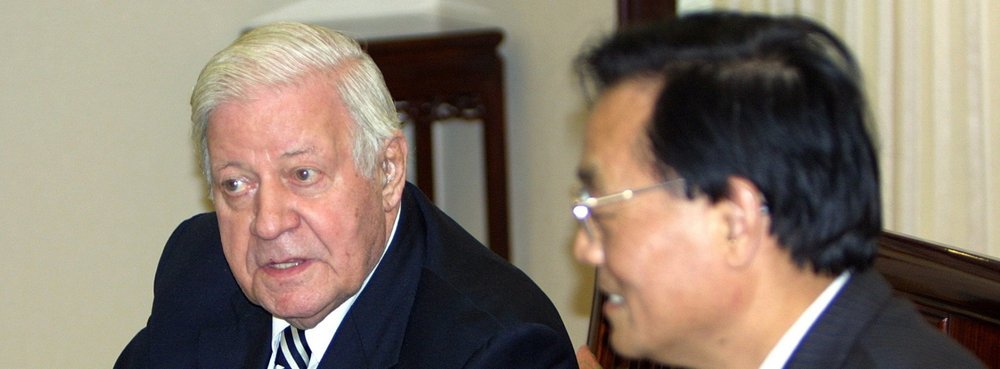
Almost 20 years ago, Helmut Schmidt ventured a glimpse into the year 2025. On his trip to Asia in August and September 2005, he stopped off at Fudan University in Shanghai, where he was invited to give his predictions for a future world. Today, several copies of the speech he gave on this occasion are stored in the Helmut Schmidt archive and bear witness to the interplay between the past and the future in his thinking. During these years, Schmidt had long since established himself as a veritable voice in national and international political debates and, according to Thomas Karlauf, nevertheless tried to correct his public image. In his book "Helmut Schmidt: Die späten Jahre" (2016), the former editor of the Siedler Verlag publishing house shows that the former chancellor was not very fond of the frequently attributed role of the almost heroic crisis manager. Instead, Schmidt tried to portray himself as an elder statesman in the American sense through carefully placed and selected contributions. This included a self-confident geopolitical view of the future. The speech in Shanghai in 2005 thus joins Schmidt's canon of similar outlooks, such as a speech in Beijing two decades earlier or the conclusion of a Bucerius Summer School Reunion in Hamburg in 2008.
"Economists are trustworthy as long as they talk about the past"
Not at a loss for a joke, the former Chancellor opened in Shanghai with an awareness of the problems for the forecasts that followed. However, these should not be trusted, especially coming from an economist: "Economists are trustworthy as long as they talk about the past; the public should be careful when they talk about the present. But especially cautious when they talk about the future." Schmidt builds his speech schematically. Based on the current world situation, certainties and uncertainties can be expected from the future. In this three-step process, the past, present and future are intermingled. The host country China is given the special role of a "world power", which Schmidt knows how to differentiate from the USA ("superpower"). With his usual admiration for the economic rise of the People's Republic and its leading figure Deng Xiaoping, he believes the country is also well equipped for the future. The fact that the global political situation in 2025 will also remain one of de-escalation in military terms is not solely dependent on China's policy, but also on that of the United States. Due to the deterioration in relations between the two powers today, these 20-year-old warnings seem like gloomy prophecies. Russia's position as a world power, on the other hand, is secure in the future due to its territorial expansion, enormous reserves of raw materials and military strength. However, Schmidt does not want to recognise any dangers for former Soviet states or Europe in this: "Similar to China, no aggression is to be expected from Russia in the foreseeable future if it is not provoked." It is now disappointed optimism combined with an appeal for international cooperation. Whether climate change, pandemics, the threat of international terrorism, European foreign and defence policy, migration movements or the advancement of nuclear weapons, the former Chancellor always exhorts his audience in 2005 and us today to work together. All of these are crises and phenomena of a globalised world that must be dealt with together as far as possible.
In the shadow of the Cold War
As Chancellor and elder statesman, Helmut Schmidt was characterised by the Cold War. This historical peculiarity characterises the form and content of his speech. Concerned about preserving peace and aware of the fragility of the international community, this document is an expression of his time and his biography. Thinking in broad lines of world history and key figures of the world economy has its limits, despite all the forecasts that have been made in the details. Although it is possible to recognise the changes following the end of the bipolar world order, the benevolence towards China and the one-sided view of Russia lead to misjudgements. Hardly anyone in politics would have expected a Russian war against Ukraine in the future back in 2005. The belief in a peace-orientated, rules-based and diplomatic world was too strong. However, in the elder statesman's statements, the division of roles between the world powers and the order they have established is so firmly anchored that there is no room for doubt.
Predictions are seductive. Especially when their gloomiest predictions materialise, the past seems to catch up with the present and no other future seems conceivable. But if we know how to categorise Helmut Schmidt's view of the year 2025 as historical testimony and do not fall prey to the idea of omniscience, we can start the new year with the openness of the future.