
Between hate comments and cuddling: in search of a new culture of debate
10. Apr 2021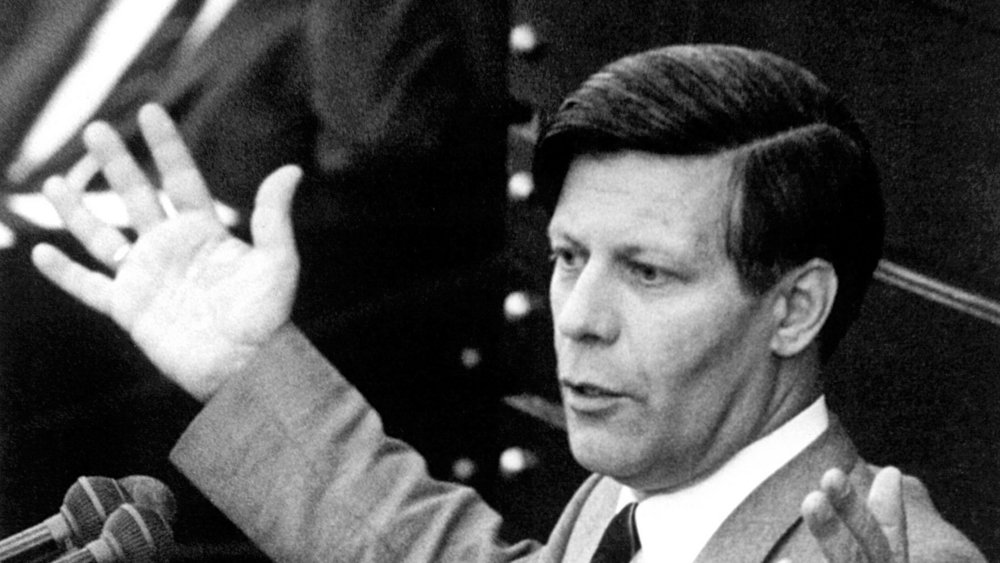
For 20 years, young people have been exchanging their arguments in the nationwide "Jugend debattiert" competition. They compete against each other in verbal battles according to set rules. The state final was held in Hamburg on 25 March. Federal President Frank-Walter Steinmeier called the debating competitions "impulses for successful education in democracy" and emphasised the importance of debating for our democracy. On 12 February this year, inspired by our namesake Helmut Schmidt, we also discussedthe extent to which democracy needs debate. The necessity of political debate for our society is not new, but it is being challenged anew, as a look at the development of our culture of debate shows.
Consensus democracy has a long tradition
Germany has a long tradition of consensus democracy. The ideal of consensus formed the foundation of the post-war republic and contributed to its stability. It is therefore hardly surprising that many people in our country still associate conflict and debate with something negative - and shy away from them. Conflict is equated with instability and jeopardising our cohesion. If we can find a consensus, then our democracy is stable. This is symbolised by shaking hands after heated debates, which even party-political opponents are not denied. The two major popular parties also epitomise the ideal of consensus and governing in coalitions, which is an exception by international standards.
Genuine discourse is becoming rarer
In view of the increase in the incidence of protest and political engagement, it could be assumed that this has changed for the better. In contrast to the Shell youth studies conducted years ago, young people are no longer disinterested and disenchanted with politics, but are politicised and active in voluntary work. It seems that people across all age cohorts in Germany are arguing more again, including about politics. But our ideal of consensus has left an aftertaste. Members of parliament, but also committed activists, often enter the debate with a compromise already within their grasp and are increasingly less likely to defend their own point of view in political debates, according to Andrea Römmele, professor at the Hertie School of Governance, in her book on the German culture of debate. At the same time, critics are expressing themselves in a different form, in outrage. We can observe this in online forums, on the street, but also in the right-wing populist Alternative for Germany (AfD) party, which has made outrage its programme. Genuine discourse, on the other hand, has become rare.
The tone has become harsher
Journalist Meredith Haaf talks in her book "Streit! Eine Aufforderung", journalist Meredith Haaf talks about the shouting on the one hand and the "cuddling course" on the other. This development can be seen particularly clearly in online debates. Through the comment function on news portals, Facebook or YouTube, we as users react to something - but rarely talk to each other. The tone is harsher, partly because we talk about rather than with our counterparts. This roughness and even hate comments are exacerbated by the fact that we don't meet the other person in person. We can dehumanise them and stylise them as the enemy. At the same time, we are also experiencing the other extreme on the internet, the "cuddle course": we move around in our filter bubbles, in which we receive self-assurance, or "likes" in modern parlance. Algorithms ensure that we are always connected to the same opinions and therefore to people and media makers who think similarly. We post our opinions, which in turn are seen by people who are already linked to us - and often come from the like-minded political camp. A parade of self-affirmation appears on our screens.
Debates as a new series of events
So it is hardly surprising that a large number of newspaper articles and books on our culture of debate have appeared in recent years, most of them with the same credo: argue more and better. The weekly newspaper "Die Zeit" even set up its own disputes section, in which it regularly brings together people with different positions on the same topic. As a foundation, we recently created our "Streitgespräche" series of events to allow experts with different positions on the same topic to engage in controversial discussions. A study by the University of Chicago shows that controversial opinions often lead to a better result. The researchers analysed Wikipedia articles and found that the content of articles written by several people with different opinions is more convincing and well-founded.
In this "super election year", much will revolve around the minimum requirement of representative democracy - voting. The underlying values that make our society democratic are usually only up for debate with regard to the anti-democrats. We discuss non-voters as those who do not see their interests represented and those who vote for right-wing parties and decide in favour of abolishing liberal, plural democracy. In the aftermath, however, we should not only analyse the projections in detail, but also the debates that accompanied the election campaigns. After all, discourse is crucial, not least with regard to populist election promises. The philosopher Marie-Luise Frick emphasises in her book "Zivilisiert streiten. Zur Ethik der politischen Gegnerschaft", philosopher Marie-Luise Frick emphasises that it is not necessarily the resolution of a conflict that is decisive, but the way in which we engage with our opponent.
Daring to launch an argumentative attack
The patron saint of our foundation, former German Chancellor Helmut Schmidt, was known for his willingness - and even enjoyment - of heated debates. He aptly compared politics to martial arts - and alluded to the factual exchange of arguments. Convinced democrats are best able to debunk populist statements by entering the debate with factual arguments. However, the decisive factor here is not only to respond with counter-arguments, but also to actively defend one's own convictions - and at best to passionately promote liberal, pluralistic democracy. To stick with the martial arts metaphor: Democrats should not only defend themselves defensively against anti-democrats. They should also dare to launch an argumentative attack and fight for their democratic values and ideals. In many moments, however, we experience precisely this defensive stance - especially in discussions. But how can we manage to get out of the defensive in a debate? How can we argue better?
The first step is to become aware of our own message before we address the other person. A second step is an honest willingness to engage with the other person - without immediately coming to the negotiating table with positions that are ready for compromise. During the discussion itself, we should also keep looking at ourselves from the outside. Thea Dorn, a philosopher and author who has repeatedly spoken on the subject in Germany, talks about self-distance in this context in order to differentiate between arguments and feelings. This also means that people can reflect on their own position and are prepared to recognise that they are wrong or now have a different view of an issue if they themselves have been convinced by arguments.
We have a discursive responsibility
The concept of responsibility regularly crops up in policy areas such as foreign or migration policy. It is also used for the resilience of our democracy, i.e. its defence against right-wing acts of violence, slogans and parties. But we also have a discursive responsibility. Dissent is part of democracy. After all, democracies distinguish themselves from dictatorships by the fact that there is publicly voiced criticism and people can freely express their opinions. Our approach to dissent therefore reflects the state of our democratic culture. But where do we learn to argue if our parents have not already taught us this skill?
Research into adolescence has amply demonstrated which places and people are formative for our later abilities. After the parental home, it is school in second place, followed by one's own peer group, i.e. people of the same age with whom one identifies. Young people learn the ability to engage in verbal debate even more explicitly in extracurricular debating clubs or at "Jugend debattiert". Ultimately, however, these only reach those who are already prepared to engage in verbal combat. Only by establishing school subjects can we succeed in reaching as many young people as possible who do not learn these skills and values at home. At the moment, media literacy is being discussed in particular. This is a good start in view of the countless pieces of information that are available to us, but which also require us to choose and weigh up between them. Only by combining democratic and media skills can we succeed in sustainably improving our culture of debate. Let's take advantage of the current moment of newly acquired digital competence, our new willingness to innovate and, not least, the urgency of the next general election, practise arguing politically again - in voluntary work, at school and in everyday life - and offer spaces for verbal debate. After all, up to a certain point, people can still be convinced by democracy and, at best, even discouraged from voting against it.

Until August 2022, Dr Nina-Kathrin Wienkoop was head of the "Democracy and Society" programme line. She is associated with the Berlin Institute for Protest and Movement Research and the German Centre for Integration and Migration Research. At the latter, she previously headed a research project on participation in youth engagement. She publishes, advises, researches and teaches on topics such as the resilience of democracies, domestic and international democracy promotion, youth engagement, non-violent resistance, diversity and protests, debate culture and diversity-conscious organisational development in civil society.
More