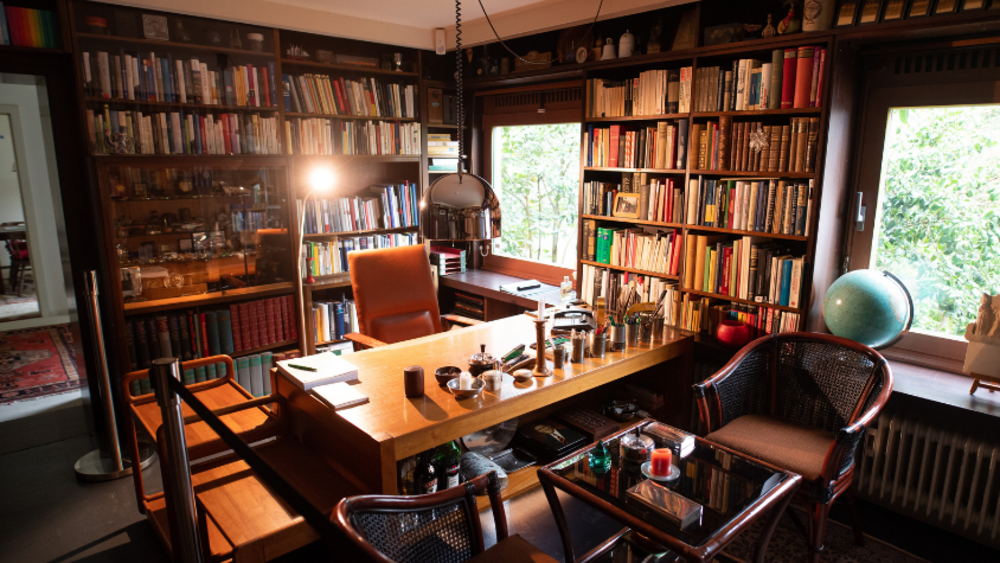
Helmut Schmidt kept his special mementos in the display cabinet behind the desk in his private home: numerous coins, finely decorated snuff boxes and unusual gifts. Schmidt’s greatest treasure, however, was a wooden chess set. He had carved it himself as a prisoner of war and brought it home with him, Schmidt reported in an interview with Zeit editor-in-chief Giovanni di Lorenzo. It symbolises a key political experience: according to Schmidt, it was his encounter with the elderly Lieutenant Colonel of the Reserve, Hans Bohnenkamp, a university professor and religious socialist before 1933, in the prisoner of war camp that opened his eyes to the crimes of the National Socialists and turned him into a Social Democrat. Helmut Schmidt returned to Hamburg from captivity as a prisoner of war in August 1945, and almost 50 years later he reflected on his childhood and youth under Hitler in his book: “I only learnt what democracy is and how democracy works in the prisoner of war camp.” This experience formed the basis of his political self-image – one that combined evidence-based reasoning responsibility, conscience and passion.
Reason and conscience as guiding political principles
During his political career, Helmut Schmidt was repeatedly faced with decisions that required not only expertise and decision-making skills, but also moral judgement. Two events in particular characterised his actions: the Hamburg storm surge of 1962 and the terrorism of the Red Army Faction (RAF) in the 1970s. Ultimately, he had to deal with questions of the state’s ability to act in the face of the central norms of the Basic Law. While the need for quick decisions in the face of a natural disaster was paramount during the floods, the period of the “German Autumn” demanded a balance between a clear stance towards terrorists and compliance with the rule of law. In both extreme crises, it was Schmidt’s conscience that ultimately determined his actions. However, according to Helmut Schmidt in his speech “Responsibility and conscience of a politician” (2007), the decision based on conscience was preceded by a penetrating endeavour of reason.
Democracy as a culture of debate
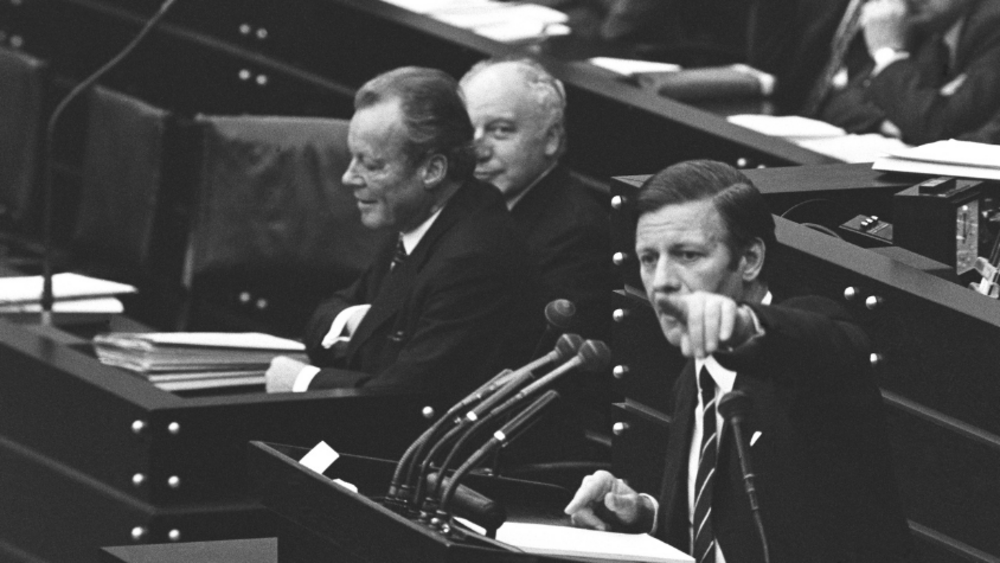
For Helmut Schmidt, politics was bound to clear values, despite all his pragmatism. His most important moral compass was the Basic Law, the first 20 articles of which he frequently quoted. When receiving an honorary doctorate from the Philipps University of Marburg in 2007, he recalled that the constitution was a “healthy reaction to the extreme elimination of individual freedom under Nazi rule and was based solely on the only fundamental value clearly and unambiguously expressed in the constitution: the ‘inviolable dignity’ of man”. As a passionate democrat, the defence against anti-democratic forces was of enormous importance to him. As Federal Minister of Defence (1969-1972), he advocated the “citizen in uniform” – soldiers should not just be recipients of orders, but critically thinking citizens. By founding the Bundeswehr universities in Hamburg and Munich, Schmidt wanted to combine military training with civic education. The aim was an army that not only protected democratic values, but also understood them. Closely linked to this was Schmidt’s idea of open debate and a culture of political discussion. For him, fact-based debate was the essence of a living and functioning democracy. In a television interview in 1965, he compared political debate to the boxing ring: “In a way, politics is a combat sport [...] and I also enjoy it.” He emphasised that a willingness to compromise was essential.
Helmut Schmidt also emphasised the importance of social cohesion and the need to bring different players together in order to strengthen democracy. A democracy that only fulfils the will of the majority and ignores minorities is unthinkable for him. “Democracy does not consist solely of the principle of majority formation,” he warned. “It finds its existential justification in the humanisation of politics.” This attitude arose from his own biographical experience. To this day, the small chess set in the display case in his study symbolises the conclusions he drew from the conflict in the prisoner-of-war camp.
Lessons for the present
Helmut Schmidt called on the guests at Philipps University to live democracy and defend it against its enemies: “We Germans — because of our catastrophic history — nevertheless have every reason to hold on to our democracy with tenacity, to renew it again and again, but also to bravely confront its enemies again and again. Only if we agree on this, only then will the beautiful verse of ‘unity and justice and freedom’ retain its justification.” Schmidt’s admonition is more relevant today than ever: democracies around the world are under pressure and anti-democratic forces that question the values formulated in the Basic Law have also been gaining strength in Germany for years. Attacks on our freedom of the press, the relativisation of human rights and the undermining of the separation of powers show that democratic values can by no means be taken for granted.
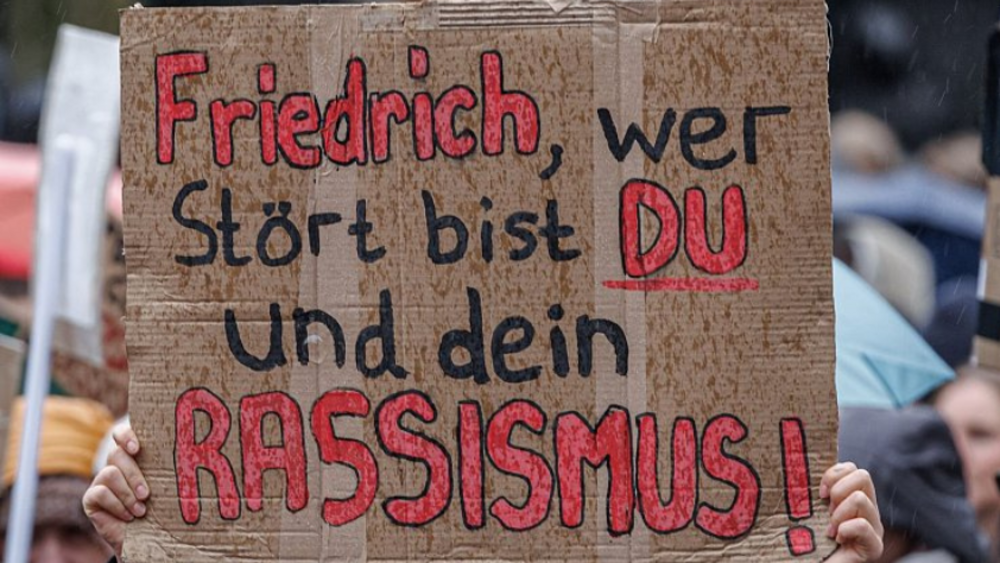
At the same time, we are experiencing new forms of engagement – from climate protests and citizens’ initiatives to solidarity movements for equal rights and participation, such as the recent demonstrations against Chancellor Friedrich Merz’s (CDU) “Stadtbildäußerung”. Democracy is changing and it needs people who actively shape it and protect its fundamental values.
In an interview with Die Zeit in 2014, Helmut Schmidt said: “I would go to the barricades for human rights in my own state if necessary (...)” – would you do the same?