
Dog-ears, staples and cancellations - traces of Helmut Schmidt's work in his private library
20. Nov 2021
Reading and writing formed a unity in the life of the politician Schmidt. His private library of around 22,000 volumes is matched by some 12,000 of his own publications, even though it contains "only" 55 book titles and the majority are published essays, newspaper articles, speeches and lectures.
Helmut Schmidt said of himself that he had already enjoyed reading a lot as a schoolboy. In an interview, he mentioned reading Moby Dick as an eleven-year-old and Russian classics such as Tolstoy and Dostoyevsky as a teenager. In fact, the library of the Helmut Schmidt Archive in Hamburg Langenhorn contains an edition of Moby Dick from 1944; there is no evidence of older editions of Tolstoy and Dostoyevsky.
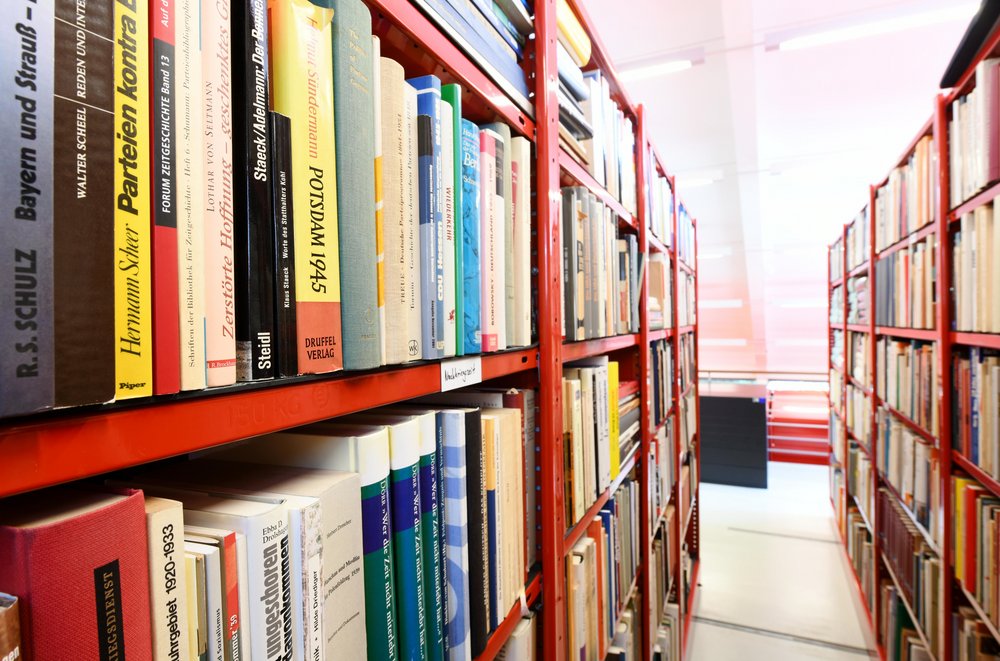
The layout of the Schmidts' library fits into the limited space of the Langenhorn estate. The rooms in the two semi-detached houses at Neubergerweg 80 and 82, built in 1960/61 as part of the Neue Heimat "Young Family" and "Better and More Beautiful Living" programmes, have a normal ceiling height, which meant that they could not accommodate impressive bookshelves or even a separate library room. Instead, the book collection was thematically organised and distributed across several rooms in the neighbouring houses. In the living room, behind the famous red sofa where Leonid Brezhnev once sat, art books and encyclopaedias are arranged in four rows of shelves, crowned by editions of classics that extend above the doors into the small passageway to the bar. Diagonally opposite are mainly fiction books. In Helmut Schmidt's study, there are mainly political and philosophical titles as well as books whose content he particularly appreciated and which he picked up frequently. The Schmidts' books, which were probably only read once, had to be moved to the first archive extension, where they stand on a gallery. A second book gallery is located in the archive opposite. This functional building, erected to house the estates of Helmut and Hannelore "Loki" Schmidt, contains the most extensive part of the library in the stacks. Travel literature, Hamburg publications and volumes on German, European and world history have been placed here. There are also editions of works by politicians, biographies, economic and political literature, volumes on architecture, music and art, as well as on the military and a collection of caricatures by Schmidt.
A separate shelf in the archive office contains writings on the history of social democracy, including the SPD's Godesberg Programme (1959), which Schmidt often quoted. All in all, Helmut Schmidt has amassed a considerable working library. Only a few bibliophile and antiquarian volumes, often gifts and dedications, including a volume of Kant from 1763 by Karl Popper, whose works have found a place next to Kant in the study, round off the picture, but do not show Schmidt to be a bibliomaniac. The works of Kant, Popper and also Marcus Aurelius' "Selbstbetrachtungen" - all of Schmidt's favourite authors - were badly damaged by him while he was reading them. Dog-ears, marks in all colours, notes in the margins, paper clips and staples in the books can be found everywhere and give bibliophiles a shock. The bad habit of simply cutting out passages of text and physically inserting them into his own works as quotations not only pains all book lovers, but would also make his texts suspected of plagiarism today, as Schmidt usually did not cite the sources.
But for Helmut Schmidt, his books were working titles. He read them in order to understand them and to be able to pass on and disseminate what he had understood. He probably found references to sources, other authors or the labelling of quotations or even footnotes superfluous, especially as he occasionally used the phrases "You can read up on [...]" or "As [...] also said".
In addition to books, Schmidt was an avid and all-encompassing reader of newspapers and magazines. During his time as Senator of the Interior in Hamburg in 1963, the list of subscriptions he considered necessary included the impressive number of 32 newspapers and magazines, supplemented by ten official titles. As this was beyond the scope of his budget, he was asked by the Ministry of the Interior at the beginning of 1963 to reduce this number. Schmidt cancelled eight titles, including the Englische Rundschau and the Flensburger Presse as well as three police magazines. Irrespective of this, Helmut Schmidt collected all press articles by and about him throughout his life, so that the volume of press echoes in his estate comprises around 200,000 sheets.
We don't know whether the two Schmidts sat together in the living room in the evening and occasionally read a particularly interesting chapter to each other. What we do know is that they were both avid readers of specialised and non-fiction literature and were interested in expanding their knowledge throughout their lives. They got to the bottom of things before forming an opinion and did not rely on pre-formulated statements. They enjoyed passing on their findings by giving public speeches or lectures or by writing essays and books. The print runs of all their books are enormous and they are still being reprinted and selling well today. Both as authors and readers, the Schmidts can be seen as hard-working and likeable role models.