The Federal Government is currently working on Germany’s first China strategy, which is due to be published shortly. With this strategy, Germany is practising the balancing act between the realisation of economic interests and its own claim to the universality of human rights. Even if the debate has to be reopened in light of the Russian war of aggression, the discussion about the apparent conflict between moral behaviour and economic interests in foreign policy is nothing new.
Until his death in 2015, Helmut Schmidt was one of the key figures in the debate on German-Chinese relations. He was enthusiastic about China, which was particularly evident after his chancellorship in the form of numerous trips to the People’s Republic. He summarised his impressions in books and gave numerous interviews. His knowledge of Chinese culture and history sometimes earned him the reputation of a “China connoisseur”, but also that of a “China expert”. This sometimes not unproblematic role can be analysed by looking at Helmut Schmidt and selected examples of German-Chinese relations over time.
Helmut Schmidt: the first German Chancellor in China
Before the establishment of diplomatic relations in October 1972, the relationship between West Germany and China was characterised by the political ideology of the Cold War, and an official rapprochement seemed unthinkable in view of the hardened fronts. Nevertheless, the lack of an economic policy agenda was criticised within the party, not in the SPD, but in the CDU/CSU: as early as 1967, the then Federal Chancellor Kurt Georg Kiesinger (CDU) criticised the fact that despite all the analyses according to which the People’s Republic was becoming the world’s strongest economy, there was still no clearly developed strategy towards China.
In their foreign policy concepts, the West German governments had to orientate themselves towards both the USA and the Soviet Union. This can also be seen in the implementation of the “New Ostpolitik” as the guiding principle of West German foreign policy by the social-liberal government under Willy Brandt from 1969 onwards. It is true that the Sino-Soviet rift, which reached its peak in the same year, expanded the room for manoeuvre of West German politicians – in their eyes, the People’s Republic was developing into a potential ally against the Soviet Union. However, political steps could only be taken after US President Richard Nixon’s visit to China three years later, which was organised by Henry Kissinger.
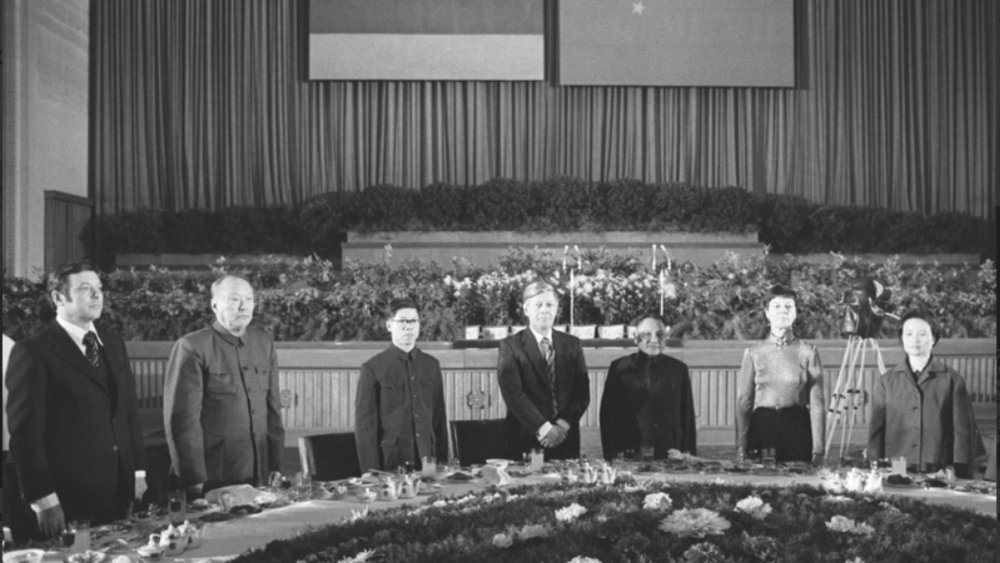
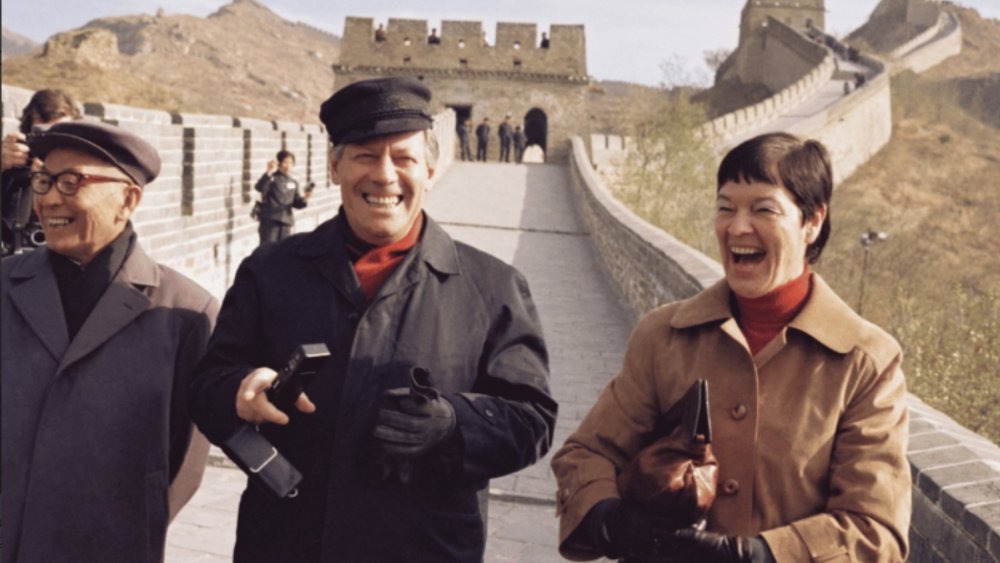
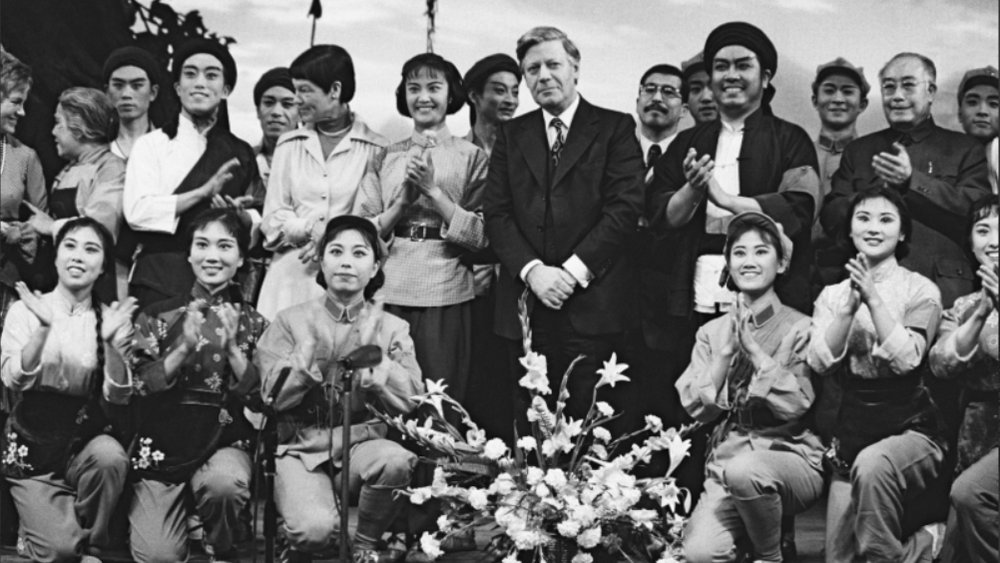
Following the resignation of Willy Brandt in May 1974, it was Helmut Schmidt who became the first German Chancellor to visit the People’s Republic in October/November 1975. Schmidt repeatedly reported on his meeting with Mao and Deng Xiaoping in his publications. Among other things, he was impressed by the 5,000-year-old Chinese civilisation, by Mao’s knowledge of philosophy and by Deng’s pragmatism, who was responsible for China’s economic development from the end of the 1970s with the implementation of the economic reform programme – the “Four Modernisations”.
Visit to Beijing in 1990
On 4 June 1989, the Chinese government violently suppressed a democracy movement that was mainly supported by workers and students. The use of military force resulted in numerous deaths. As a consequence, some Western industrialised countries decided to impose sanctions, an arms embargo and political isolation.
Almost exactly one year after the event that became known as the “Tiananmen Massacre”, Schmidt attempted to calm the waves. To this end, he met with German journalists, businessmen and diplomats as well as high-ranking representatives of the Chinese Communist Party (CCP) in Beijing. The trip, which is also featured in our exhibition “Schmidt! Living Democracy” is an important chapter in German-Chinese relations, as it was the first time that diplomatic relations had been seriously jeopardised since the Tiananmen massacre.
After this trip, Helmut Schmidt defended the CCP’s actions and continued to advocate good relations. In doing so, he raised the ever-present decision between moral self-demand and economic interests, which continues to determine relations with the superpower today. As interview transcripts from the Helmut Schmidt archive show, Schmidt allowed himself to be strongly influenced by Chinese party officials in his assessment of the situation. His assessments of the events appear to be based in particular on the accounts of Luo Gan, then Secretary General of the State Council. Contemporary assessments by human rights organisations such as Amnesty International or critical voices towards the Chinese government, on the other hand, received less attention, at least this cannot be found in the archive materials.
During Schmidt’s visit to Beijing in 1990, just one year after the “Tiananmen Massacre”, this perspective could perhaps have been attributed to insufficient information. However, Schmidt insisted on this point of view well into old age. In 2008, he went even further in his argumentation in an interview with the Westdeutsche Zeitung. There he labelled the protesters as “wild-eyed students” who had attacked the soldiers first. This and the threat of losing face – due to the visit of Soviet Communist Party leader Mikhail Gorbachev in the midst of the protests – had left the party leadership with no other choice.
More China expertise – then and now
Schmidt acquired his knowledge of China over decades and he realised early on that it would no longer work internationally without China. However, Schmidt’s views sometimes resembled the official guidelines of the CCP, for example in the historical assessment of Mao or the narrative of China as the “most peaceful country in world history”. At the same time, he warned against growing Chinese nationalism and criticised the repression against Tibet as well as the oppression of the Uyghurs and other ethnic minorities in the Chinese province of Xinjiang.
China’s 5,000-year history also plays an integral role for the current Chinese government, but on closer inspection it turns out to be a politically instrumentalised myth – there was simply no such thing as a Chinese empire that was culturally and geographically united. This in no way denies the achievements of civilisation. However, history is always a construction that is highly dependent on the current view of events. The question is therefore to what extent political conclusions can be drawn from this narrative. In the case of the current Chinese President Xi, the narrative becomes a politics of history, which is also used to justify the merger with Taiwan, for example.
The positions and statements of Helmut Schmidt described above clearly show how much a deeper and more differentiated understanding of China is needed in Germany. Schmidt himself pointed out the widespread ignorance of China’s culture and history that often seems to dominate the discourse in this country. This should still be criticised today, as the media construction of China often works with centuries-old images and ciphers. Even more so, a tradition of exoticism is used (for example the Spiegel cover from 22 January 2021), which in turn manifested itself in anti-Asian racism in the wake of the coronavirus pandemic. It is not without reason that more China expertise is also essential for a modern strategy.
International symposium of the BKHS: “International Perspectives on a Global China”
Helmut Schmidt was deeply impressed by China’s development throughout his life. Good relations with the country were sometimes more important to him than a German foreign policy that uncompromisingly demanded respect for human rights. Even after his time in office as Federal Chancellor, Schmidt used this attitude to influence the way China was talked about in Germany.
“Global economic power”, “equal partner”, “global investor”, “aggressor”, “strategic rival” or “peace power” – these are just some of the competing buzzwords that currently dominate discussions about China or are propagated by the country itself. Such narratives shape our ideas and discussions. They can influence interests that are followed by (economic) policy actions or serve political actors as rhetorical and strategic instruments of persuasion in political decision-making processes.
As part of the international and interdisciplinary symposium “From the ‘workshop of the world’ to ‘systemic rival’ – International Perspectives on a Global China”, the Bundeskanzler-Helmut-Schmidt-Stiftung (BKHS) is inviting an international audience of experts from academia, politics, media and business to Hamburg on 30 and 31 March 2023 to jointly analyse the perspectives on China in different regions of the world and to ask: Who shapes the view of China, what are the driving motives? Do the different narratives facilitate international cooperation or do their contradictions hinder international partnerships?
We set regional priorities and cooperate with some of the most renowned institutions in this field: the Mercator Institute on China Studies(MERICS), the Africa Policy Research Institute(APRI), the European Council on Foreign Relations(ECFR), the German Institute for Global and Area Studies(GIGA) and the Kissinger Institute on China and the United States at the Wilson Center(KICUS).