
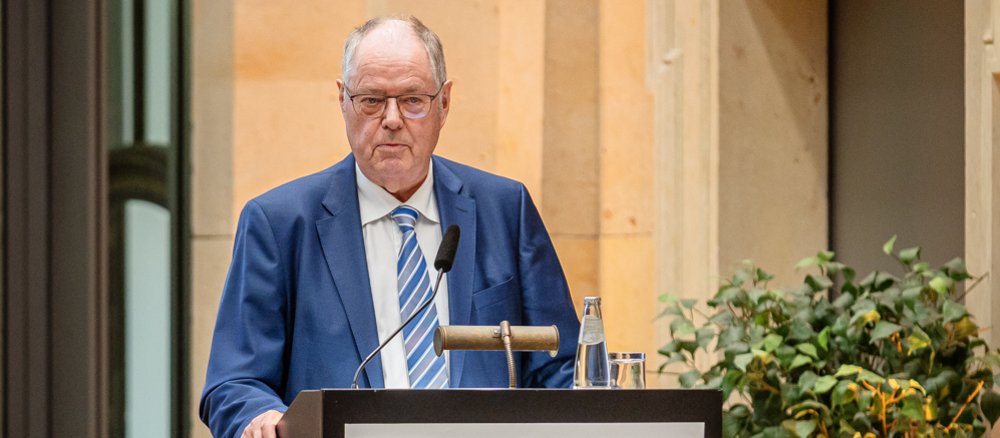
Disclaimer: The speech was delivered in German. Check against delivery.
Dear Federal Minister, dear Boris,
Ladies and gentlemen,
A warm welcome to the Helmut Schmidt Lecture, through which our foundation honours its namesake, opens up his themes for debate and carries them forward into the future.
Helmut Schmidt ranks among the most significant statesmen of the 20th century. He was an international visionary, a brilliant public speaker and, not least, the fifth Chancellor of the Federal Republic of Germany – at a time of global crises and massive challenges, both political and economic. As a politician, Schmidt consistently championed peace, economic cooperation and democracy.
The Bundeskanzler-Helmut-Schmidt-Stiftung continues this mission through research, political consultancy and educational programmes for the general public, in keeping with our foundation’s motto: “Dialogue. Inspiration. Stance.”
Being open to dialogue, seeking an exchange of ideas – particularly with those who hold different views – thereby refining one’s own arguments and providing political impetus, whilst demonstrating conviction, taking a clear stand and always speaking plainly – that is what set Helmut Schmidt apart; it was his hallmark and made him the sort of politician whom many today say we are missing, particularly in view of the world we live in, which has been thrown into disarray, and given the enormous need for reform in Germany.
And that, dear Boris, is the perfect segue to you and your lecture, which we are all eagerly looking forward to. You are cut from the same cloth as Helmut Schmidt, as has been repeatedly noted in the media. The major challenges of our current political landscape, the global tensions, your extraordinary responsibilities, and the fierce opposition you face as Federal Minister of Defence do not daunt you. On the contrary: they are your mission and your duty, and they spur you on.
There is indeed quite a lot of “Schmidt” in that – you are his 15th successor in the Ministry of Defence. One could also mention your ability to address serious problems, such as the Bundeswehr’s current lack of defence capability, in a straightforward manner, even when they are uncomfortable for politicians and in public debate. But: as is well known, one should not take historical comparisons too far (and they are always somewhat flawed).
Just one more thing: the conviction that soldiers come from the heart of civil society and must be ‘citizens in uniform’, that the Bundeswehr must be a parliamentary army and must never again become a ‘state within a state’, that Germany must be militarily strong in order to secure and preserve peace, – all of this also links you to Helmut Schmidt, who was a staunch supporter of conscription and, thinking in the long term, regarded it as a central element of our democracy.
Ladies and gentlemen, the Helmut Schmidt Lecture is one of the BKHS’s flagship events. It was launched in 2021 by the Belarusian opposition leader Svetlana Tikhanovskaya; most recently, Ekrem İmamoğlu addressed us with the message “For a Just Democracy!”. He has since been removed from office as Mayor of Istanbul and arrested on the basis of dubious allegations, clearly with the aim of politically sidelining him ahead of the Turkish presidential election campaign.
The Helmut Schmidt Lecture is dedicated to the most pressing issues of our time. This evening, the focus will be on the new challenges facing security policy and the European Union’s capacity to act, which is at risk of dwindling on the international stage.
It is obvious that these were core issues for Helmut Schmidt, which we must now consider in a changed context. From the second half of the 1950s onwards, the transatlantic defence alliance formed the cornerstone of Schmidt’s thinking on security policy, which crystallised in 1961 in his groundbreaking study “Defence or Retaliation” and culminated in the NATO Double-Track Decision, which Schmidt, as Federal Chancellor, helped shape conceptually and successfully pushed through with the US and his European partners.
The reality of security policy is currently changing faster than we can adapt our strategies to it. One thing is certain: security is created today through coalitions, and Europe needs global alliances more than ever. Underlying this is a comprehensive concept of security. It encompasses military alliances, the protection of critical infrastructure and the defence against hybrid threats, effective civil protection, resilient energy strategies and robust supply chains.
In Europe, we are facing a “double Zeitenwende”: Russia’s war of aggression against Ukraine and Donald Trump’s rejection of the liberal, rules-based international order, coupled with a fundamentally altered role and foreign policy on the part of the US.
International politics is now once again being shaped to a much greater extent by economic and military “hard power”, volatility and disruption, as well as – at present – by three major powers and their respective specific interests: Russia, China and the USA. These states are undermining international norms, borders and institutions to varying degrees, and destabilising regional and global systems of order. The resulting dynamics directly challenge other states within this system to rethink existing assumptions and convictions. For the EU, this means nothing less than calling into question almost all the long-held certainties in transatlantic relations.
In order to assert itself as an independent actor in this environment and to be allowed to take a seat at the negotiating table rather than ending up on the menu (as Canadian Prime Minister Mark Carney put it at the World Economic Forum in Davos), to help shape the development of the international order and politics, and to be able to pursue its foreign policy interests and values, the EU requires comprehensive European capacity for action. This requires economic strength and competitive advantages, technological sovereignty, democratic resilience within society, and sufficient security and defence capabilities of its own.
Before any of you in the audience get the impression that I’m trying to deliver the Helmut Schmidt Lecture myself, I’ll bring this to a close.
I am delighted that two former Federal Ministers are present here today – Rudolf Scharping and Markus Meckel – who, each in their own capacity, have made important contributions to security and foreign policy. I would also like to extend a special welcome to Karl Kaiser, the doyen of security policy research and consultancy in the Federal Republic of Germany, and to Jochen Thies. From 1980 to 1982, he was deputy head of the speech-writing team at the Federal Chancellery – precisely during those years when Helmut Schmidt’s policy of the NATO Double-Track Decision met with protest from the peace movement, which reached one of its high points in 1981 with the demonstration of around 300,000 people on the Hofgartenwiese in Bonn.
Following Mr Pistorius’s speech, he will discuss the lecture topic with Thu Nguyen, currently Co-Director of the Jacques Delors Centre at the Hertie School, and with Elisabeth Winter, Deputy Managing Director of the BKHS, in a session skilfully moderated by Melanie Amann.
I would also like to express my sincere thanks to the team at the Bundeskanzler-Helmut-Schmidt-Stiftung, who have once again gone “above and beyond the call of duty” in the planning and preparation of this evening and of the BKHS Magazine, which is always associated with the Helmut Schmidt Lecture and will be presented in more detail later on.
And now, dear Boris Pistorius, the floor is yours.