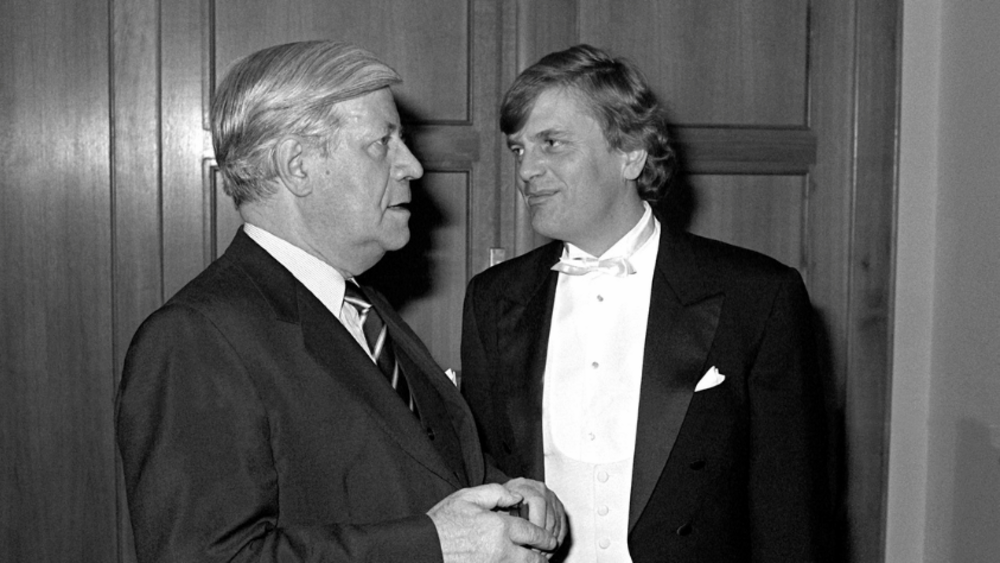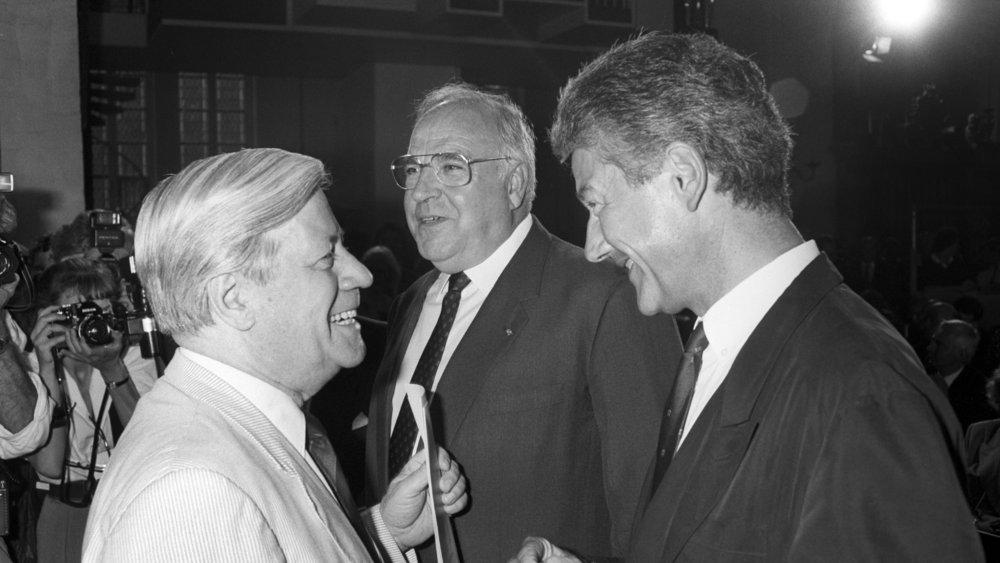
It takes a lot to get a festival off the ground and keep it alive: commitment and enthusiasm, political and financial support, big names in the music scene and a large audience. These factors actually came together in 1986 and one of the sponsors at the time was Helmut Schmidt. He was the first German prizewinner to receive the Alexander Onassis Foundation’s “Athinai Prize” of 100,000 dollars with the aim of “promoting the common good throughout the world”. The co-editor of Die Zeit, Marion Gräfin Dönhoff, promised Helmut Schmidt to use half of the prize money to support the Schleswig-Holstein Musik Festival e.V., which was founded in 1985. Convinced by this, Schmidt wrote to Honorary Professor Ioannis Georgakis of the Onassis Foundation on 29 May 1987 about his plans: “The latter is a non-profit-organisation that pursues the purpose of inviting musicians from East and West for concerts. Last year we organised almost 100 concerts in the North of Germany in several places – as well as in concert halls, churches and even barns, met by the public with great enthusiasm. Of course we were also left with a deficit, which was covered by the state government of Schleswig-Holstein.”
Promoting art and culture as a goal of economic development
In addition to Schmidt as a sponsor, the Minister President of the northern federal state was also found as a vital partner; the fact that the then head of government Uwe Barschel also considered the promotion of art and culture as one of three new goals of economic development ultimately benefited the Schleswig-Holstein Festival. A cultural foundation was established with the state budget in 1983, which – financed by funds from a lottery ticket – was also able to support citizens’ initiatives for music. Ultimately, the budget deficits could always be compensated by the state funds. This cultural subsidisation is perfectly normal and is even higher for paying guests attending concerts or operas in Hamburg, for example.
The first years of the Schleswig-Holstein Festival developed favourably. in 1986, around 100,000 guests attended 96 concerts in 15 cities and municipalities over seven weeks. in 1987, around 220,000 visitors attended 230 events at 25 venues over eight weeks. In the following years, the numbers levelled off at 200,000. That was quite an achievement, and as Leonhard Bernstein said in the early days of the festival: “I fell in love with Schleswig-Holstein.” What could be bigger?
Well, the following Minister President and patron Björn Engholm found it worrying in 1992 that over 20 per cent of visitors were aged 50 and over. The “twens” needed to be addressed more specifically and skilfully. It was also still a long way from offering a “culture for all” when 70 per cent of the audience came from academic circles.
Summary after 10 years
Schmidt wrote an encouraging greeting for 1994, looking back on the beginnings with joy and pride. “I still remember the day when Justus Frantz told me about his idea of using the beautiful manor houses and halls of Schleswig-Holstein for concerts to bring music to the people. What a good idea. [...] Music is spirit. Listening to music is life. Why should we have to travel to Salzburg, Bamberg, Munich or Zurich for this joy of life? No! Here in the north, at home, this is where the music should be played. Justus Frantz certainly had my support. And not only mine. Our fellow northern Germans – who are sometimes thought to be a bit stubborn and slow – made good use of the wide range of music on offer. Looking back today, it’s amazing how far the Schleswig-Holstein Music Festival has come. To this day it has lost none of [...] its freshness [...] – although after eight years it has become one of the largest of its kind in Europe. [...] It all started with my friend Leonhard Bernstein. The fact that there was no major break after his death [...] is thanks to the efforts of Justus Frantz.”
The musical résumé of the ninth SHMF in 1994 reads satisfactorily. Around 180,000 visitors attended 140 concerts, ensuring a capacity utilisation rate of 82 per cent.
In the crisis
In its tenth year in 1995, however, the festival slipped into an identity crisis. It was seething behind the scenes, partly due to the charismatic ambivalence of its artistic director Justus Frantz. However, the pianist was both a bridge builder and an enthusiast. After ten years, Frantz left the directorship and founded a “Philharmonie der Nationen” – an orchestra without state support with predominantly Eastern European musicians dedicated to “peace and international understanding”. Helmut Schmidt left the SHMF Board of Trustees in 1995 and followed Frantz together with Yehudi Menuhin, Rita Süssmuth and others. Chairwoman and Minister-President Heide Simonis nevertheless hoped that Schmidt would continue to support the festival with his benevolent publicity as before. In his letter to the Minister President, Schmidt expressed his disappointment at the dismissal of Artistic Director Frantz. “Under these circumstances, it is unfortunately no longer possible for me to be a member of the Board of Trustees. At the same time, I wish the festival success in its endeavours to continue Justus Frantz’s educational work and to introduce many people to classical music, as well as to continue the link between orchestral education and understanding between young people of different nationalities in Salzau and, thirdly, to continue to promote the state of Schleswig-Holstein. For the sake of good order, I would like to inform you that I have joined the board of trustees for the ‘Philharmonie der Nationen’.”
That was not a good sign. The departure of the most important organiser, Justus Frantz, was very painful. The number of SHMF e.V. members was around 5,000 and the festival lived not only thanks to their membership fees, but above all through their voluntary commitment on site during the festival weeks. How would the sponsors behave? There was a threat of cuts to the artists’ fees or a growing deficit that could only have been offset by even higher state funding.
As Chairman of the Supervisory Board of SHMF GmbH, Peer Steinbrück, Schleswig-Holstein’s Minister of Economic Affairs at the time, had the difficult task of implementing measures and resolutions to consolidate the music festival. The FDP parliamentary group criticised the SHMF’s lack of professional management. Bankruptcy was averted thanks to substantial funding from the state of Schleswig-Holstein.
In its press release of 10 December 1994, the Board of Trustees set out the scope of its tasks and asked “that Justus Frantz continue to help shape the SHMF artistically in the future – in whatever form. The Board of Trustees is convinced that this will ensure that the festival retains its unique character and identity.” With the new “Philharmonie der Nationen”, there were now two North German festivals.
And today
Over the next few decades, only the SHMF has survived to this day, under the directorship of Christian Kuhnt since 2013. More than 300 volunteers and 8,000 sponsoring members currently support the association. In 2022, around 165,000 music lovers attended the festival at around 200 concerts at over 60 venues. The programme ranged from pianist Igor Levit to rapper Danger Dan. The festival would not work without the help of the many volunteers who put their heart and soul into their work. An enthusiastic volunteer from Lübeck reports: “That’s also what makes the SHMF so special, that we do it with our heart and soul. We bring flowers from our garden to put on the buffet. And it’s really a lot of fun. We have the feeling that we get a lot in return. Today, for example, the artists have said very, very often that they feel incredibly welcome here and that they find it special.”