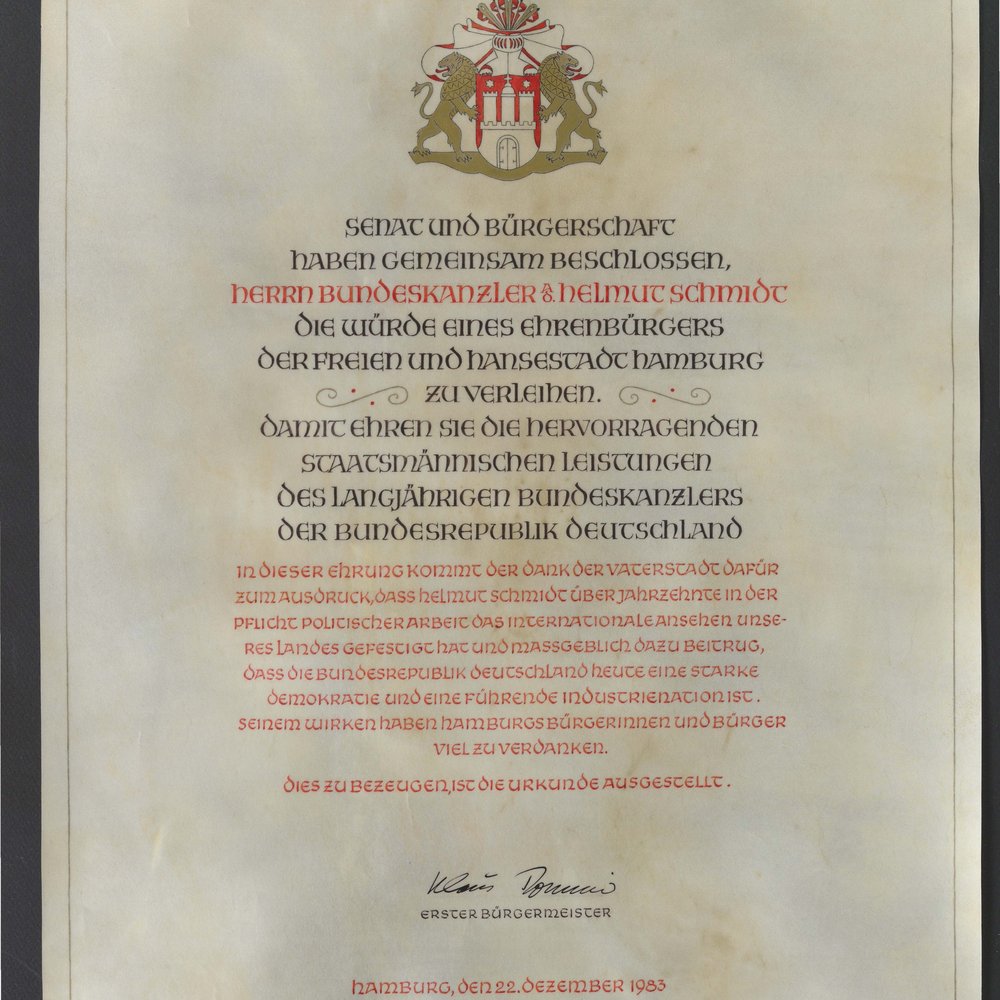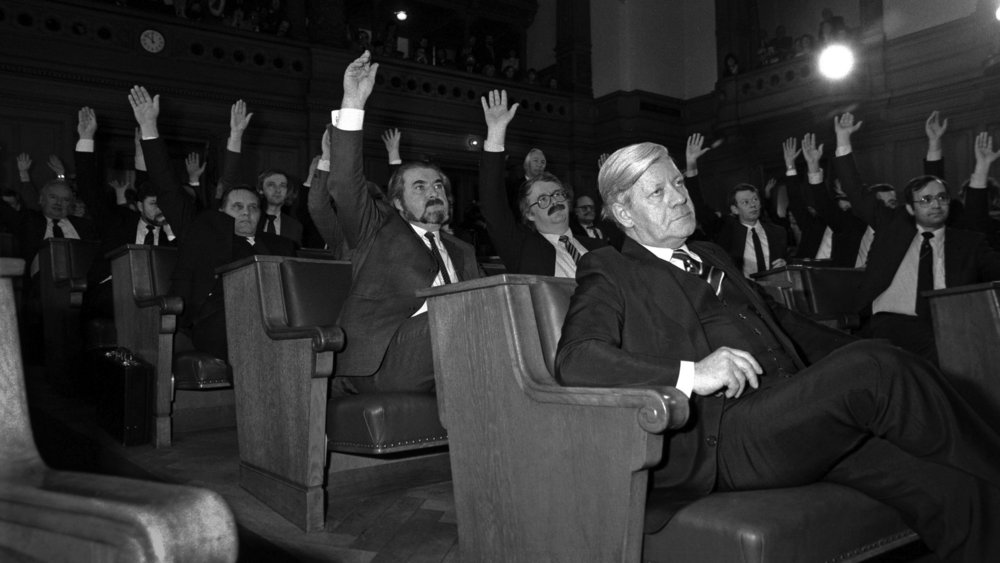
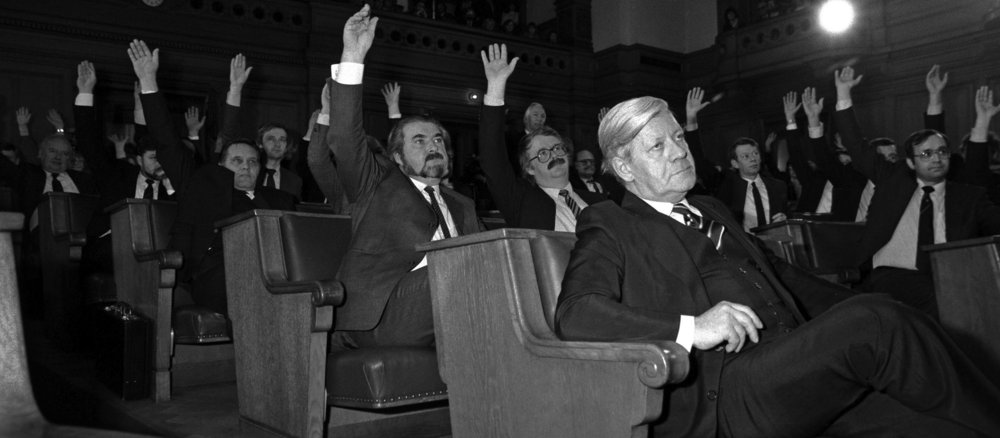
Two days before Christmas, Hamburg City Hall was in a hurry. The Hamburg Parliament, which as an “after-work parliament” normally only met from 4 p.m., postponed its Christmas holidays and called its 120 members of parliament together at 11 a.m. on 22 December 1983. The only item on the agenda of the special session was the Senate bill with the document number 11/1402: “Motion by the Senate to award honorary citizenship to former Federal Chancellor Helmut Schmidt”. What appears to be a state affair had a simple reason.
One day later, Schmidt celebrated his 65th birthday. This was an opportunity for the Hanseatic city to avoid the embarrassing situation in terms of protocol that the cities of Bonn and Bremerhaven could beat them to it, as Veit Ruppersberg, the long-standing town hall reporter for the Hamburger Abendblatt, was able to report. So in June 1983, the Hamburg Senate decided to make Helmut Schmidt an honorary citizen – before he was awarded the same honour in Bremerhaven on 9 September and in Bonn on 6 October. Only the approval of the Hamburg Parliament was still outstanding. The government and parliament made up for this on 22 December.
Helmut Schmidt was to be presented with the highest honour of his home city “for his great statesmanlike services”. Schmidt, who was called by First Mayor Klaus von Dohnanyi (SPD) immediately after the Senate decision on 14 June, is said to have “accepted the proposal with pleasure”, as von Dohnanyi reported the following day at the state press conference. In this case, Schmidt abandoned the much-cited Hanseatic reserve. Schmidt also left aside the legendary custom that a Hamburg citizen does not accept medals and decorations. Even 20 years later, he surprised Federal President Horst Köhler with this bon mot during his inaugural visit to Hamburg. “I have refused all decorations so far. But if you want to do something good for me, you can give me a silver cigarette tin,” the now 85-year-old told the Federal President and the First Mayor Ole von Beust, who was standing next to him – and later received a corresponding gift with the Hamburg coat of arms engraved on it, which can still be found in his study in Hamburg-Langenhorn today.
The honorary citizenship was to be the crowning glory of Schmidt’s political career in Hamburg, which had come to an abrupt end with the vote of no confidence and the change of chancellor from Schmidt to Helmut Kohl in October 1982. Schmidt’s second career began in May 1983. He became author and editor of the weekly newspaper Die Zeit. His workplace moved from the Rhine back to the Elbe.
However, honouring him in his home city proved to be a tricky mission. To this day, there are no written regulations or legal basis for the awarding of honorary citizenship in Hamburg, as Dr Josef Schmid from the Research Centre for Contemporary History in Hamburg stated in 2014 in an academic report for the Senate Chancellery. It is simply part of the Hanseatic tradition to honour deserving personalities in this way. Since the Imperial Russian Colonel Friedrich Karl Freiherr von Tettenborn was appointed the first honorary citizen in 1813 for leading the liberation from Napoleonic troops and thereby restoring Hamburg’s independence, the Free and Hanseatic City has honoured 22 men in this way. Adolf Hitler and Hermann Göring were stripped of their honours in 1945. Helmut Schmidt was therefore to become the 21st candidate on the official list of honorary citizens of Hamburg – and find himself in the company of Count von Moltke, Otto von Bismarck and Johannes Brahms.
Incidentally, for the first 172 years, the honour was bestowed exclusively on men. It was not until 1985 that the actress, director and theatre principal Ida Ehre became the first woman to receive the award, followed by the Zeit publisher and journalist Marion Gräfin Dönhoff in 1999, the Hamburg patron Hannelore Greve in 2005 and finally Hannelore “Loki” Schmidt in 2009, who was honoured for her outstanding services to nature conservation.
Von Tettenborn was the first honorary citizen of Hamburg to receive an “honorary gift” of 5,000 gold coins (“Friedrich d’or”), but since then the honorary citizenship in Hamburg has not been associated with any privileges – in contrast to other cities that grant their honorary citizens free admission to museums and theatres, for example. There is also no provision for an official grave in the municipal cemetery in Hamburg. It is a matter for the family. Even the funeral service, which is usually hosted by the Hamburg Parliament and Senate for honorary citizens, was not held at the city’s expense for Helmut Schmidt in 2015, as the Federal President had ordered an official state ceremony and the farewell was organised under the auspices of the Federal Ministry of the Interior.
The awarding of honorary citizenship in Hamburg was originally the responsibility of the Hamburg Senate. It was not until 1890 that the Senate decided to involve the city council “in order to avoid unpleasant differences of opinion”, as the city’s website states. Almost 100 years later, this was only partially successful in the case of potential honorary citizen Helmut Schmidt. After the parliamentary elections in June 1982, the Hanseatic city was considered “ungovernable”. The CDU as the election winner and the SPD as the second strongest party did not want to form a grand coalition. Forming a government with the new Green Alternative List (GAL) also failed. As a result, new elections were held in December 1982, in which the SPD achieved an absolute majority.
Six months later, the government and opposition were more conciliatory. Both the Social Democrats and the CDU were clearly in favour of making Helmut Schmidt an honorary citizen before the vote in the state parliament. Opposition leader Hartmut Perschau declared immediately after the announcement of the Senate’s plans: “His work as Senator of the Interior is unforgotten. Regardless of all differences of opinion, we regard Helmut Schmidt as a statesman of international standing. His mistakes and wrong decisions do not obscure his lasting services to Germany and Hamburg”.
At the extraordinary parliamentary session, Mayor Klaus von Dohnanyi (SPD) paid tribute to his party colleague for having “made a significant contribution through his political work [...] to making the Federal Republic of Germany a strong democracy today”. He conceded: “Helmut Schmidt is not exactly someone who keeps his opinions to himself. But over many years, people have seen with great respect how tirelessly Helmut Schmidt has repeatedly organised facts and insights in order to arrive at rational decisions. Making politics predictable in this way was his constant endeavour,” said the First Mayor in his speech to the MPs.
In addition to the First Mayor, only two other speakers had their say in the 51-minute session: Parliamentary President Peter Schulz (SPD), who was a close friend of Schmidt, and GAL politician Thomas Ebermann. His speech was eagerly awaited by the media, as he himself explained with some satisfaction in the parliament. The then 32-year-old co-founder of the Green Party and controversial representative of its eco-socialist left wing fulfilled all expectations. Powerfully eloquent and rhetorically skilful, he attacked the established parties and their “hypocritical consensus” “in this situation of depressing solemnity”. He launched an all-round attack on the jubilarian. “So today I am allowed to praise an anti-aircraft helper and not ask how he ended up in the Reich Aviation Ministry,” Ebermann harshly criticised Helmut Schmidt and his role as a Wehrmacht officer. “As a paragon of undogmatic left-wing intellectuality”, as the Hamburger Abendblatt wrote in 2019 on the occasion of a retrospective of historical events, Ebermann left no topic untouched: from Schmidt’s commitment to NATO to his position on nuclear power, his leadership style and the reason of state in dealing with the terror of the Red Army Faction (RAF), he spanned an arc to attest to the former Chancellor: “You were an outstanding executive employee for the major shareholders of this republic”.
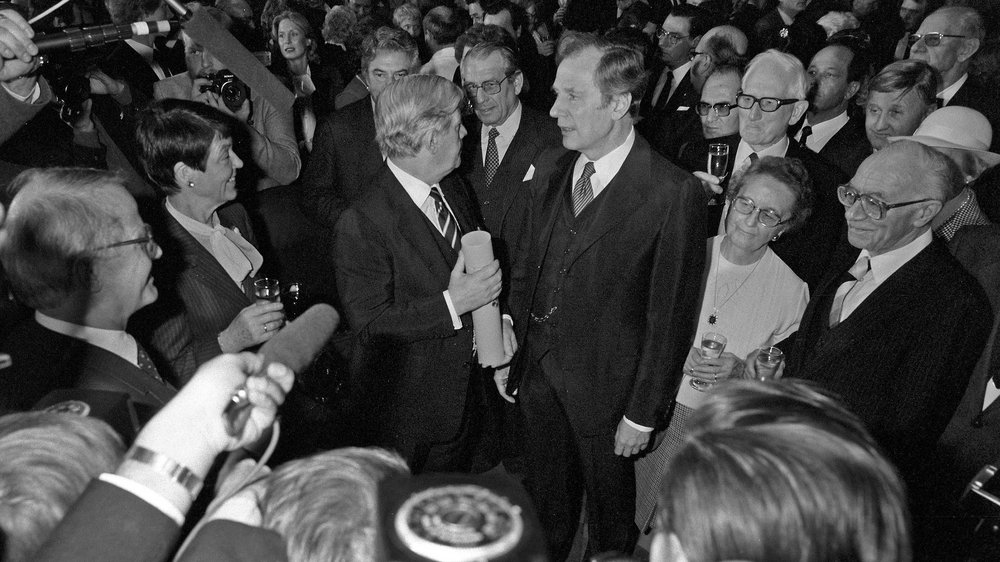
His appearance met with the appropriate response: “On his greatest day: Schmidt severely insulted in Hamburg” was the headline in the Bild newspaper the next day. According to the journalists, Schmidt himself is said to have taken note of Ebermann’s speech in silence and pulled a snuffbox out of his jacket with a deadpan expression. At the reception that followed in the large ballroom of the town hall, he thanked all the speakers “for their encouragement as well as their polemics. Both are necessary, both I will not conceal from our city and will not spare it. Both are also an expression of togetherness.”