
Helmut Schmidt's politically active years coincided with turbulent times in society. The 1960s and 1970s in particular were characterised by a spirit of optimism. The New Social Movements questioned old structures and demanded more participation in political decision-making processes. The student movement, anti-nuclear protests, women's rights and peace movements are now part of the collective memory of post-war West German history. Some of the key scenes from these years can also be found in our exhibition "Schmidt! Living Democracy" exhibition.
However, the history of the (West) German disability rights movement is much less well known. The fact that it is rarely mentioned in the same breath as the other social movements of those years is not least due to the fact that it is given little space in popular historical narratives. However, the commitment of people with disabilities to equality and self-determination can also be categorised as part of the social awakening since the 1960s. And it has lost none of its topicality and urgency to this day. Not only because equality for people with disabilities has to be fought for time and again, but also because the rise of right-wing extremist forces in Europe has led to an increase in open hostility towards people with disabilities (ableism) in many places. Strengthening democracy must therefore also mean strengthening an inclusive democracy. For the depiction of the history of democracy, this also means making the traces of people with disabilities and their struggle for their rights visible.
No awakening after the war
During National Socialism, mentally ill people and people with physical and, above all, mental disabilities were systematically discriminated against and persecuted. Hundreds of thousands were forcibly sterilised and murdered. However, after the end of the Second World War, little attention was initially paid to this group of victims. There was also little commitment in Germany to improving the situation of people with disabilities. The institutionalisation of disabled people in homes or "asylums", which became established in the 19th and early 20th centuries, continued. For them, the only alternative is often to remain in their family of origin. A self-determined life is neither possible nor the aim of the existing concepts for dealing with people with disabilities. The focus is on their accommodation and care. Disabilities are rarely considered from a social or political perspective.
The first signs of change emerged in the course of the social upheavals of the 1960s. Until then, so-called special kindergartens and schools and "workshops for disabled people" were created to support people with disabilities. However, this resulting structure separates people with disabilities from the rest of society. The concept of inclusion and the idea of self-determination are not yet at the forefront.
First protests
In the 1960s, more and more young people with disabilities began to politicise themselves. The influence of the student and women's rights movements played a significant role in this. They realised that it was possible to protest against old social patterns. The influence of the USA, where the civil rights movement raised fundamental questions of equality and equal rights and the Disability Rights Movement emerged, also played a role. As in the USA, camps and clubs for people with disabilities are now also being set up in West Germany. The "CeBeeFs" ("clubs of disabled people and their friends") are places of exchange and mutual support. The first initiatives achieve greater media attention. For example, the Frankfurt adult education centre course "Coping with the environment", initiated by social worker Gusti Steiner (himself confined to a wheelchair) and journalist Ernst Klee. From 1974, together with disabled and non-disabled people, they drew attention to everyday barriers, for example by blocking a tram. in 1978, they awarded the "Golden Crutch" negative prize for the first time to companies, associations or laws that marginalise or discriminate against people with disabilities.
In addition, associations of people with disabilities are formed that give themselves the name "cripple groups". The name serves to self-empower this discriminatory term and is intended to cause discomfort among people without disabilities. The "cripple groups" are highly political. The participation of people without disabilities in these groups is undesirable.
1981: "Year of the disabled"
The early 1980s become a key moment for the disability rights movement in West Germany. A court ruling triggers nationwide protests when a traveller wins a lower price for her package holiday because she encounters people with disabilities at her holiday destination. The subsequent demonstrations are covered by the media nationwide. Many activists felt encouraged that their protests might not immediately bring about a change in the situation (the so-called Frankfurt judgement still stood), but that they could still sensitise and win over more people to their cause.
the United Nations declares 1981 the "International Year of the Disabled". On this occasion, the "Federal Government Commissioner for the Interests of People with Disabilities" is appointed for the first time in West Germany under Chancellor Helmut Schmidt.
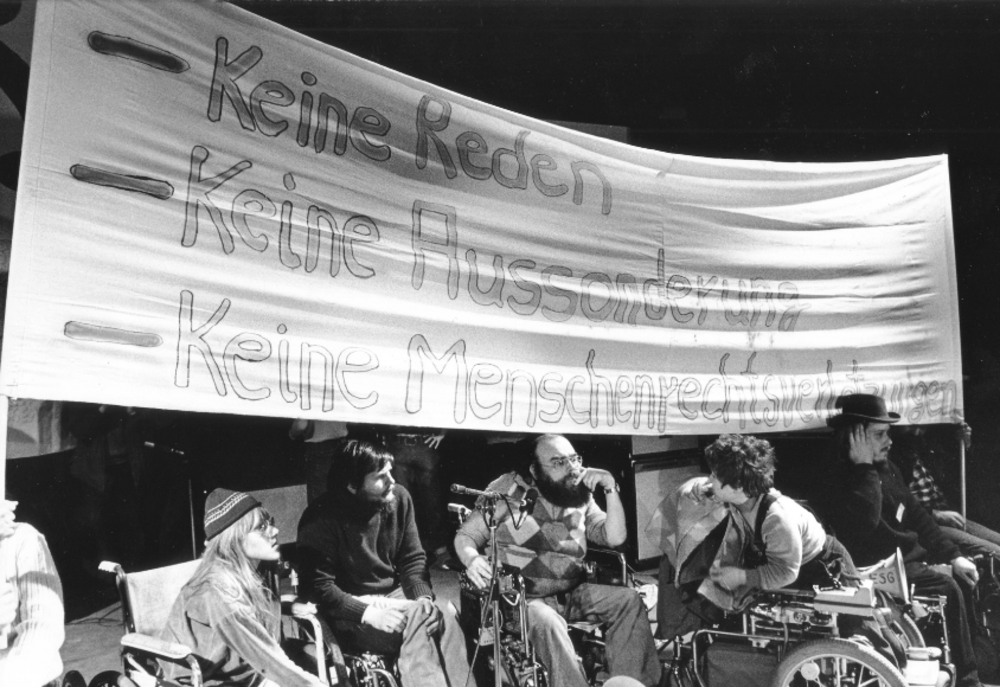
The disability rights movement takes advantage of the stage offered by the Year of Action. Activists quickly renamed the year the "Year of the Disabled". They are already present at the opening event in Dortmund's Westfalenhalle. One group chained itself to the stage so that Federal President Karl Carstens had to give his speech in an adjoining room. The movement's demands are unmistakable: "No speeches, no segregation, no human rights violations". The media attention that the movement receives as a result of these and other actions is huge. However, many steps, such as the establishment of centres for "self-determined living", continue to be driven by the movement itself and the commitment of disabled people. There is still some catching up to do at a political and legal level.
Legal milestones
From the 1990s onwards, various legal steps were taken to protect the rights of people with disabilities and enable them to participate - still driven forward and supported by those affected, such as the "Forum of Disabled Lawyers". in 1994, another milestone is finally reached: Article 3 paragraph 3 of the Basic Law is amended to include the sentence "No-one shall be disadvantaged because of their disability". Equally important are the Disability Equality Act (2002), the General Equality Act (2006), the UN Convention on the Rights of Persons with Disabilities, which Germany ratified in 2009, and the Federal Participation Act (2016).
However, those affected continue to protest regularly, as key demands of the disability rights movement are not incorporated into legislation, or only to a limited extent. They also repeatedly see shortcomings and loopholes in the specific design of the measures and in their interpretation in court.
Inclusive themed tour through the exhibition
The struggle of people with disabilities for equal rights, self-determination and participation is long and ongoing. It is a part of German history and the present. As the Federal Government's political memorial foundation, whose core tasks include dealing with the history of German democracy, we at the Federal Chancellor Helmut Schmidt Foundation are not only constantly improving our accessible programme. We also want to make the history of the disability rights movement visible and honour it.
As part of the Hamburg Foundation Days, we have teamed up with the Evangelical Foundation Alsterdorf and developed an accessible tour through our permanent exhibition "Schmidt! Living Democracy". On this tour through Germany's post-war history, we also want to highlight the history of the disability rights movement in Germany. The tour will be conducted in easy-to-read language. It will be translated into German sign language. Touch objects will be used in several places.
The guided tour "History seen anew" will take place on 13 September at 1 pm in the Helmut Schmidt Forum. If you would like to take part, please register at .