
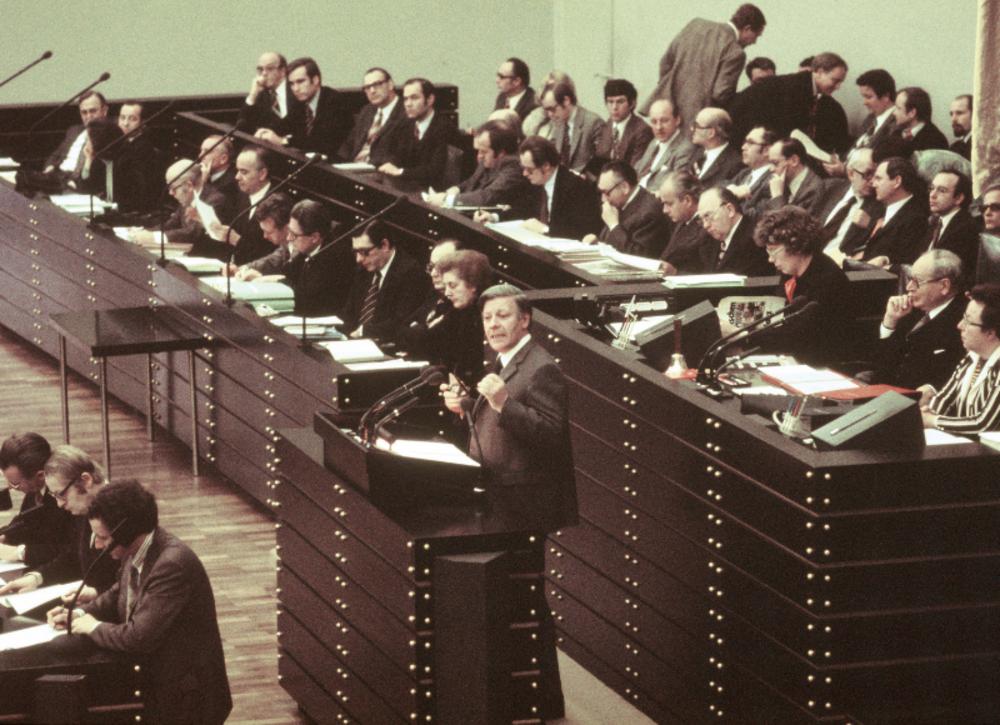
Helmut Schmidt behind the lectern during his speech, numerous politicians in the background

Milestone for more democracy in large companies

It is a complex issue and at the same time one of the most important projects of social democracy in the 1960s and 1970s: employees should be given more influence on decisions in their companies - above all via works councils and employee representatives on the supervisory boards of large corporations. The interests and experiences of workers and employees were to be taken into account and incorporated into company decisions; they were to have a say in personnel matters, questions of work organisation and investment decisions. Basically, the aim was and still is to control economic power, defuse potential conflicts in companies and balance the interests of capital and labour.

The history of co-determination in the Federal Republic of Germany

The first steps towards greater influence of dependent employees in the Federal Republic were the Coal and Steel Industry Co-Determination Act of 1951 for the coal and steel industry and the Works Constitution Act of 1952, which was amended in 1972. For a long time, there was no regulation for large corporations, including stock corporations, partnerships limited by shares and limited liability companies. The Co-Determination Act of 1976 filled this gap. It applies to all corporations with more than 2,000 employees and guarantees and regulates the inclusion of employee representatives on a company's supervisory board, which is composed of equal numbers of shareholders and employees. This means that the shareholders and employees have the same number of members.

Economic democracy and co-determination: a core social democratic demand

As early as the Weimar Republic, the German Social Democrats pursued plans for an extensive democratisation of the economy. At that time, the aim was still the nationalisation of key industries and the communitisation of means of production. After the founding of the Federal Republic of Germany in 1949, it was not until the adoption of the Godesberg Programme in 1959 that the SPD finally turned away from these concepts of redistribution.

However, the strengthening and expansion of co-determination in the workplace remained a core demand of the Social Democrats. The economics graduate Helmut Schmidt also supported this line. As a pragmatic regulatory politician, he saw co-determination as an instrument for securing an efficient and socially peaceful market economy, i.e. as a "new social contract" between capital and labour. In his view, more employee participation should go hand in hand with a greater willingness on the part of the workforce to take responsibility and a willingness on the part of the trade unions to cooperate. Schmidt demanded that supervisory boards in large companies should have equal representation, while at the same time taking into account the interests and willingness of companies to invest.

The compromise of 1976

The Co-Determination Act, which was passed by a large majority of the Bundestag in Bonn on 18 March 1976, significantly extended the rights of employees in large companies. Among other things, it stipulated that the seats for employees on supervisory boards had to be distributed among blue-collar workers, white-collar workers and senior executives in proportion to their share of the total workforce. Depending on the size of the supervisory board, trade unions could fill two to three seats with their own representatives, but these had to be put up for election on the board.

The issue of parity on the Supervisory Board was highly controversial for a long time. The trade unions had demanded full parity on the supervisory boards. However, the SPD was unable to push this point through in negotiations with its coalition partner, the FDP, and the CDU/CSU opposition. In the end, a compromise was reached: in the event of a stalemate on the supervisory board, the business side would retain the majority via a double vote by the chairman of the supervisory board. Nevertheless, around 300 companies lodged a constitutional complaint against the law. They saw their guarantee of ownership and freedom of association violated. However, the Federal Constitutional Court rejected the complaint in March 1979.

Company co-determination is and remains important

Workplace co-determination still exists today. However, the economic framework conditions have changed over the last 50 years: European regulations on freedom of establishment, the continuing trend towards the service and platform economy and towards smaller, labour-intensive companies are restricting traditional co-determination instruments. According to information from the trade union-affiliated Hans Böckler Foundation, there are currently around 660 companies with supervisory boards with equal representation, meaning that their number has hardly changed since 1976. Works councils and employee representatives on supervisory boards remain important players. The German model can also be considered successful internationally.

The idea of democratisation in economic life has lost none of its relevance and importance: Where employees have a say, the chance of socially cushioning permanent structural change increases. Moreover, ownership structures are and remain central areas in which economic and thus political concentration of power can be contained through democratic checks and balances. In times of growing social inequality, company co-determination is therefore also an important lever for stabilising trust in democracy and the social market economy.

It is a complex issue and at the same time one of the most important projects of social democracy in the 1960s and 1970s: employees should be given more influence on decisions in their companies - above all via works councils and employee representatives on the supervisory boards of large corporations. The interests and experiences of workers and employees were to be taken into account and incorporated into company decisions; they were to have a say in personnel matters, questions of work organisation and investment decisions. Basically, the aim was and still is to control economic power, defuse potential conflicts in companies and balance the interests of capital and labour.

The history of co-determination in the Federal Republic of Germany

The first steps towards greater influence of dependent employees in the Federal Republic were the Coal and Steel Industry Co-Determination Act of 1951 for the coal and steel industry and the Works Constitution Act of 1952, which was amended in 1972. For a long time, there was no regulation for large corporations, including stock corporations, partnerships limited by shares and limited liability companies. The Co-Determination Act of 1976 filled this gap. It applies to all corporations with more than 2,000 employees and guarantees and regulates the inclusion of employee representatives on a company's supervisory board, which is composed of equal numbers of shareholders and employees. This means that the shareholders and employees have the same number of members.

Economic democracy and co-determination: a core social democratic demand

As early as the Weimar Republic, the German Social Democrats pursued plans for an extensive democratisation of the economy. At that time, the aim was still the nationalisation of key industries and the communitisation of means of production. After the founding of the Federal Republic of Germany in 1949, it was not until the adoption of the Godesberg Programme in 1959 that the SPD finally turned away from these concepts of redistribution.

However, the strengthening and expansion of co-determination in the workplace remained a core demand of the Social Democrats. The economics graduate Helmut Schmidt also supported this line. As a pragmatic regulatory politician, he saw co-determination as an instrument for securing an efficient and socially peaceful market economy, i.e. as a "new social contract" between capital and labour. In his view, more employee participation should go hand in hand with a greater willingness on the part of the workforce to take responsibility and a willingness on the part of the trade unions to cooperate. Schmidt demanded that supervisory boards in large companies should have equal representation, while at the same time taking into account the interests and willingness of companies to invest.

The compromise of 1976

The Co-Determination Act, which was passed by a large majority of the Bundestag in Bonn on 18 March 1976, significantly extended the rights of employees in large companies. Among other things, it stipulated that the seats for employees on supervisory boards had to be distributed among blue-collar workers, white-collar workers and senior executives in proportion to their share of the total workforce. Depending on the size of the supervisory board, trade unions could fill two to three seats with their own representatives, but these had to be put up for election on the board.

The issue of parity on the Supervisory Board was highly controversial for a long time. The trade unions had demanded full parity on the supervisory boards. However, the SPD was unable to push this point through in negotiations with its coalition partner, the FDP, and the CDU/CSU opposition. In the end, a compromise was reached: in the event of a stalemate on the supervisory board, the business side would retain the majority via a double vote by the chairman of the supervisory board. Nevertheless, around 300 companies lodged a constitutional complaint against the law. They saw their guarantee of ownership and freedom of association violated. However, the Federal Constitutional Court rejected the complaint in March 1979.

Company co-determination is and remains important

Workplace co-determination still exists today. However, the economic framework conditions have changed over the last 50 years: European regulations on freedom of establishment, the continuing trend towards the service and platform economy and towards smaller, labour-intensive companies are restricting traditional co-determination instruments. According to information from the trade union-affiliated Hans Böckler Foundation, there are currently around 660 companies with supervisory boards with equal representation, meaning that their number has hardly changed since 1976. Works councils and employee representatives on supervisory boards remain important players. The German model can also be considered successful internationally.

The idea of democratisation in economic life has lost none of its relevance and importance: Where employees have a say, the chance of socially cushioning permanent structural change increases. Moreover, ownership structures are and remain central areas in which economic and thus political concentration of power can be contained through democratic checks and balances. In times of growing social inequality, company co-determination is therefore also an important lever for stabilising trust in democracy and the social market economy.

Photo of staff member

Author

Dr. Magnus KochHead of Exhibitions and History

Magnus combines in-depth expertise on the life and political career of Helmut Schmidt with public history formats centered on the foundation’s exhibition projects. Central to this work is always the question of how history and the present are interconnected.


He studied history in Göttingen and earned his doctorate at the University of Erfurt on the everyday history of World War II. Since 2005, he has worked both independently and as a staff member and exhibition curator for institutions including the German Historical Museum in Berlin, the Foundation Memorial to the Murdered Jews of Europe, the Hamburg Institute for Social Research, and the University of Vienna.