
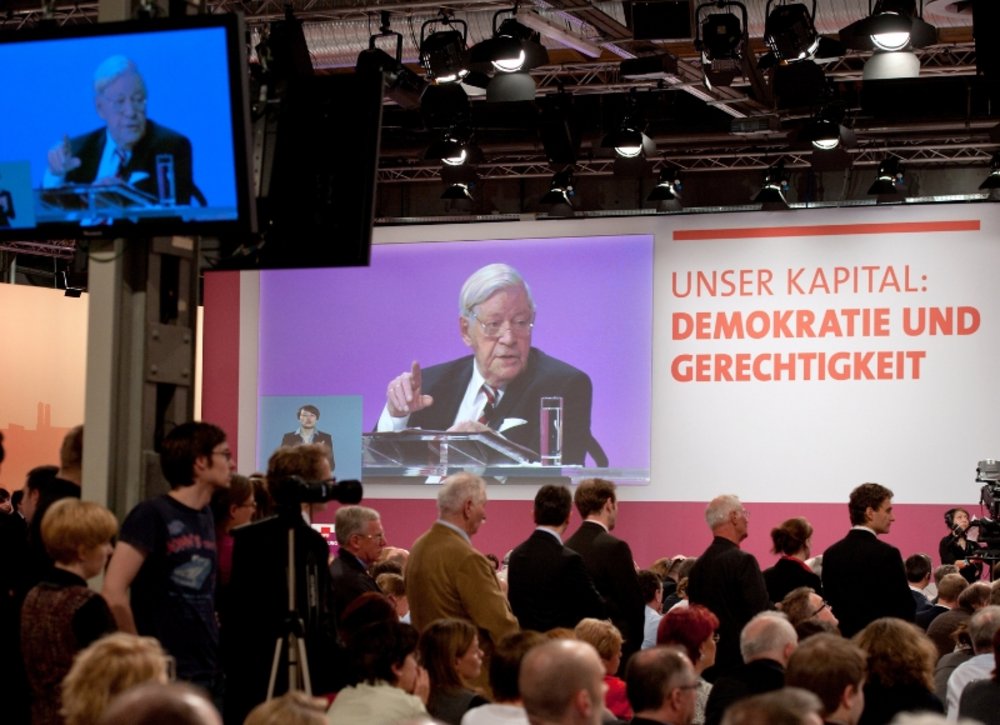
Whether in his books such as "Europe's Self-Assertion: Perspectives for the 21st Century" (2000) and "The Powers of the Future" (2004) or in his last major speech at the SPD federal party conference in December 2011, the development of the international order and Europe's role in it have always been of particular concern to Helmut Schmidt. In view of the massive shifts in power and forces - away from Europe and towards Asia, Africa and Latin America - Schmidt called for the European Union to develop a "common capacity to act". If this did not succeed, Europe would risk a "self-inflicted marginalisation" in future world politics. A prophecy that currently seems to be coming true in the attempts to resolve the war against Ukraine and maintain a European security order: against the aggressor Russia and its violent, revisionist policy, but also with regard to its previous ally, the USA.
Accelerated global trends and three revisionist superpowers
Since Schmidt's speech in 2011, the developments described above have intensified and the centre of international relations has shifted from the transatlantic region to the Indo-Pacific. The numerous crises of recent years have overlapped and combined to form what is perceived as a "polycrisis". This has recently been compounded by the "double turning point" of the Russian war of aggression against Ukraine and the active cancellation of the liberal model of world order by the US administration. The old "West" no longer exists and the EU is facing numerous internal and external challenges. Liberal values, not least individual human and civil rights, freedom and equality, are not only being called into question by autocracies as "Western values". In addition, the preservation of a rules-based order in large parts of the "Global South" is interpreted as an attempt to preserve the asymmetrical structure of the international power structure.
International politics is increasingly determined by economic and military hard power and currently by three revisionist superpowers: Russia, China and the USA. These are undermining international norms, borders and institutions to varying degrees and destabilising regional and global systems of order. The resulting dynamics directly challenge other states in this system to rethink existing assumptions and convictions.
Development scenarios of the international order
At present, the intentions of Russia, China and the USA appear to be geared towards mutual recognition of their exclusive zones of influence, which have yet to be defined, and their special status, which is also yet to be determined. This would mean a global "concert of the great powers" with power and balance of power politics as in 18th and 19th century Europe. Whether the European Union, India or other players would be part of this concert of great powers is debatable. One thing seems clear: without its own ability to act, backed up by available economic, technological and military means of power, Europe is unlikely to have much chance of co-determination, and not only in this option.
A bipolar constellation between the USA and China also appears possible. Peaceful coexistence is just as conceivable as a growing confrontation, which some see as a new "Cold War". The conditions for this are undoubtedly in place, but both China and the USA appear to lack the willing partners for such a policy. While the People's Republic has traditionally shown little interest in firm alliances, Washington itself is working on dismantling its alliances. Trump's transactional foreign policy is promoting trends towards regionalisation, the dissolution of alliances and the bi- and minilateralisation of security policy relations.
A rules-based multicentric order, possibly with overlapping regional orders, would be the best option, and not just for the EU. The common basis should be the United Nations Charter and the concept of inclusive and fair multilateralism, which contributes effectively to overcoming existential transnational challenges and managing global issues. Revisionism and the violent enforcement of national claims to order and territory also meet with rejection in most countries of the "Global South". These could be won over in favour of the creation of a just, multilateral international order and strategic partnerships. Pragmatism and common interests, not primarily ideological commonalities, should guide action.
To realise this scenario, the EU should not only have the political will but also the ability to act in global politics. Internal consolidation (reform and deepening debate) and maintaining economic and technological competitiveness(Letta and Draghi Report) would be helpful in this regard. What is most urgent, however, is the attainment of foreign and security policy independence and an autonomous deterrent capability vis-à-vis an aggressive Russia. Under the current conditions of the international system, economic and diplomatic power are dependent on credible military capabilities. Without such a capacity to act, the EU's role in shaping a peace solution for Ukraine and a future European security order is likely to remain extremely limited. This would have direct consequences for the question of whether Europe belongs to the "powers of the future" or marginalises itself in the international politics of the 21st century.