Extremely polarising
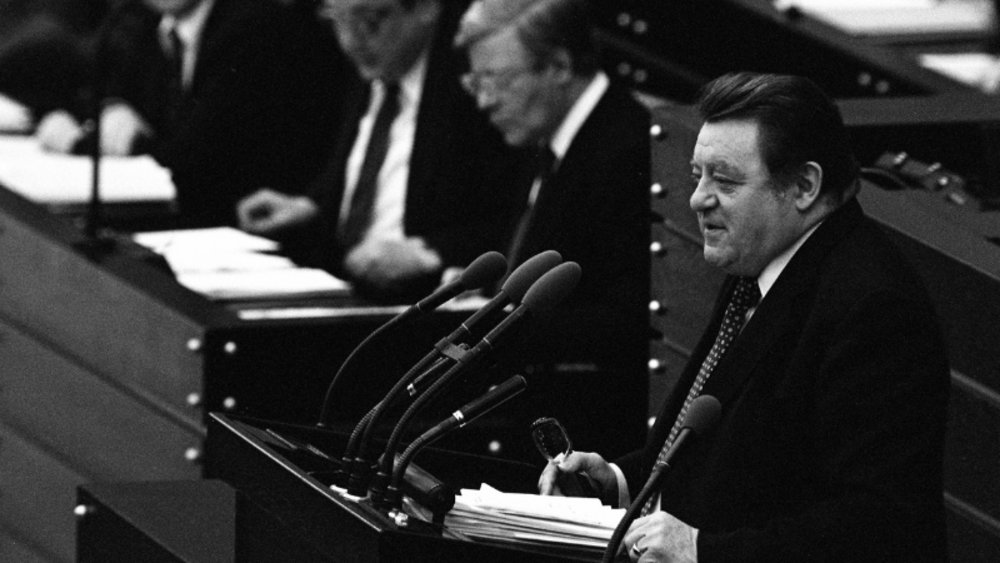
Even in contemporary perception, the campaigns for the Bundestag election of 5 October 1980 were seen as extremely polarising and personalising, which from a historical perspective is the exception rather than the rule. The leading candidates were the Bavarian Minister President Franz Josef Strauß (CSU) and Helmut Schmidt (SPD), who had been Federal Chancellor since 1974 and was originally from Hamburg. Despite their national and ideological differences, they also had lesser-known similarities – starting with intellectual talent, political determination and rhetorical talent.
The career
Strauß (born 1915) and Schmidt (born 1918) were still teenagers when the Reichstag abolished the democratic order of the Weimar Republic with the “Enabling Act” on 23 March 1933, paving the way for the tyranny of the Nazi regime. Both served in the Wehrmacht up to the rank of first lieutenant and were deployed during the Second World War in 1941, including in the “Russian campaign” in the Soviet Union. Above all, however, they taught groups of soldiers from the army and air force how to operate anti-aircraft guns (“Flak”) on the “home front” as training officers.
Shaped by their generational experience of dictatorship and world war, a few years later they were already working for Franco-German reconciliation, European cooperation and transatlantic relations. Strauß was elected to the Bundestag in Bonn for the first time in 1949 and Schmidt in 1953, both of whom were to serve for almost three decades. The latter sent them to Strasbourg as members of the transnational “Common Assembly”, a predecessor organisation of today's EU Parliament. In the course of their political careers, both were also responsible for the finance and defence portfolios.
The duel
In 1980, Strauß and Schmidt competed against each other for the chancellorship as the leading candidates for the CDU/CSU and SPD respectively. The dominant motif of the media coverage was the “duel” popularised by US western films as a duel for honour and power fought with weapons. A somewhat more peaceful version of this title was used on a Spiegel cover, which depicted the politicians with superhero attributes. Such publications not only reflected an existing mood, but also helped to reinforce it.
Of course, the two power-conscious and eloquent protagonists had their own part to play in the unpleasant climate of debate during election campaigns, for which their parties then blamed each other. Strauß, for example, used a variety of pejorative characterisations against his political rival, including “chameleon”, “peace talker” and “war chancellor”. But Schmidt showed himself to be quite capable of rhetorical satisfaction with the following formulation: “This man has no control over himself and therefore he must certainly not be given control over our state.”
The election campaign
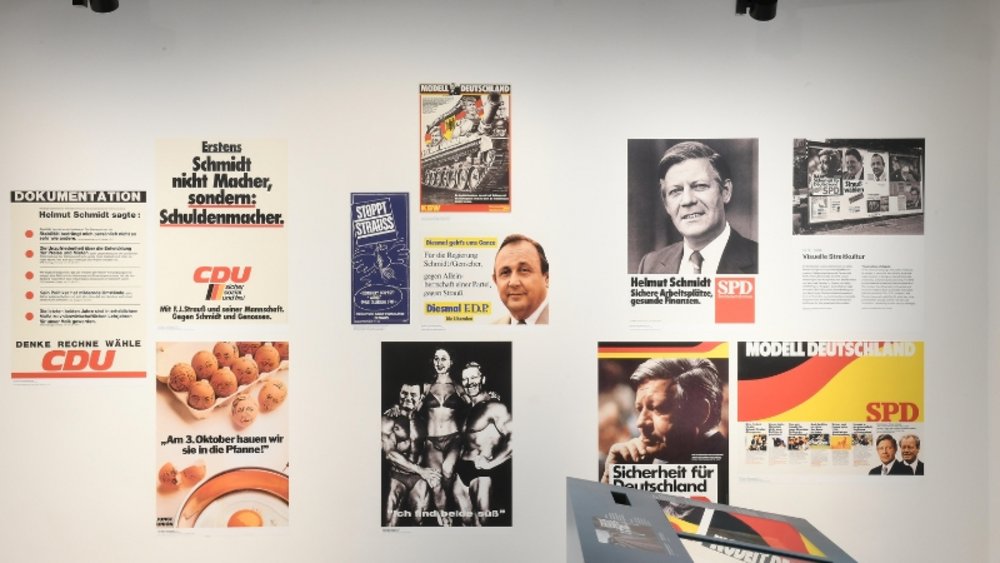
Both camps repeatedly promoted themselves with critical statements about the leading candidate of the other side, which today would be described as “negative campaigning” as in the last US election campaigns. The CDU, for example, used the slogan “Schmidt not a doer, but a debt maker”, which was part of a whole series of unfriendly descriptions such as “fear monger”, “riot maker” or “slogan maker”. The Young Socialists, on the other hand, alluded to the fact that the Bundestag elections coincided with the harvest festival and wanted “Lots of flowers – but no bouquets”.
In addition, formal non-party initiatives such as “Democrats for Ostriches” and “Stop Ostriches” contributed to the further intensification of the political discourse with their own publications. In the left-wing camp, there was intense debate as to whether the newly founded party DIE GRÜNEN should be supported or whether the few percentage points that the SPD lacked could lead to an election victory for Strauß. In view of this debate, the Socialist Youth of Germany “Die Falken”, for example, demanded: “STOP STRAUSS – CRITICISE SCHMIDT – VOTE SPD WITHOUT ILLUSION”.
The result
With 1.5%, the Greens, who were running for the first time, clearly missed out on a place in parliament. Despite a majority of votes in favour of the CDU/CSU (44.5%, - 4.1 percentage points), Franz Josef Strauß did not become Federal Chancellor and continued to serve as Bavarian Minister President until his death eight years later. The SPD (42.9%, + 0.3 percentage points) and FDP (10.6%, + 2.7 percentage points) quickly agreed to continue the social-liberal coalition, as announced during the election campaign. And so Helmut Schmidt remained chancellor for almost two years until he had to give way to CDU chairman Helmut Kohl after a "constructive vote of no confidence" on 1 October 1982.
To read and watch:
Spiegel double interview “What makes you qualified to be chancellor?” (28 September 1980)
ARD/ZDF television debate “Three days before the election” (2 October 1980)
CSU election advert for Franz Josef Strauß (1980)
SPD election advert for Helmut Schmidt (1980)